Pakistan Tells UN: Keep Nuclear Decisions Human
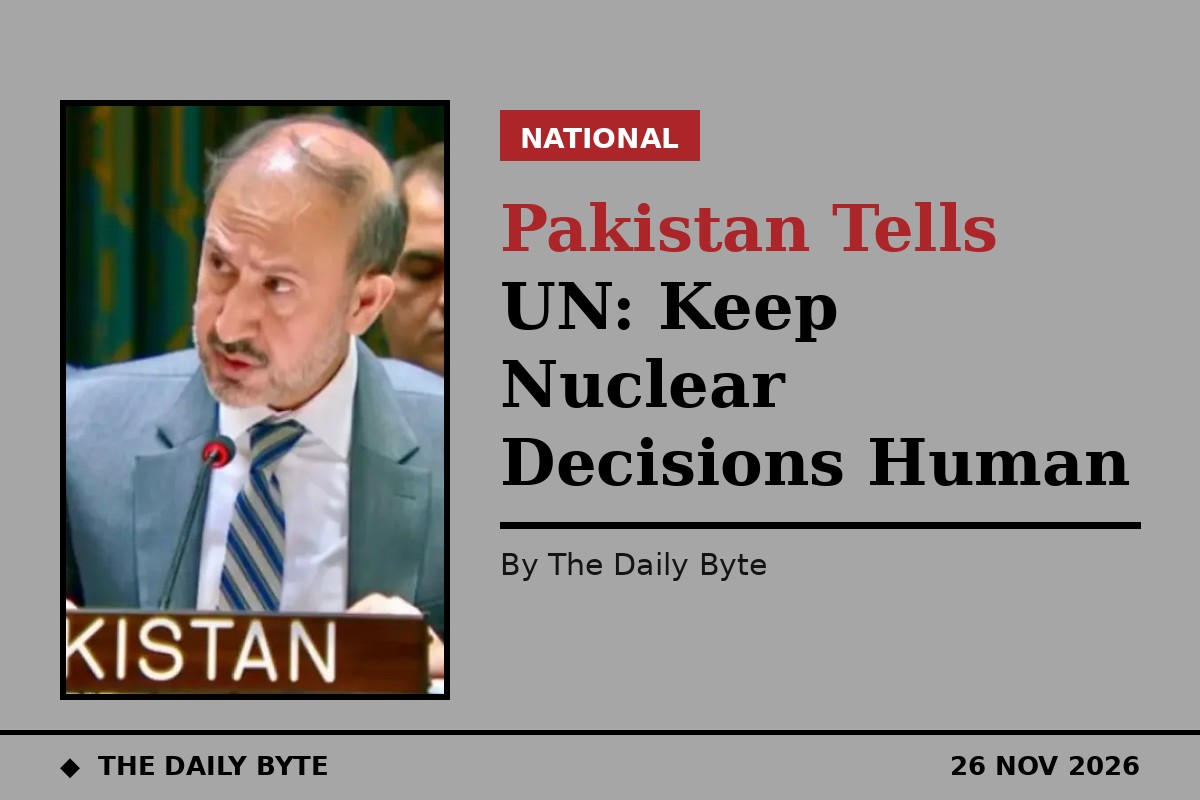
Pakistan has told the United Nations Security Council that decisions on the use of nuclear weapons must remain under human control, and that artificial intelligence systems must never be used to target nuclear command, control and communications systems.
Ambassador Syed Haider Shah, Pakistan's Permanent Representative to the UN, delivered the message at a high-level open debate of the 15-member Council on Tuesday, held under the Latvian presidency, on conflict resolution in an era of rapid technological change.
"We must ensure that rapid emergence of technologies does not supercharge the ongoing arms race impacting global peace and security," Shah told the Council.
Compressed decisions, higher risk
Shah said technology itself was neutral, and that its impact depended on the intentions of those using it. But he warned that integrating AI into military operations compresses the window for human judgment during crises, significantly raising the risk of unintended escalation.
"This is most critical in the nuclear domain, where decisions on the use of nuclear weapons must remain under human control, and AI systems must never be used to target nuclear command, control and communications systems," he said.
Alongside keeping human beings at the centre of nuclear launch authority, the envoy called for an absolute prohibition against deploying AI capabilities to target nuclear command, control and communications (NC3) systems. He also urged restraint and confidence-building measures to cut the risk of miscalculation, including crisis communication, deconfliction and mutual restraint.
Rules written together
Pakistan called for safeguards, regulations and governance frameworks to make sure technological advances served peace rather than becoming tools of geopolitical dominance and war. Shah said all relevant issues should be taken up comprehensively in representative and inclusive forums with universal participation under UN auspices, including legally binding instruments where fitting.
He warned against advanced technologies becoming the monopoly of a few powerful countries, and said measures taken in the name of safety should not be used to deny other countries access to technology and infrastructure. Every state kept its right to the peaceful use of technology, he said, and delaying regulation to secure advantage would not work.
Guterres: humans alone must decide
UN Secretary-General Antonio Guterres, opening the debate, said AI had entered the battlefield in troubling ways and that today's wars had become proving grounds for AI-enabled targeting. From intelligence gathering to target selection, he said, algorithms were increasingly shaping life-and-death decisions.
"As long as nuclear weapons exist, the decision to use them must rest with human beings alone," Guterres said. "When civilians are killed, or human rights are violated, the answer must never be 'the algorithm did it.'" He repeated his call to urgently launch negotiations for a legally binding instrument on lethal autonomous weapons, saying killer robots must have no place in the future.
Shah also raised the dangers of misinformation, disinformation, fake news and cyberattacks, including attacks on critical infrastructure by state and non-state actors, and said the UN Charter and international law applied in all situations, irrespective of underlying technologies. He noted that AI and unmanned aerial vehicles could improve civilian protection and the safety of UN peacekeepers, while their misuse by extremist groups needed attention when Council mandates came up for renewal.