Pakistan and Turkmenistan Agree TAPI Steering Committee to Push Gas Pipeline
By aminah
·17 Nov 2026
·3 min read
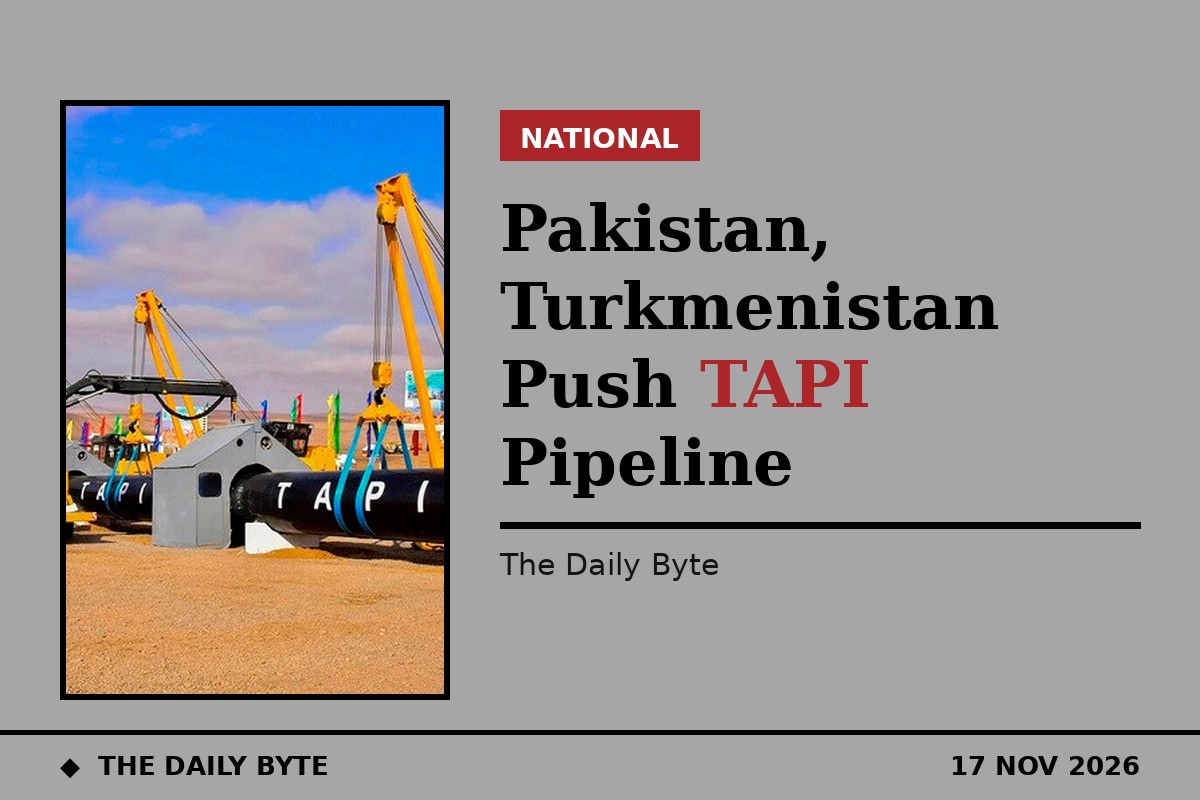
Pakistan and Turkmenistan have agreed to convene a steering committee meeting to advance the long-delayed Turkmenistan-Afghanistan-Pakistan-India (TAPI) gas pipeline, giving fresh political momentum to a project that has been discussed for decades.
The decision followed talks in Islamabad on Tuesday, 17 November 2026, between Deputy Prime Minister and Foreign Minister Ishaq Dar and Turkmenistan's Foreign Minister Rashid Meredov, at the sixth session of the Pakistan-Turkmenistan Joint Intergovernmental Commission (JIC).
## What was agreed in Islamabad
The two sides agreed to hold a meeting of the steering committee for the TAPI gas pipeline and stressed political engagement on the technical and commercial matters still outstanding, Dawn reported. They also signed three documents covering institutional cooperation, diplomatic engagement and tourism.
The JIC session reviewed the entire spectrum of bilateral cooperation and discussed opportunities in power cooperation, transit trade and regional connectivity, the Associated Press of Pakistan reported. The meeting was co-chaired by Dar and Meredov, who is also Deputy Chairman of the Cabinet of Ministers of Turkmenistan.
Federal ministers for power, commerce and petroleum attended, along with the minister of state for federal education and professional training and the minister of state for national heritage and culture.
## What TAPI is
The TAPI gas pipeline is designed to carry natural gas from Turkmenistan's Galkynysh gas field through Afghanistan and Pakistan to India. The pipeline is about 1,800 kilometres long and is regarded as a flagship regional energy connectivity project.
Pakistan and Turkmenistan have discussed the project for years, but progress has repeatedly stalled over financing, security in Afghanistan and the commercial terms for the gas. A steering committee meeting is the mechanism the two governments use to settle those outstanding questions at a political level before construction work can move forward.
## Wider cooperation on the table
Beyond energy, the two sides discussed ways to deepen collaboration across trade and investment, agriculture and food security, transport and communications, industry, information technology and telecommunications, education, health, banking and finance, tourism, sports and culture.
Dar stressed the need to implement the agreed outcomes through joint working groups, close institutional coordination and regular follow-up, so that the longstanding friendship between the two countries translates into tangible benefits.
Meredov arrived in Pakistan for the commission session, which was held a day after the 30th meeting of the Economic Cooperation Organisation's Council of Ministers concluded in Islamabad, with Pakistan taking over the organisation's chairmanship for 2026–2027.
## Why it matters
Pakistan faces a structural shortage of natural gas, with domestic production declining and demand from homes, industry and power plants outstripping supply. Imported gas through TAPI would diversify supply away from liquefied natural gas shipments, but the pipeline's route through Afghanistan remains its biggest obstacle, and no construction timetable has been announced.
For now, the agreement to convene the steering committee is a political signal rather than a construction start. Whether it turns into movement on the ground will depend on what the committee agrees on financing, security and the price of the gas.
Sources: Dawn, "Pakistan, Turkmenistan to convene steering committee for TAPI gas pipeline", 17 November 2026; Associated Press of Pakistan, "6th Pak-Turkmenistan JIC emphasize stronger B2B engagement", 17 November 2026.