Panasonic T-Rex Robot AI Uses Touch for Dexterous Tasks
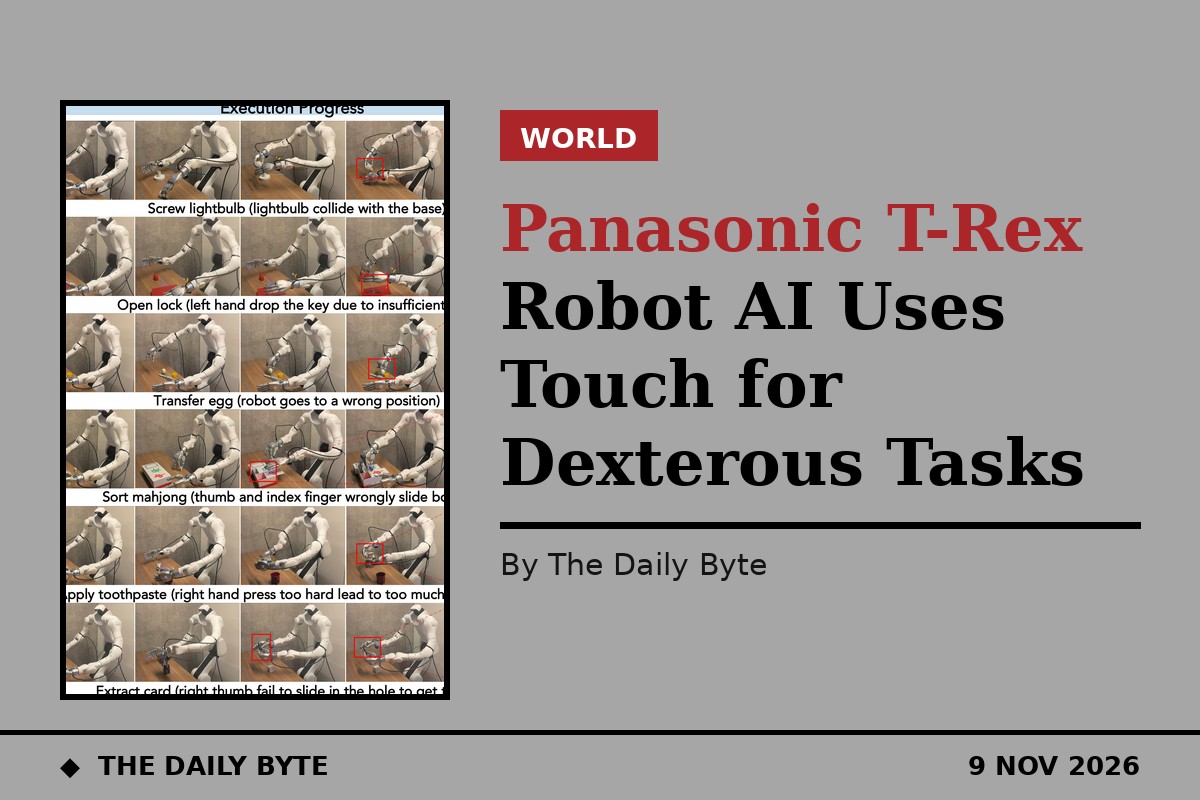
Panasonic has developed a robot AI that can feel what it is holding. The system, called T-Rex, gives a two-handed robot a sense of touch at its fingertips, letting it correct its movements in real time when an object slips, collides or needs a gentler grip. Panasonic Holdings announced the work on 5 November 2026, and it is being presented at the Conference on Robot Learning in Austin, Texas, from 9 to 12 November.
T-Rex stands for Tactile-Reactive Dexterous Manipulation. It was developed by Panasonic Holdings and Panasonic R&D Company of America together with researchers from the University of California, Berkeley, Nvidia, Stanford University, Sapienza University of Rome and ItalAI.
Two speeds of thinking
The system builds on a vision-language-action model, the type of AI that turns camera images and spoken or written instructions into robot movements. Conventional versions of these models rely mainly on vision, and even when they use touch they often treat it as a static input. That makes delicate work difficult: pulling out a thin card or turning a key needs instant adjustment to force, slip and deformation felt through the fingertips.
T-Rex splits the job in two. A motion-generation module processes vision and language and produces the overall movement at about five updates per second. A separate action-correction module reads tactile information from the fingertips at about 20 updates per second and fine-tunes the movement as contact conditions change. The robot can therefore respond quickly to slipping or pressing too hard without having to rerun slower image recognition each time.
65% success on 12 delicate tasks
In real-world evaluations across 12 contact-rich tasks, T-Rex achieved an average success rate of 65%, against 35% for the strongest baseline the researchers compared it with. The tasks included turning pages, transferring eggs, applying toothpaste, unlocking a door with a key, pulling out a card and screwing in a light bulb.
Removing touch entirely was the most damaging change in the team's tests: without tactile information, the average success rate fell to 42%. That result, Panasonic says, confirms that the sense of touch and the high-speed correction mechanism are doing real work, rather than simply adding complexity.
The system was tested on a 58-degree-of-freedom bimanual robot, the Dexmate Vega-1, with two seven-degree-of-freedom arms and two 22-degree-of-freedom Sharpa Wave dexterous hands, each with five fingertip tactile sensors. T-Rex was the top-performing method on every one of the 12 tasks in the benchmark.
100 hours of robot practice
Training data was a major part of the project. The team combined more than 200 types of everyday objects with 22 types of basic actions to collect over 7,700 episodes, a total of 100 hours, of two-handed robot manipulation data. Each episode records video from head and wrist cameras, the robot's states and actions, force and deformation data from tactile sensors on ten fingertips, and natural-language instructions.
The model first learns broad visual and motion knowledge from 22,889 hours of human first-person video, then learns robot-specific contact-rich behaviour from the tactile-annotated data, and is finally fine-tuned with about 100 demonstrations per task. The team has open-sourced the 100-hour dataset and published the research paper, with the full details available on the T-Rex project page and on arXiv.
Panasonic says the aim is to use the technology in manufacturing and logistics, for work that needs fine force control, such as inserting, removing and screwing components, and handling soft or fragile items, reducing the burden on frontline workers and helping to ease labour shortages. The results are laboratory evaluations, not a commercial robot product, and the Austin conference presentation is where other researchers will test the claims.