PM Links Offshore Exploration to Energy Security
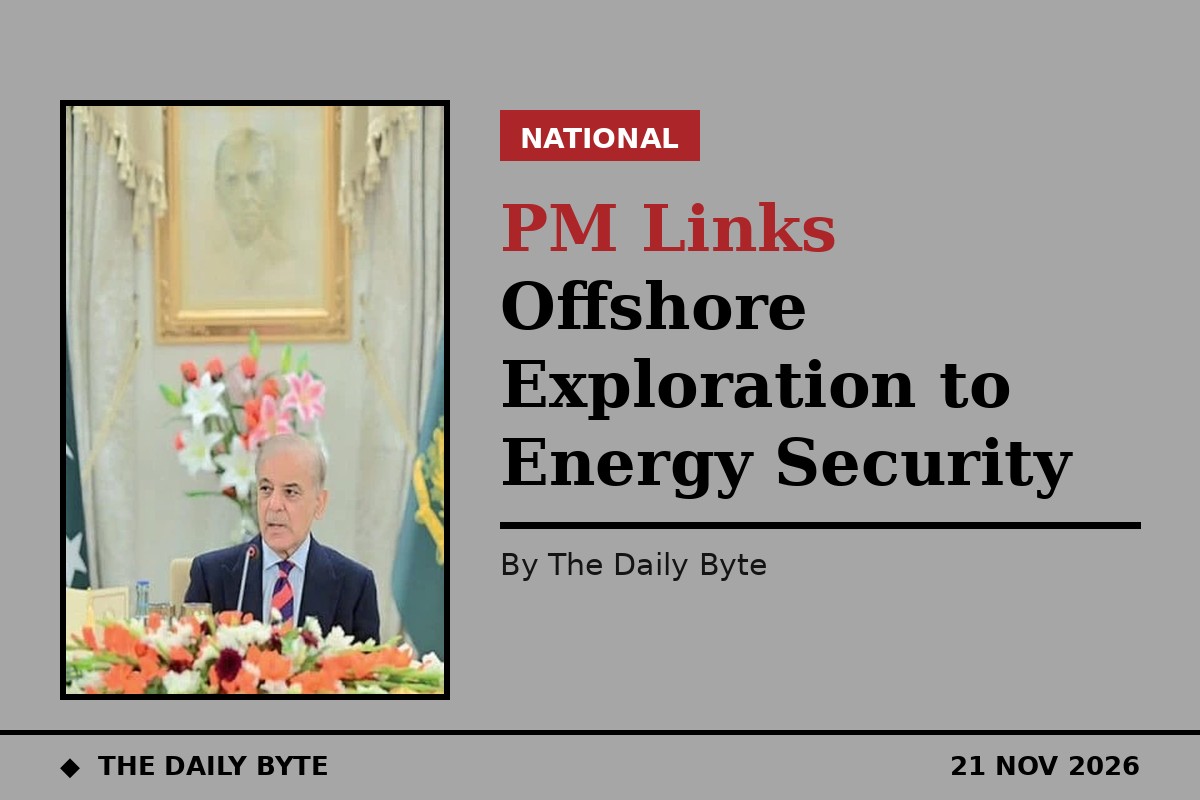
Prime Minister Shehbaz Sharif has tied the exploration of Pakistan's offshore oil and gas reserves to the country's energy security, telling a visiting Turkish delegation that surveying the country's maritime areas is an important step for economic development as well as energy supply.
The prime minister was speaking at a dinner he hosted on Friday for Turkish Minister of Energy and Natural Resources Alparslan Bayraktar and his delegation, as the Turkish research vessel Oruc Reis began work in Pakistani waters.
He thanked Turkish President Recep Tayyip Erdogan for sending the vessel and for Turkiye's full cooperation in the offshore oil and gas exploration project, and said Pakistan wanted to expand cooperation in the energy sector by drawing on Turkish experience and technical expertise.
"Exploration of potential oil and gas reserves in Pakistan's maritime boundaries is an important step for the country's energy security and economic development," he said.
What the survey will do
Mr Bayraktar said the arrival of the Oruc Reis marked a new era in energy cooperation between Pakistan and Turkiye, and that Ankara was committed to using its technical expertise, scientific experience and engineering capabilities for Pakistan's benefit.
He said the vessel would conduct a three-dimensional seismic survey for about two months to explore potential oil and gas reserves in the maritime areas of Sindh and Makran, and that the scientific data gathered would help determine the possibilities of exploration and drilling in the future.
Deputy Prime Minister and Foreign Minister Ishaq Dar welcomed the vessel at a ceremony at Karachi Port on Friday, describing its arrival as "a new chapter of scientific exploration and strategic cooperation" between the two countries.
Mr Dar said Pakistan's natural resources, including minerals, hydrocarbons and gemstones, were conservatively estimated to be worth between 8 trillion and 10 trillion dollars. He contrasted that figure with the government's debt of about 100 billion dollars, rising to about 130 billion dollars once the foreign-exchange liabilities of private companies and public-sector enterprises were included.
"Sometimes people talk about Pakistan being a heavily indebted country or a debt-trap country. I always negate that," he said.
He was candid about the uncertainty involved, saying a seismic survey could not guarantee a commercial discovery. "Offshore exploration is complex, capital-intensive and inherently uncertain," he said. "A seismic survey cannot guarantee a commercial discovery, but no discovery can be made without seismic and exploration."
Wider energy cooperation
The prime minister said that, in addition to offshore oil and gas exploration, there were vast possibilities to enhance bilateral cooperation in minerals and renewable energy.
He said Pakistan's historical relations with Turkiye were based on long-standing friendship, mutual trust, brotherhood and common interests, and thanked Mr Erdogan and Turkish Foreign Minister Hakan Fidan for their personal commitment to strengthening ties.
Mr Dar said the Oruc Reis would bring together Turkish scientific expertise and the experience of Pakistan's national energy companies to conduct advanced exploration in the country's offshore domain. He said the data gathered could deepen understanding of the geological structures beneath the seabed and provide a stronger basis for future exploration plans.
He added that Pakistan's maritime domain offered opportunities in energy, shipping and fisheries, and that a vibrant blue economy required reliable scientific data, skilled human resources and environmental safeguards.
The Turkish delegation included Ali Shaheen, a member of the Turkish parliament and president of the Pakistan-Turkiye Friendship Group, Turkish Ambassador to Pakistan Irfan Neziroglu and senior officials from the Turkish energy ministry.