Poland Gun Laws Explained After Kraków Shooting
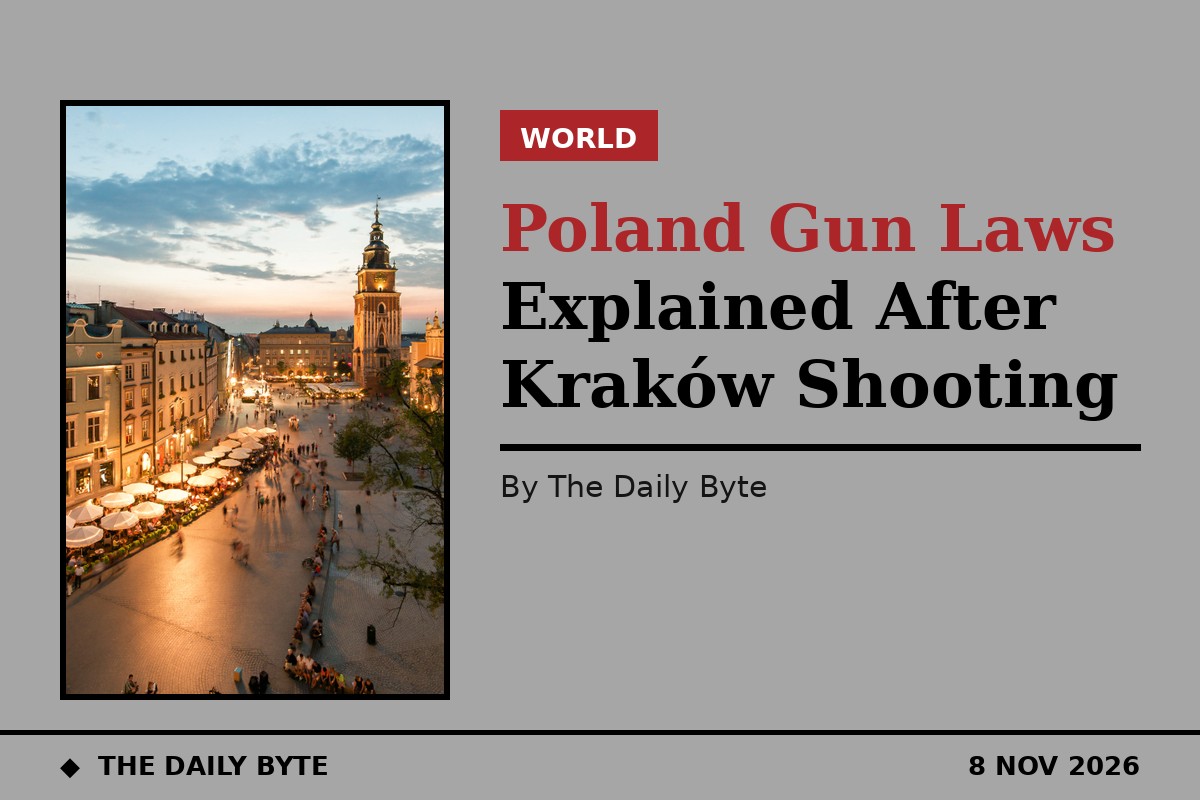
Six people were killed and at least 15 injured when a gunman opened fire in Kraków's Main Market Square on Saturday afternoon, in an attack Polish prosecutors are investigating as a terrorist offence. The shooting has shocked a country where mass shootings are almost unheard of, and it has raised an obvious question: how does anyone own a gun in Poland at all? The short answer is that ownership is tightly controlled by a police permit system, and a licence is hard to obtain. CNN reports that police said the suspect held a firearms licence, but it was not immediately clear whether the weapon used in the attack, or the other guns found in his car, were legally held. That distinction matters, and it is still under investigation.
The basic rule: a permit, not a right
Poland does not treat gun ownership as a constitutional right. The governing law is the Act on Arms and Ammunition of 21 May 1999, and its default position is prohibition: acquiring, possessing or selling a firearm or ammunition is illegal unless you hold the right permit. Permits are issued by the police, and every applicant must give a specific, justified reason for wanting a gun. There is no general-purpose licence. The reason you give decides what you may own, how many guns you may hold, and whether you may carry one in public.
Applicants must also pass medical and psychological examinations, clear a background check, and pass an exam covering firearms law and safe handling. The police authority in the applicant's province, the voivodeship, makes the final decision. Applicants generally must be at least 21 years old and permanently resident in Poland, although the minimum age drops to 18 for sport shooting or hunting permits where a recognised association recommends the applicant. Visitors cannot obtain a Polish permit, though they may use firearms at a shooting range under supervision.
The main permit types
The most common route to legal ownership is sport shooting. It requires membership of a shooting association, a sports qualification proven by an association exam, and a valid competition licence. Hunting permits require membership of a hunting association and a valid hunting permit. Collecting and professional training are further recognised purposes, each with its own conditions.
Personal protection, or self-defence, is the hardest permit to obtain. Unlike the other categories, it is issued on a may-issue basis, meaning the police have discretion even when the formal conditions are met. An applicant must prove a constant, real and above-average threat to their life, health or property. That is a deliberately high bar, and for years very few such permits were granted, although numbers have risen sharply in recent years.
Some firearms sit outside the permit system altogether. Antique black-powder firearms manufactured before 1885, and modern replicas of them, do not require a permit, and most air guns are also exempt. Everything else, from a hunting shotgun to a semi-automatic pistol, needs the matching permit.
What permit holders can own and carry
What a permit allows depends on its purpose. A sport shooting permit typically covers semi-automatic pistols and rifles up to 12 millimetres in calibre, rimfire firearms and shotguns. A hunting permit covers hunting shotguns and rifles as prescribed by hunting law. Collectors face different carrying rules from sport shooters, and a handgun cannot be bought on a hunting permit.
Carrying rules are strict. Since November 2014, holders of sport shooting permits have been allowed to carry their firearms loaded and concealed in a holster close to the body, but not on public transport or at mass gatherings. In general, very few people in Poland are allowed to own military-style weapons or to carry guns in public, and using firearms outside an officially recognised shooting range is prohibited, even on large private property.
How common are guns in Poland?
By European standards, Poland is one of the least armed countries on the continent, although ownership has grown fast. As of 31 December 2025 there were 411,769 active permits and 1,037,778 registered firearms held by individual citizens, according to police figures. A record 50,709 new permits were issued in 2025 alone. Sport shooting and collecting account for about three-quarters of all licences, while hunting holds the largest share of registered firearms, with more than 400,000 guns.
Even so, only a small fraction of the population owns a gun. Around 411,000 permit holders in a country of more than 37 million people means roughly one person in ninety holds a permit. An older Small Arms Survey estimate put civilian firearms at about 2.5 per 100 people, among the lowest rates in the European Union. The growth in permits has been driven mainly by sport shooting and collecting, and most dramatically by personal protection permits, of which just 81 were issued in 2021 compared with more than 7,200 in 2025.
How rare is gun crime?
Gun crime in Poland is very rare, and mass shootings are almost non-existent. Police statistics show the number of homicides and attempted homicides committed with a firearm fell from 111 in 2002 to 21 in 2023, reaching a low of 12 in 2019. The exceptions underline the rarity: in May 2019 a student wounded two people at a school using an unlicensed black-powder firearm, and in mid-October 2026 three knife attacks at schools in the Mazovia region left one person dead and many wounded, prompting police to arrest 117 people for weapons possession or for threatening attacks on schools.
That is why the Kraków attack has had such an impact. Poland's defence minister described it as an act of terror, the interior minister said the attacker appeared fascinated by far-right ideologies and held very radical views, and Poland declared a period of national mourning. Kraków's mayor declared mourning in the city, and the Main Market Square, one of Europe's largest medieval squares and a major tourist hub, became a scene of grief rather than the busy public space it normally is.
What is still not known
Several central questions remain unanswered. Prosecutors said 11 firearms were recovered from the two sites, in Kraków and at the suspect's family home in Ostrowiec Świętokrzyski, and that the figure aligns with the number of weapons permits issued to the suspect and his father. But that does not settle whether the military-type long gun used in the square was legally held, and officials have not confirmed which permit, if any, covered it. No motive has been formally established, although the investigation is proceeding as a terrorist offence. Until the police and prosecutors publish their findings, the Kraków shooting explains why Poland's gun laws are under scrutiny, but it does not by itself show that those laws failed.