Punjab Plans Anti-Rape Law and Speedy Courts
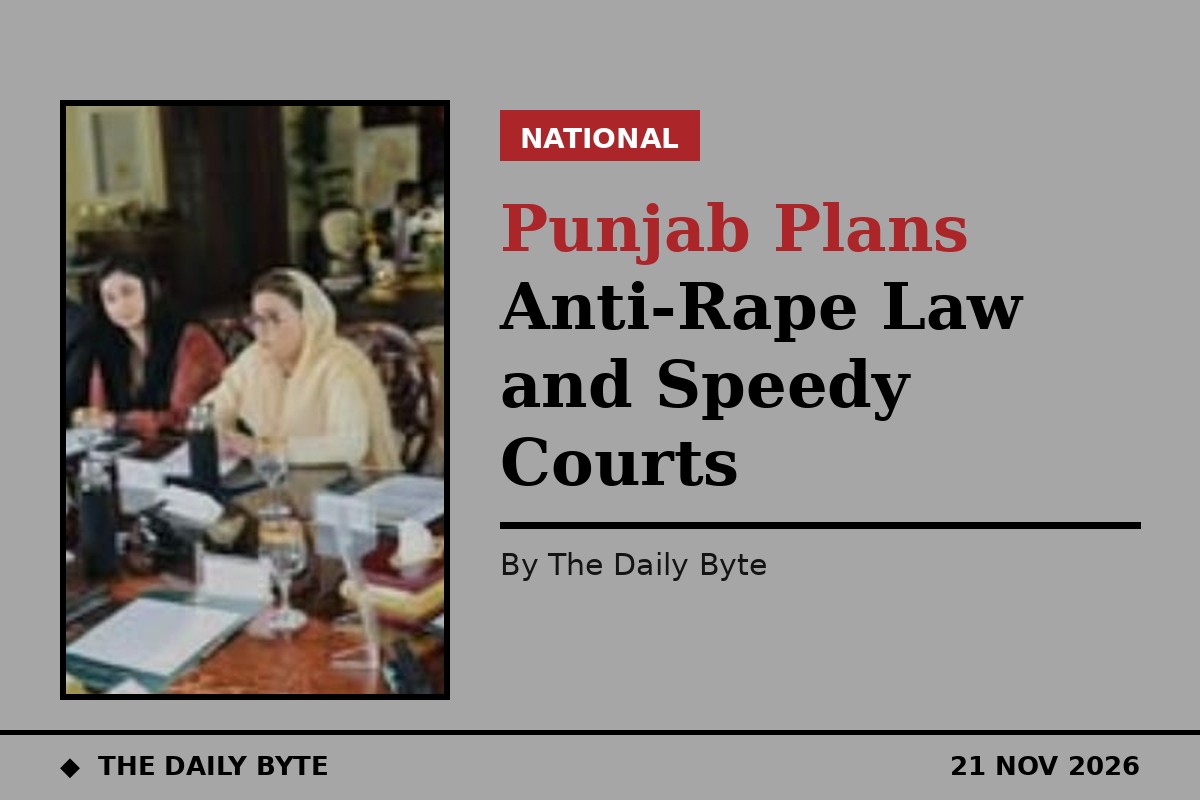
Punjab Chief Minister Maryam Nawaz has ordered the introduction of a new provincial anti-rape law and the establishment of speedy courts for cases involving violence against women and children, seeking time-bound trials and stronger prosecution.
The decision was taken at a meeting on the protection of women and children in Lahore on Monday, 16 November. The chief minister expressed concern over the low conviction rate in such cases and directed police to strengthen investigations, improve officers' capacity and take preventive measures against sexual violence. The meeting also agreed to use artificial intelligence to improve the quality of investigation and prosecution, and to ensure that audio and video evidence is properly recorded.
What the new law would do
Provincial Information Minister Uzma Bukhari told a press conference in Lahore that the new Anti-Rape Act would be combined with other laws protecting women, including the Protection of Women Against Domestic Violence Act and the Punjab Destitute and Neglected Children Act, to form comprehensive legislation for the province. Special courts would hear cases promptly so that victims receive justice as soon as possible, and the courts would be modelled on anti-terrorism courts.
The chief minister will also meet the chief justice in connection with the plan. No draft of the law has been published and no date has been given for tabling it in the Punjab Assembly, so its precise scope will only become clear when the text appears.
A conviction rate below 1 per cent
The driving force behind the plan is the conviction rate. Officials put the rate in cases involving crimes against women and children at below 1 per cent in 2025, with one report putting the figure for rape cases at 0.77 per cent. Bukhari said offenders committed abuses and were then easily acquitted, in some cases celebrating with victory signs after their release.
Maryam Nawaz referred in particular to a case in which a father died by suicide after his daughter was raped and the accused was acquitted, leaving the family without justice. She said women and children were among the most vulnerable segments of society, that their protection remained a priority, and that the government would introduce effective legislation to ensure exemplary punishment for those involved in sexual abuse.
The scale of the problem
A briefing by the inspector general of police set out the scale of the problem. Around 1.24 million complaints relating to women have been registered at police stations across the province, and about 125,000 complaints were lodged through the Virtual Women Police Station, with action completed in 92 per cent of cases. The meeting was told that 70,000 missing or abducted children had been recovered through complaints registered with the Virtual Centre for Child Safety, while 4,000 children with special needs were reunited with their families, and 7,588 child sexual abuse cases were resolved.
The briefing also found that people known to the victims were involved in 71 per cent of sexual abuse cases involving women and children. Separate figures reported from the press conference said neighbours were involved in 44 per cent of crimes against children and close family members or relatives in 54 per cent, and that 96,892 first information reports had been registered for domestic violence.
What already exists, and what happens next
Punjab would not be starting from nothing. Parliament passed the federal Anti-Rape (Investigation and Trial) Act in 2021, which created special courts, required trials to finish within four months and set up crisis cells and specialised investigation units. That law was amended this year, with the National Assembly passing changes in May that made sexual assault and child exploitation non-bailable.
The question for the provincial plan is whether it fixes the stages where cases are lost: investigation, evidence and prosecution. Help desks, virtual police stations, virtual centres for child safety and mobile police stations have already been established across the province. Bukhari described women and children as the chief minister's red line and said the government was pursuing a zero-tolerance policy. Whether the new law and the new courts lift the conviction rate from below 1 per cent will be the test of that promise.