Pupil premium cliff edge feared as meals expand
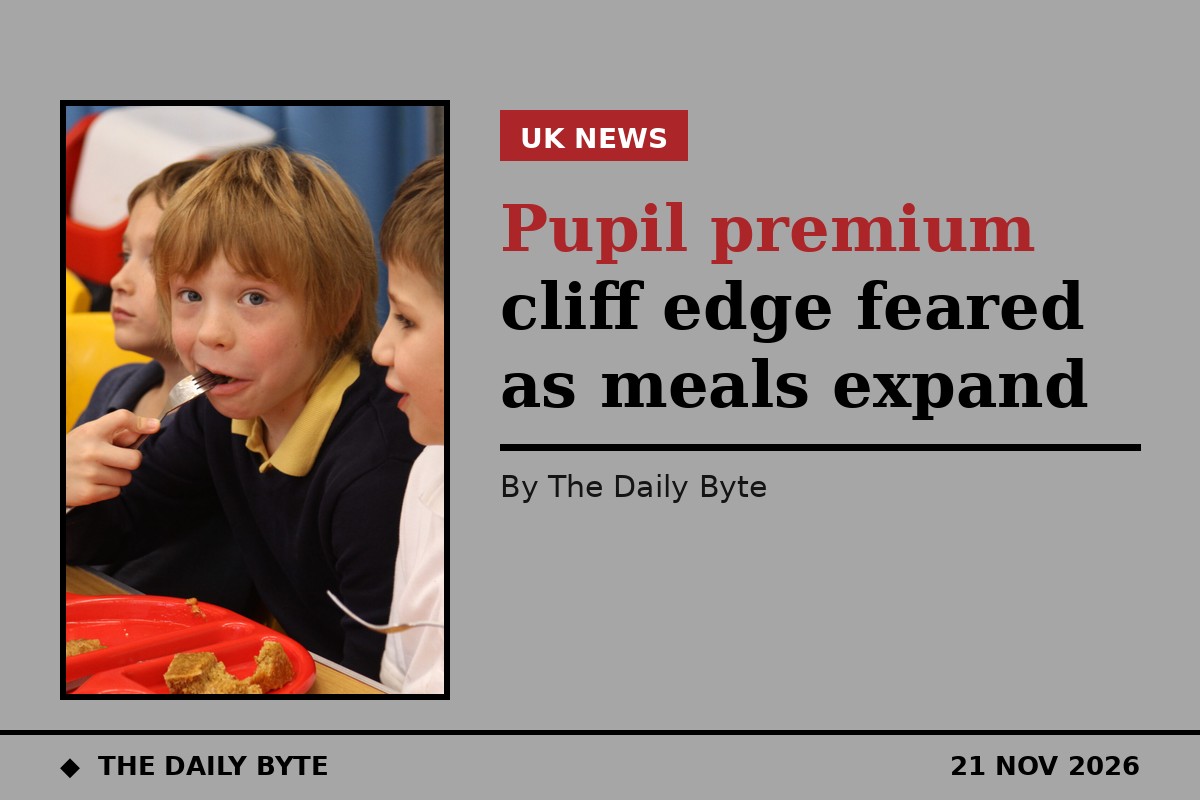
School leaders are warning that the government's expansion of free school meals could leave the most disadvantaged schools facing a steep fall in pupil premium funding, describing the risk as an impending cliff edge. The warning comes as schools plan budgets without knowing how the government will reform disadvantage funding.
Since September, all children in households receiving universal credit have been eligible for free school meals in England. But the government created two categories. Pupils in "targeted" free school meals, under the previous 7,400 pounds earnings threshold, still attract pupil premium. Pupils who qualify only under the new "expanded" category, for universal credit families above that threshold, receive the meals but attract no pupil premium, and they do not join the Ever 6 cohort under which pupils keep attracting the funding for six years after they were last recorded as eligible.
Benedicte Yue, chief financial officer at River Learning Trust, which runs 31 schools across Oxfordshire and Swindon, said eligibility checks at the start of the academic year found many previously eligible pupils were now being classed as expanded rather than targeted. "Unless the government fundamentally reforms disadvantage funding, we are looking at an impending cliff edge leading to a dramatic drop in pupil premium," she told Tes.
Mo Chatra, chief financial and operations officer at Academy Transformation Trust, which runs 21 schools across the East Midlands and East of England, said schools with higher proportions of disadvantaged pupils could be hit particularly hard. "For a trust like ours, which does have higher-than-average disadvantage and therefore greater levels of pupil premium, we potentially stand to take a financial hit," he said. River Learning Trust received 3.9 million pounds in pupil premium funding in 2024-25, and Academy Transformation Trust received 5 million pounds. Neither trust has yet quantified its potential losses, which will depend on pupils' eligibility histories and on future government reforms.
Meals cost more than the funding
The expansion has also strained school budgets directly, leaders say. Schools receive 2.66 pounds per meal from the government, while industry data puts the cost of a healthy, compliant school meal at roughly 3.16 pounds. Pepe Di'Iasio, general secretary of the Association of School and College Leaders, said the expansion was a positive step but needed careful management. "We remain concerned that current funding is not sufficient to meet costs and some schools are being forced to cover the excess from their own budgets," he said.
A headteacher at a local authority-maintained school in the East Midlands told Tes the uncertainty was making it difficult to plan a three-year pupil premium strategy, including funding smaller classes in core subjects. Trusts with outsourced catering contracts could face particular difficulty controlling rising costs, Mr Chatra warned.
What the new funding settlement does
The Department for Education's funding allocations for 2027-28, published on 19 November, raise the deprivation factor in the national funding formula, which supports pupils who have been eligible for free school meals at any point in the past six years, by 5 per cent. But Tes's analysis of the announcement notes that once pension and grant adjustments are applied, the cash value of that factor in fact falls, from 1,210 pounds to 1,160 pounds per primary pupil and from 1,725 pounds to 1,655 pounds per secondary pupil. The core schools budget for 2027-28 is set at 66.7 billion pounds, with mainstream per-pupil funding rising by 3.89 per cent after the pension adjustment.
The government's schools white paper proposed reforming pupil premium and the funding formula's deprivation funding to better reflect levels of poverty. Trust leaders welcomed the direction but called for greater weighting for persistently disadvantaged pupils and for geographical inequalities to be taken into account. Pupils who were eligible for free school meals before the expansion stay in the Ever 6 cohort for six years even if they now qualify only for expanded meals, so the funding gap builds over time as that historic eligibility expires and newly eligible pupils never enter the cohort. For now, school leaders say they are being asked to plan for the most vulnerable pupils without knowing what the replacement system will look like.