What Is the CMA? UK Competition Watchdog Guide
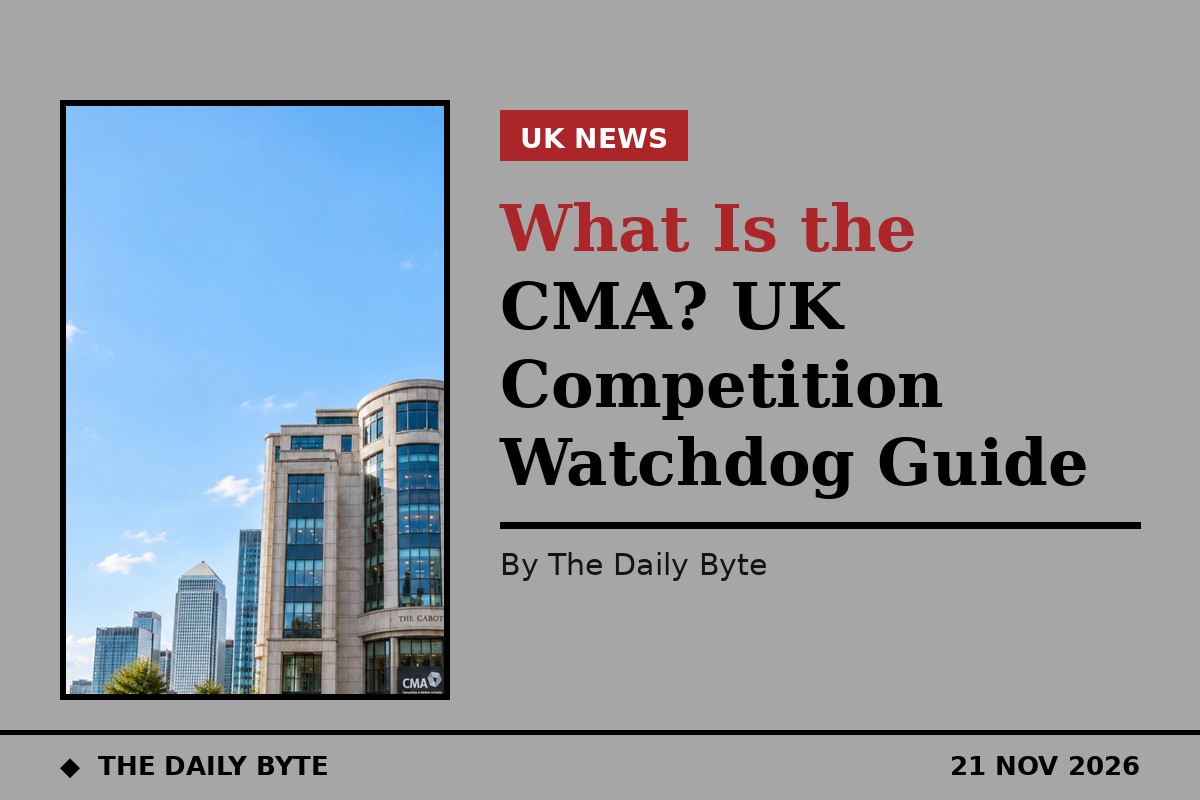
The Competition and Markets Authority, known as the CMA, is the body that decides whether big mergers can go ahead in the United Kingdom, and whether businesses are treating their customers fairly. It returned to the headlines on 18 November 2026, when it opened a formal investigation into OCS Group's proposed 3.1 billion pound takeover of the facilities management company Mitie. This explainer sets out what the CMA is, what powers it holds, how a merger investigation works, and what happens next in the OCS-Mitie case.
What is the CMA?
The CMA is an independent non-ministerial department of the UK government. That means it is part of the state but operates at arm's length from ministers: the government does not tell it which mergers to clear or which companies to investigate. Its work is overseen by a Board and led by a Chief Executive and senior team, while decisions in some investigations are made by independent members of a CMA panel.
The authority was created on 1 April 2014, when it replaced two older bodies: the Office of Fair Trading, which handled the first stage of merger and competition cases, and the Competition Commission, which carried out in-depth inquiries. Bringing both stages under one roof was intended to make the system faster and more consistent, while keeping the decision-makers at each stage separate from each other.
The CMA has staff in London, Edinburgh, Belfast, Cardiff, Manchester and Darlington. Its headquarters is The Cabot, at 25 Cabot Square in Canary Wharf, London. Its stated ambition, in its own words, is to promote an environment where people can be confident they are getting great choices and fair deals, where competitive, fair-dealing businesses can innovate and thrive, and where the whole UK economy can grow productively and sustainably.
What does the CMA do?
The CMA's work falls into several areas. The best known is mergers: it investigates takeovers that have the potential to lead to a substantial lessening of competition. If a merger is likely to reduce competition substantially, the CMA can block it or impose remedies to address those concerns, such as requiring the merged company to sell off part of the business.
It also takes action against businesses and individuals that take part in cartels or other anti-competitive behaviour, such as price-fixing or carving up markets between rivals. It protects people from unfair trading practices, including cases where unfair treatment suggests there may be a systemic problem in a market. And it can investigate an entire market if it thinks there are competition or consumer problems, even when no single company has broken the law.
Beyond those enforcement roles, the CMA promotes effective competition in digital markets, encourages government and other regulators to use competition effectively on behalf of consumers, and carries out regulatory appeals on issues such as price controls. It also provides technical advice, reporting and monitoring on the UK internal market through its Office for the Internal Market, and on government subsidies through its Subsidy Advice Unit. It publishes information and advice for people and businesses about their rights and obligations under competition and consumer law.
The CMA does not set prices, run industries, or decide industrial policy. Its test in a merger case is a narrow one: will this deal reduce competition enough to harm consumers? A merger can be unpopular, or involve large job losses, and still be cleared if competition is not harmed. Equally, a deal can be blocked even when the companies involved argue it would make them more efficient.
How does a merger investigation work?
Merger control in the UK is voluntary: companies are not legally required to notify the CMA before they merge. But most large deals are notified in practice, because completing a merger the CMA later finds anti-competitive can lead to the deal being unwound. The CMA can also investigate a completed merger on its own initiative.
An investigation has two phases. Phase 1 is an initial assessment, and the CMA has a statutory timetable of 40 working days to decide. The question at this stage is whether the merger gives rise to a realistic prospect of a substantial lessening of competition. If the answer is no, the deal is cleared. If the answer is yes, the companies may offer undertakings, such as selling a division, to resolve the concern. If the concern is not resolved, the CMA must refer the deal for a deeper investigation.
Phase 2 is an in-depth inquiry, normally lasting 24 weeks, which can be extended by up to eight weeks in exceptional circumstances. It is conducted by an inquiry group of between three and five independent panel members, deliberately different people from those who handled Phase 1, so that the case gets a fresh pair of eyes. At the end of Phase 2, the CMA can clear the merger, clear it subject to remedies, or block it outright. It can also order a completed merger to be unwound.
Before a formal investigation begins, the CMA usually runs a pre-notification stage and invites comments from interested parties, including customers, suppliers, competitors and trade bodies. Anyone who thinks a merger will affect them can write in. The CMA publishes a case page for each inquiry, with the timetable, the documents, and a contact address for representations.
The OCS-Mitie case
The OCS-Mitie deal is a good example of the process in action. OCS Group International, a facilities management company backed by the private equity firm Clayton, Dubilier and Rice, agreed in July 2026 to buy Mitie Group for 218.5 pence per share in cash, plus a dividend of 3.1 pence per share, valuing Mitie at about 3.1 billion pounds. Mitie is one of the UK's largest outsourcing companies, providing cleaning, security, maintenance and other services to businesses and public bodies. The two companies had said they expected the transaction to complete in the first quarter of 2027.
The CMA opened a case on the deal on 15 September 2026 and invited comments from interested parties. That invitation to comment closed on 29 September. On 18 November 2026, the CMA announced the launch of its merger inquiry by formal notice to the parties. The deadline for its Phase 1 decision is 20 January 2027, although the CMA notes that the statutory deadline can be extended in certain limited circumstances.
Two other regulatory hurdles have already been cleared. The European Commission gave the deal merger control clearance on 21 October 2026, and on the same day the UK government's Investment Security Unit said it would take no further action under the National Security and Investment Act 2021. Court sanction is still required, because the deal is structured as a court-sanctioned scheme of arrangement, and Mitie shareholders must approve it.
Mitie, for its part, reported in November that its revenue had climbed 8.2 percent to 2.90 billion pounds in the half year, and said the takeover remained on track. None of that affects the CMA's assessment, which will turn on competition in the markets where OCS and Mitie overlap, such as facilities management services for large customers. If the CMA finds a realistic prospect of reduced competition, the deal will go to a Phase 2 inquiry in the new year. If it clears the deal, completion can proceed as planned.
What the CMA is not
It is worth being clear about the limits of the CMA's role. It is not a court, although its decisions can be challenged before the Competition Appeal Tribunal. It is not a consumer complaints service: it says it cannot always respond in detail to individual complaints, and it directs people to its guidance on how it handles information from the public. And it is not a ministry: ministers cannot direct its decisions in individual cases.
That independence is the point. Competition decisions are meant to be taken on evidence about markets, not on political convenience. When the CMA blocks a merger, the companies involved often complain loudly. When it clears one, consumer groups sometimes do the same. Both reactions are a sign that the system is doing what it was set up to do: applying the same test, in public, to every deal that comes before it.
Why it matters to shoppers and workers
Merger control can seem remote from daily life, but its effects are concrete. Facilities management covers the cleaning, security and maintenance of offices, hospitals, schools and stations. If two of the largest providers merge and competition falls, the organisations that buy those services can face higher prices and less choice, and those costs eventually reach taxpayers and customers.
The same logic applies across the economy, from supermarkets to mobile networks to veterinary practices. The CMA's job is to make sure that when companies combine, the result is a stronger business rather than a weaker market. The OCS-Mitie inquiry, with its decision due by 20 January 2027, is the latest test of that principle, and its outcome will be watched well beyond the facilities management industry.