Quaest poll: 81% say Brazil more divided after election
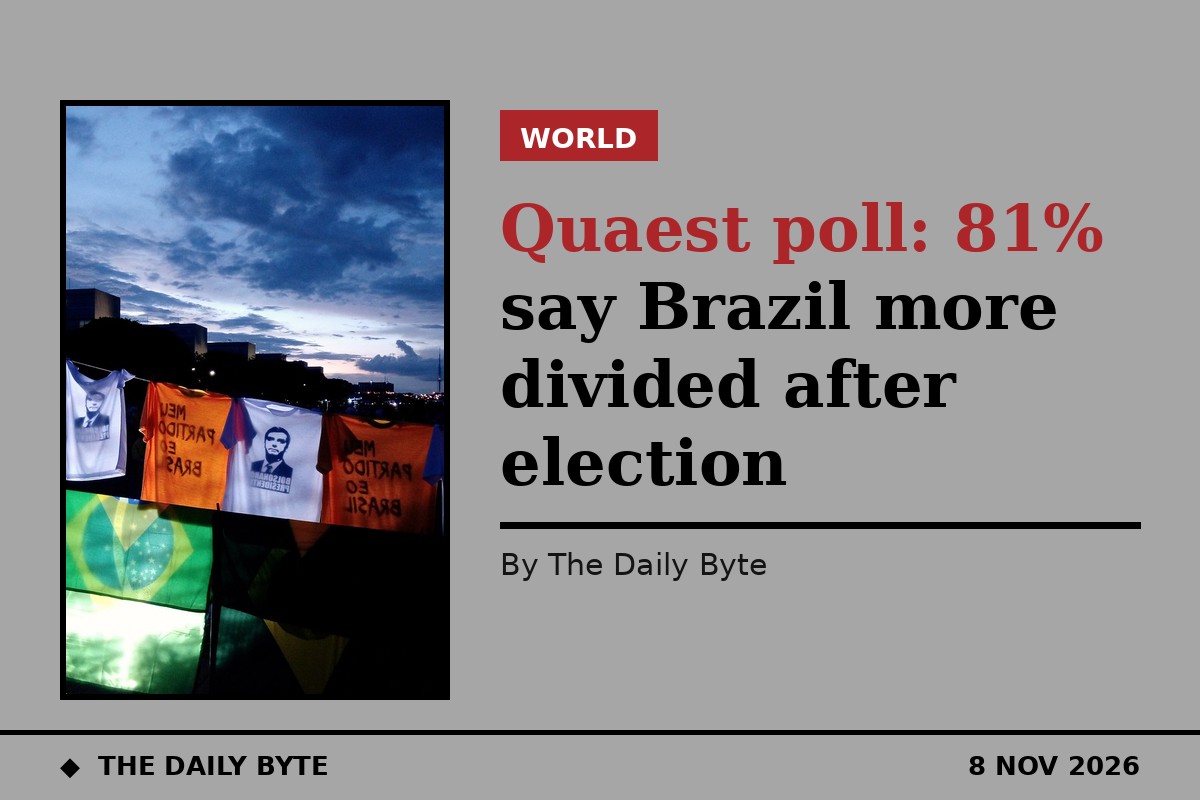
Brazil came out of its 2026 presidential election more divided, according to most voters in the first Quaest poll published after the result. The survey, titled “O Brasil depois das urnas”, found that 81% of respondents believe the country emerged more divided from the contest, while 15% said it emerged more united.
The poll was released on Sunday, 8 November, after Luiz Inácio Lula da Silva won re-election to a fourth term as president. It interviewed 2,004 Brazilians aged 16 and over between 30 October and 2 November, with a margin of error of two percentage points and a confidence level of 95%.
Despite the widespread sense of division, the survey also recorded a broad wish for the next government to succeed. Asked whether they hoped Lula would deliver a good government, 94% of respondents said yes. The same figure was recorded in December 2022, after the election that returned Lula to the presidency.
The poll’s authors draw a distinction between that hope and approval of the government. On approval, 48% of respondents said they approved of Lula’s government and 44% said they disapproved, with 8% saying they did not know or not answering. That leaves a net approval margin of four points.
Approval was unchanged from the survey carried out on 24 October, on the eve of the first round, when the figures were 48% approving and 45% disapproving. Disapproval has fallen to its lowest level since January, according to the series presented by the institute.
The four-point margin is the narrowest recorded for a re-elected president in the comparisons presented in the survey. In 1998, Fernando Henrique Cardoso had 54% approval and 44% disapproval, a margin of 10 points. In 2006, Lula recorded 69% approval against 31% disapproval, a margin of 38 points. In 2014, Dilma Rousseff had 59% approval and 41% disapproval, a margin of 18 points.
Expectations for the country have improved since December 2022, although concern still outweighs optimism. In the new survey, 48% of respondents said they were worried about Brazil’s future and 44% said they were optimistic. In December 2022, 54% said they were worried and 41% said they were optimistic.
Looking at the next 12 months, opinion is evenly split: 39% believe the situation will get worse and the same proportion expect it to improve, while 19% think it will stay the same and 3% did not know.
When asked what should be the priorities of the new term, 17% pointed to ending the six-days-on, one-day-off working schedule, known as the 6x1 scale. A further 16% cited zero tax on the basic food basket, 11% mentioned raising the minimum wage, and 10% chose a pact against femicide.
The economy dominates concerns about the new government. Spending, public debt and interest rates were cited by 27% of respondents as the main worry. Public security, violence, criminal factions, militias and drugs came next, mentioned by 17%, followed by corruption and scandals on 12% and governability, relations with Congress and the opposition, also on 12%.
Most respondents expect a difficult relationship between the executive and Congress. Seventy per cent believe there will be more conflict with Congress than in the current Lula government, while 18% expect less conflict, 3% expect the same level and 9% did not know. On the Supreme Court, 46% expect more conflict and 35% expect less.
Among the reasons given for optimism about the next government, democracy and combating Bolsonarismo were cited by 20% of respondents. Social programmes, reducing inequality and helping the poorest accounted for 17%, while regulation of betting and social media was cited by 16%.
On Lula himself, 73% of respondents described him as a strong leader, against 25% who disagreed. Sixty-one per cent said he knows what he is doing, while 35% disagreed, and 58% said he is full of energy, against 39% who disagreed. The most negative assessment came on honesty: 57% said Lula is not honest, while 34% said he is.
The poll therefore paints a mixed picture for the start of Lula’s fourth term, which begins in January 2027: a public that is broadly hopeful the government will do well, but deeply divided about the election, narrowly split on approval, and expecting friction with Congress.


