Rafael unveils Super Ice cruise missile
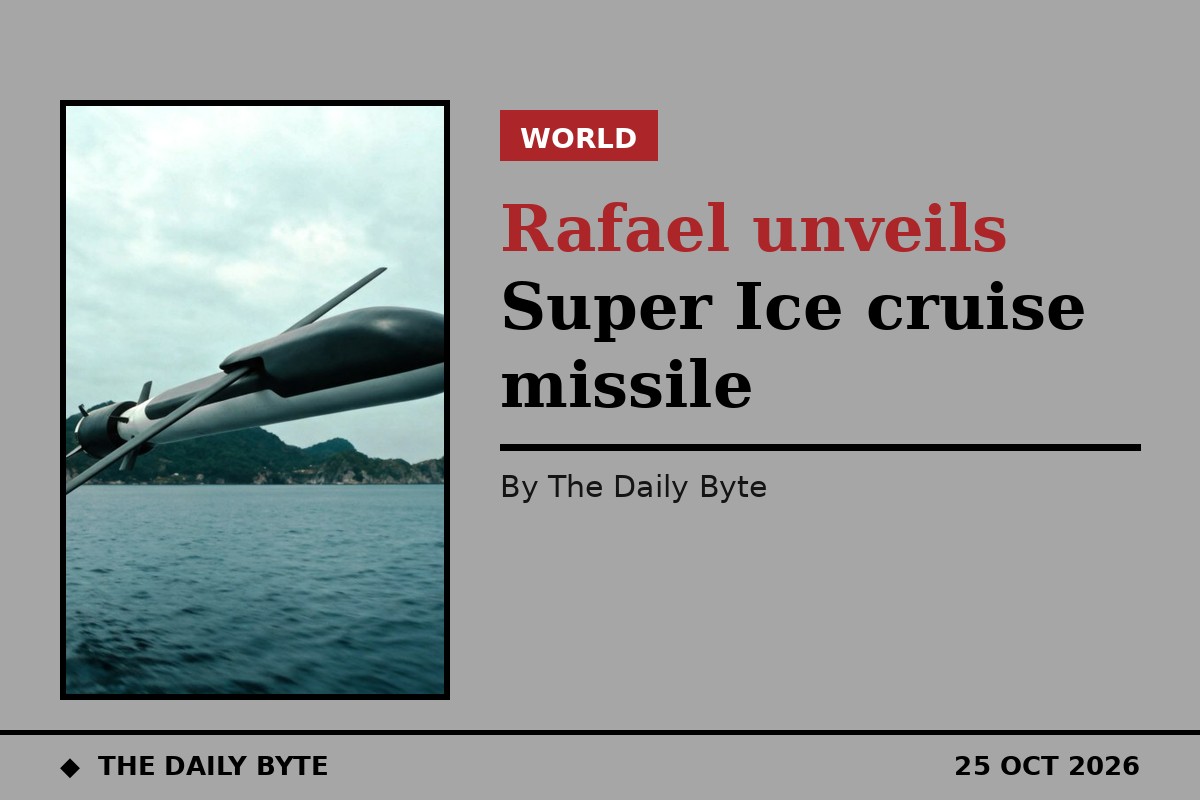
Israeli defence company Rafael has unveiled a new long-range cruise missile carrying a 1,000-pound warhead, four times heavier than the payload on its earlier Ice Breaker missile.
The weapon, called SUPER ICE, was announced on Tuesday, 11 November 2026, and is designed to be launched from aircraft, ground-based systems and naval platforms, giving Israel a bigger stand-off strike capability.
Rafael said the missile can strike high-value strategic targets, including air-defence systems, hardened bunkers and large naval vessels, from well beyond the range of enemy defences.
A much heavier warhead
The most significant change from the earlier missile is the warhead. SUPER ICE carries a 1,000-pound (454kg) warhead compatible with the American Mark 83 bomb, compared with the 250-pound warhead on Ice Breaker, which was introduced in 2023.
The missile is noticeably larger than its predecessor and comparable in size to the American-made Tomahawk, Breaking Defense reported. Rafael has not disclosed SUPER ICE’s exact range, dimensions or weight.
The company said the missile flies at low altitude, following the contours of the terrain, and can operate in all weather. It navigates autonomously using an advanced electro-optical guidance system that matches images of the target area, and can fly without relying on satellite navigation.
Part of a missile family
SUPER ICE joins Rafael’s Ice Breaker and Sea Breaker cruise missiles, expanding a family of weapons built on the same launch systems, mission-planning tools and logistics. Customers can choose between SUPER ICE and Ice Breaker depending on the target, Rafael said.
Gad Geva, Rafael’s senior vice president and head of its Air Systems Division, said the new missile was developed for integration across a wide range of aircraft without significant modifications, and can also be launched from sea or ground-based launchers.
Rafael chairman Yuval Steinitz described SUPER ICE as “the best cruise missile of its kind in the world”, a company claim rather than an independently verified assessment. Chief executive Yoav Tourgeman said Rafael’s systems had played a decisive role in recent conflicts and that the new missile answered a growing global need for long-range precision weapons.
No customers or price disclosed
Rafael has not said whether the missile has been tested, whether it is already in production, or whether the Israeli military or any foreign customer has ordered it. The company also declined to disclose its price.
Reports in Israel suggest the missile could become operational around early 2027, according to The Jerusalem Post. Rafael did not confirm a delivery schedule.
The unveiling comes as militaries around the world increase investment in long-range strike weapons, and as Israel prepares for the possibility of another round of fighting with Iran after more than eight months of war.
Sources: Breaking Defense; EDR Magazine; Interesting Engineering.; Army Recognition