Reza Pahlavi Receives Freedom Prize in Frankfurt
Iran's exiled prince Reza Pahlavi has accepted Germany's 2026 Freedom Prize on behalf of the Iranian people, in a ceremony in Frankfurt that drew both a large rally of supporters and sharp criticism from opponents who question his claim to speak for Iran.
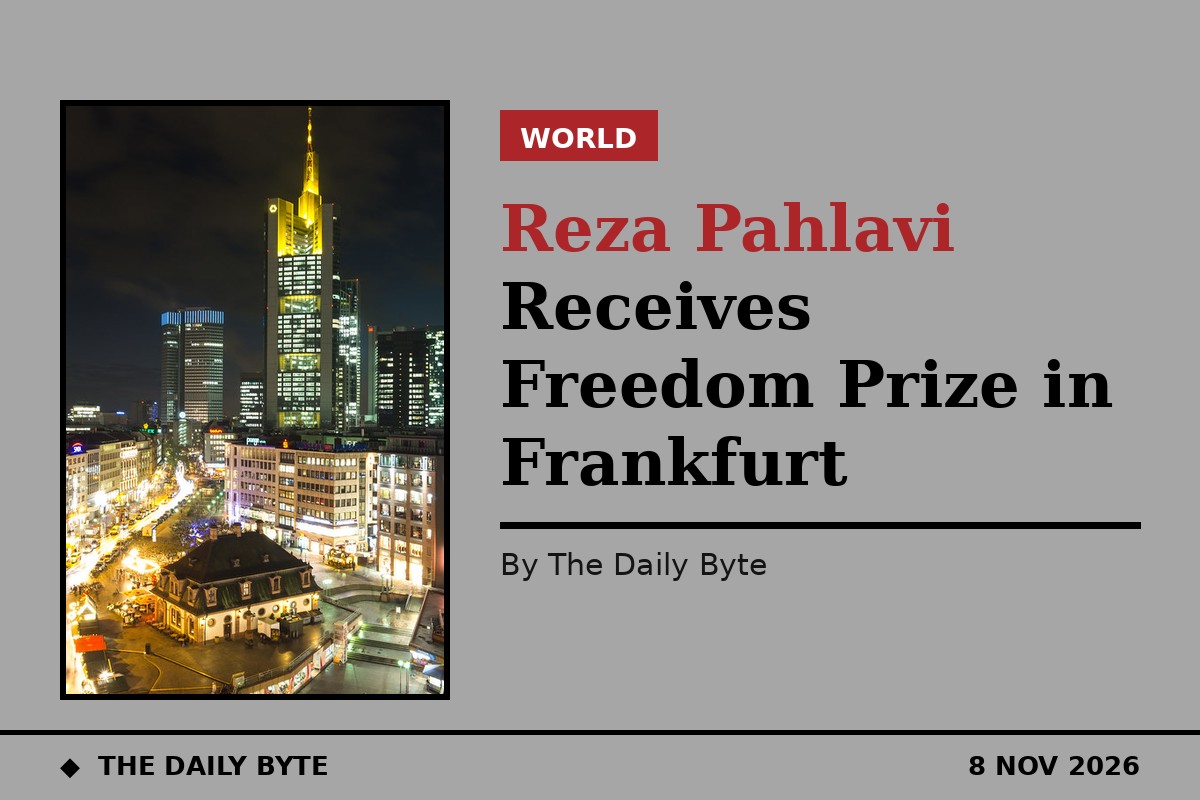
The Friedrich Naumann Foundation for Freedom presented the prize at St Paul's Church on Saturday, 7 November. The foundation, which is affiliated with Germany's liberal Free Democratic Party, has awarded the prize every two years since 2006. This year, for the first time, it chose a nation rather than an individual.
"Not to any group, any party or any person," the foundation's chairman, Steffen Saebisch, told the audience, "but to a people: the Iranian nation."
Pahlavi, the son of Iran's last shah and the best-known figure in the exiled opposition, said he had agreed to take the prize only as a custodian, not as its owner. "I hold it only temporarily," he said. "One day I will place it in the hands of its rightful owners, not on foreign soil but in our capital, Tehran."
He described Iran as a house whose owners had been shut out. "For 47 years, Iran has been like a house whose residents, its rightful owners, have been locked out of their own home or held captive inside it," he said. "The keys were taken from the people in 1979. I see it as my duty to help reclaim those keys and return them to their only rightful owners, the Iranian people."
The ceremony opened a day of demonstrations in Frankfurt and other cities. Police estimated that around 20,000 supporters gathered in Frankfurt, waving the pre-revolutionary Iranian flag and chanting in favour of the former monarchy.
Pahlavi's speech was built around the history of the building in which he spoke. Germany's first elected parliament sat in St Paul's Church in 1848, and he drew a parallel with Iran's first parliament, created in 1906. He said both moments rested on the same belief: that a nation is not the property of rulers, but of its people.
He set out four principles for Iran's future: the country's territorial integrity; equal rights for every citizen whatever their language, origin or beliefs; a secular state that belongs to all faiths and to none; and the right of Iranians to choose their form of government at the ballot box.
"No name, no party, no system of government is on it," he said of the list, "because all of those choices belong to the people. I will not take it from them. Nor will I allow others to."
Pahlavi has offered to lead a transitional administration if the Islamic Republic collapses, but says the country's future political system should be decided by a democratic referendum rather than by automatically restoring the monarchy. He has also defended military pressure on Iran's rulers, arguing that outside force should target the Revolutionary Guards and the security apparatus, while civilians and civilian infrastructure should be spared.
The choice of Pahlavi as the prize's recipient divided opinion in Germany. The Frankfurt branches of the centre-left Social Democratic Party and the Greens boycotted the ceremony, arguing that he could not claim to represent the Iranian people without a democratic mandate. Germany's Left Party objected to the use of St Paul's Church for a political gathering. Dozens of prominent German public figures signed an open letter urging the foundation to reconsider, and around 200 prisoners held in Iran signed a letter protesting his selection.
The foundation defended its decision, saying the award recognised the Iranian people's struggle for democracy and human rights rather than endorsing a particular political leader. Ludwig Theodor Heuss, a member of the foundation's board of trustees, said he believed no people in the world had paid a higher price for freedom this year, pointing to the January crackdown in which rights groups say thousands of demonstrators were killed.
Marie-Agnes Strack-Zimmermann, who chairs the European Parliament's security and defence committee, said the world had stopped talking about Iranians while it negotiated over the nuclear issue and the closure of the Strait of Hormuz.
The award came as tensions over Iran remained high. On the same day, Iran's Revolutionary Guards announced they had lifted a self-imposed limit of 2,000 kilometres on the range of the country's ballistic missiles, raising concern that future Iranian missiles could reach deeper into Europe. Washington has maintained a naval blockade of Iranian ports after months of warfare and inconclusive negotiations over ending the conflict.
Pahlavi closed his speech by recalling the fall of the Berlin Wall, 37 years ago this week. "That is how dictatorships end: slowly, and then all at once," he said. "That day is coming to Iran."