Rocket Lab earnings test after shares fall 65% from high
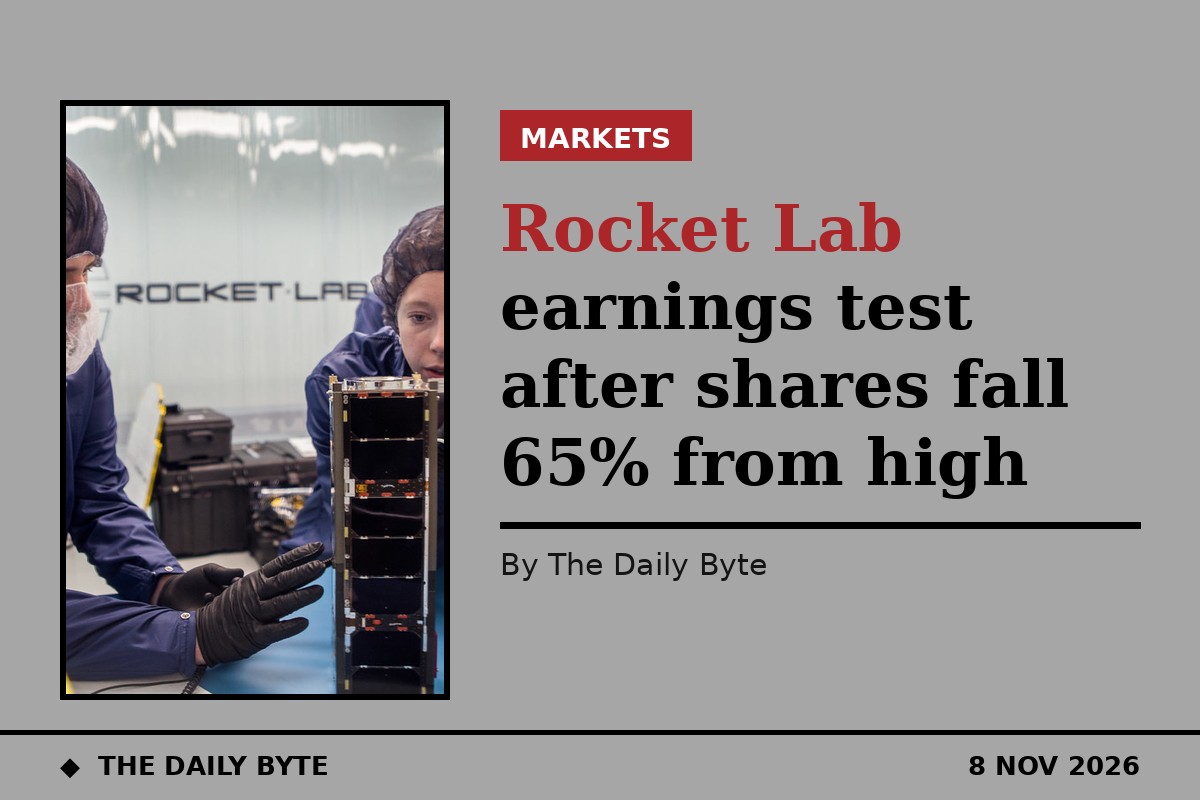
Rocket Lab reports third-quarter results after the market closes on Monday, 9 November, in what has become a test of whether the space company can keep growing while its next big rocket waits on the ground.
Analysts expect revenue of about $257 million, against company guidance of $250 million to $265 million. The company also guided to an adjusted EBITDA loss of $17 million to $23 million, a GAAP gross margin of 29% to 31% and operating expenses of $143 million to $149 million. The earnings call is scheduled for 5 p.m. Eastern Time.
Getting to Monday has been a wild ride for shareholders. The stock fell 12.2% on Thursday, 5 November, to $45.99, then jumped 15.4% on Friday to close at $53.07. Neither move was driven by company news. Thursday's fall was tied to a post-election sell-off led by AI data centre stocks, with investors worried about greater scrutiny of data centre buildouts, and Friday's bounce had no company announcement behind it either.
The deeper damage came earlier. Rocket Lab closed at $64.22 on 13 October, and the following evening the company announced that the first flight of Neutron, its medium-lift rocket, had slipped into 2027. The shares have not closed above $60 since, and Friday's close is still 65% below the 52-week high of $151.
The delay matters because so much of the growth story leans on Neutron. Inspection of a newly built forward dome for the first-stage tank turned up defects, and chief executive Peter Beck has indicated that tank assembly and testing will run into early 2027. It is the second tank problem this year, after a first-stage tank ruptured during a pressure test on 21 January. The company has not given a month for the first flight.
Chief financial officer Adam Spice said in August that adjusted EBITDA should turn positive in the quarter after Neutron's first successful flight, with positive free cash flow following 18 to 24 months after that. Every quarter Neutron slips, both milestones slip with it.
What has not changed is the business that flies today. Second-quarter revenue rose 62% year on year to $234.1 million, total backlog stood at $2.36 billion at the end of June, up 137%, and the launch backlog passed 100 missions after a 20-launch order from a Tokyo satellite imaging company on 30 September. Rocket Lab completed its 98th Electron mission in late October and its 99th in early November, maintaining a 100% mission success rate.
The question hanging over Monday's report is cash. Rocket Lab held $2.39 billion of cash and securities at 30 June, and free cash flow was negative $371 million over the 12 months to that date. Operations used $84.1 million in the second quarter, against $23.2 million a year earlier, and inventory absorbed $73.3 million of operating cash in the first half as the company built Neutron vehicles and restocked its Mynaric supply chain. At the second quarter's pace, the June cash pile covers roughly six years of burn, before the money owed to Iridium holders is counted.
The Iridium deal is the other big item on the call. Rocket Lab agreed in June to buy Iridium Communications for roughly $8 billion including debt, paying $27 in cash plus Rocket Lab stock for each Iridium share. The share count is set by a collar: if Rocket Lab averages $67.50 or less over the 10 trading days before closing, Iridium holders get the maximum of about 42.4 million shares. With the stock at $53.07, the collar is already maxed out. Add the 29.3 million shares Rocket Lab already sold through its at-the-market programme at an average near $66.35, raising about $1.94 billion, and the share count rises by roughly 71.7 million, or about 11% of the shares counted at 30 June.
Iridium shareholders approved the deal on 24 September with 99.6% of votes cast, but Ligado Networks, a satellite spectrum company, has asked the Federal Communications Commission to scrutinise the transaction, with replies due on 9 November, the same day Rocket Lab reports. Completion is still targeted for mid-2027.
Analysts have not walked away. The average price target is $102.15, and 18 of 22 analysts rate the stock a buy or strong buy, with none at sell. On analysts' average estimate for 2027 revenue of $1.33 billion, Friday's close values the company at about 25 times that figure, down from 30.4 times before the Neutron delay was announced.
Four things will decide Monday night's reaction: revenue against the $250 million to $265 million range, the adjusted EBITDA loss against $17 million to $23 million, any new language on when Neutron will fly, and any update on the Iridium timeline and share count.