Romania's Lukoil refinery ready to restart after year idle
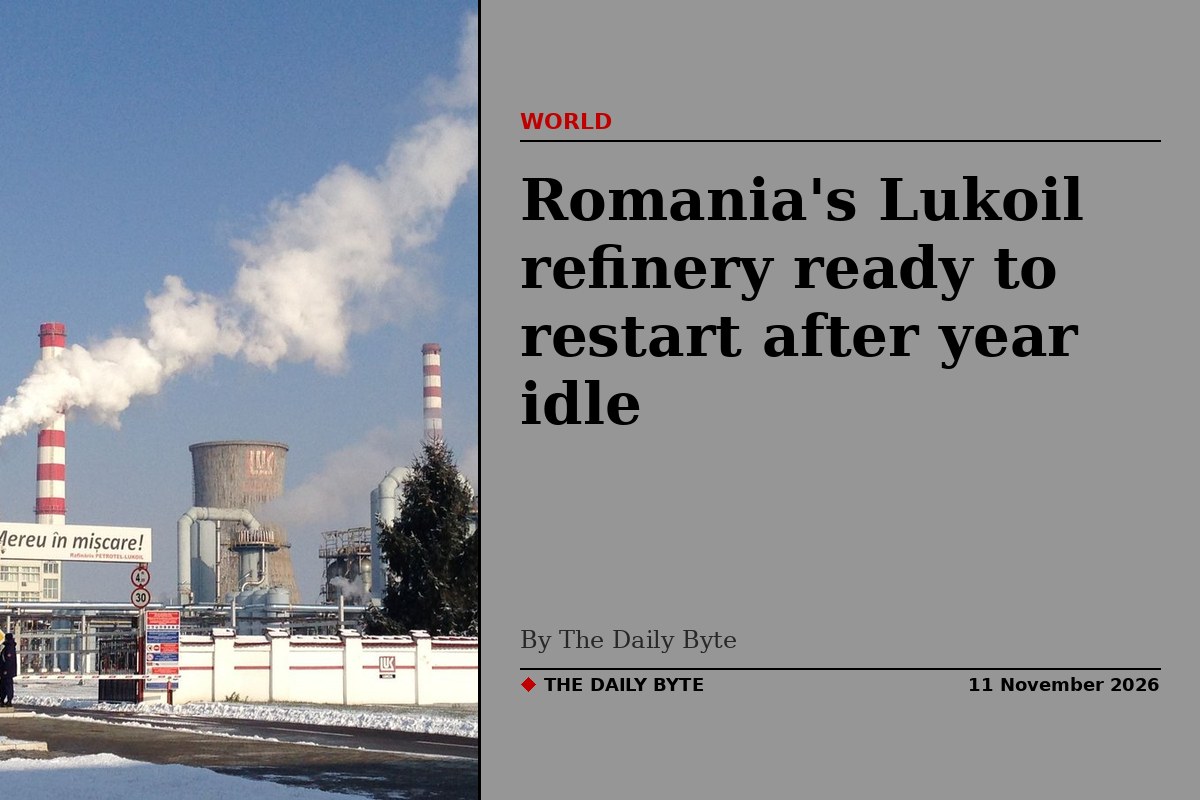
Romania's Petrotel refinery is technically ready to restart refining operations after nearly 13 months idle, according to a report published on Tuesday, in the latest twist in a long-running saga shaped by sanctions, insolvency and failed restart attempts.
The Petrotel-Lukoil refinery in Ploiești has restarted its combined heat and power plant and is technically ready to resume refining, local news outlet Mediafax reported on Tuesday, as covered by SeeNews. The plant has contracted a shipment of Kazakh crude oil, with the vessel scheduled to arrive at the port of Constanța by 20 November, under an existing derogation framework that allows operations to resume.
A refinery shut down by sanctions
Petrotel is owned by the Russian energy group Lukoil, which was placed under United States and British sanctions in October 2025. At the time, the refinery was undergoing scheduled maintenance that was due to be completed in November 2025. Once the sanctions entered into force, it did not resume operations.
Although the plant is the smallest in Lukoil's portfolio, it is of systemic importance to Romania. Before the sanctions, it had a refining capacity of 48,000 barrels per day and accounted for almost 25 per cent of domestic fuel production. In February 2026, Romania's Ministry of Energy said the shutdown had cut domestic fuel production by 25 per cent, just as the country's two other refineries, Petromidia and Petrobrazi, were preparing for scheduled maintenance.
In February 2026, the Romanian government formalised state supervision over the Petrotel refinery, Lukoil Romania and Lukoil's other assets in the country. The supervisor was given the right to attend company meetings, approve external transactions and payments, and monitor compliance with the sanctions regime, without formally nationalising the assets.
Insolvency and debts of more than 1.5 billion lei
The refinery entered insolvency proceedings at its own request following a ruling by the Prahova Tribunal on 26 August. It has debts exceeding 1.5 billion lei, about 315 million dollars or 280.7 million euros, and insolvency was seen as the only way to protect the refinery's assets, preserve its workforce and explore a restart without triggering international sanctions.
Oil pipeline operator Conpet, which operates the National Oil Transport System, and petroleum logistics company Oil Terminal play an essential role in the logistics chain required to supply the refinery. Both are majority state-owned through the energy ministry.
Earlier restart attempts fell through
This is not the first time a restart has been promised. In mid-April 2026, reports emerged that Romania had obtained approval from the United States authorities for a sanctions waiver, and the Ministry of Energy said at the time that the facility could resume operations within about 45 days and produce diesel, petrol and aviation fuel for the Romanian market. The waiver removed only some of the obstacles, however, and did not resolve uncertainty over ownership, financing, commercial relationships or the refinery's ability to rebuild normal operations.
In early September 2026, the Ministry of Energy confirmed that Petrotel had remained out of production for around 11 months. The failure to restore output increased Romania's dependence on fuel imports, including deliveries from Saudi Arabia, which accounted for 43 per cent of Romanian fuel imports in May 2026, compared with 2 per cent in May 2025.
Lukoil also tried to sell its way out of the problem. In January 2026, the Russian group announced an agreement to sell its international business, including its Romanian assets, to the United States investment firm Carlyle. The deal reportedly fell through after it did not receive clearance from the United States Office of Foreign Assets Control.
Ready to restart is not the same as restarted
The latest report is carefully worded. The refinery is described as technically ready, its power plant is running again, and a crude shipment has been contracted. That is not the same as refining operations having resumed, and no confirmation has been given that crude has arrived or that processing units are running. The ownership question also remains unresolved, and any lasting return to the market is likely to depend on a sale to a buyer accepted by United States regulators.
For Romania, the stakes are practical. Petrotel's shutdown has deepened dependence on imports, forced the authorities to cap fuel margins, control exports and temporarily cut diesel tax, and left the domestic fuel balance exposed whenever the remaining refineries go into maintenance. If the Kazakh crude arrives on schedule and refining does resume, it would restore about a quarter of the country's domestic fuel production. Until then, the refinery's return remains a report of readiness, not a completed restart.
Sources: SeeNews and Institute of Central Europe (IEŚ Commentaries).