Romania's president rejects Alice Weidel's claims about Romanians
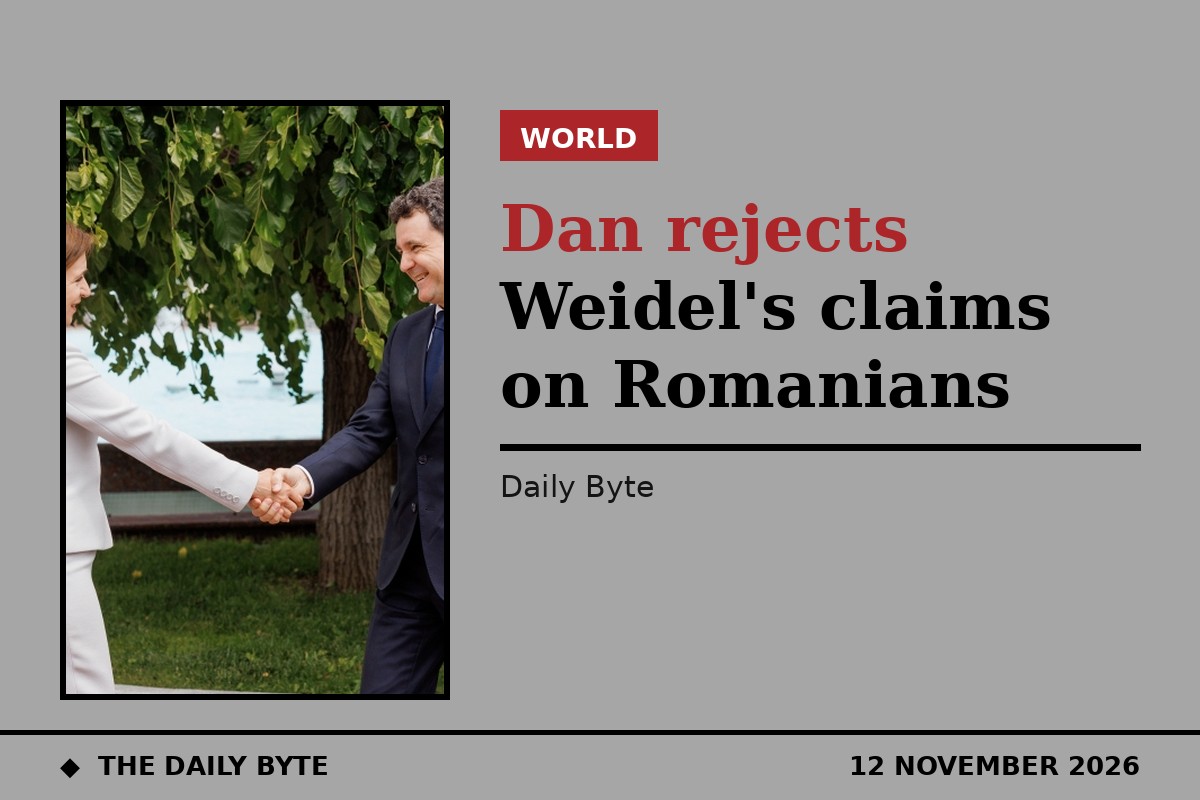
Romanian President Nicușor Dan has rejected claims by Alice Weidel, co-leader of Germany's Alternative for Germany (AfD) party, that Romanians are plundering Germany's welfare system, saying her remarks generalise about an entire community.
Dan was asked about Weidel's statements at a press conference at Cotroceni Palace in Bucharest on 10 November. He said the remarks targeted the whole Romanian community in Germany and that any abuse of the social welfare system was the work of a few individuals rather than a pattern across the community. He added that he had not spoken out on the matter before being asked about it at the press conference.
What Weidel said
Weidel made the claims in a post on X on 28 October, writing that more and more migrants from Romania were placing excessive pressure on Germany's social system through child benefits, basic income support and healthcare. She cited the city of Magdeburg, where she said costs linked to Romanian citizens had risen twentyfold to 3 million euros a year, drawing on figures from Germany's Federal Employment Agency presented in a documentary by the regional public broadcaster MDR.
"Child benefits, basic social assistance, healthcare: an increasing number of migrants from Romania are placing excessive pressure on our social welfare system. In Magdeburg alone, costs have increased 20-fold, reaching 3 million euros per year. Only with the AfD will there be a change of direction in migration policy!" Weidel wrote, according to Romanian media reports of her post.
The documentary at the centre of the row, titled "EU Poverty Migration: Welfare State in a Dead End?", examined how European social law rules can be used by migrants and the pressures on German cities. Data cited in the German debate showed that in Hagen, around 3,100 of the 4,500 registered Romanian citizens receive social benefits, and local authorities estimated that costs for Romanian and Bulgarian citizens there could reach 15 million euros in 2026.
Bucharest pushes back
Romania's Ministry of Foreign Affairs responded to Weidel's post, saying it rejects any political instrumentalisation of Romanian citizens abroad. Other Romanian politicians also answered back. Sorin Grindeanu, president of the Social Democratic Party, demanded that Weidel retract her statements and apologise to the Romanian community in Germany.
Dominic Fritz, leader of the liberal Save Romania Union, also demanded an apology, arguing that hundreds of thousands of Romanians in Germany work honestly and contribute to the country's social security funds. He pointed to Romanian doctors, carers and skilled workers who sustain German healthcare and industry, often after being trained at Romanian taxpayers' expense.
Virgil Popescu, a National Liberal Party MEP, said 519,200 Romanians work under contract in Germany and pay monthly social contributions, underlining that the community's presence in the German labour market is far broader than the benefit figures cited by Weidel suggest.
A community of around 900,000
Estimates put the Romanian community in Germany at around 900,000 people, many of them employed in industry, agriculture and services. As EU citizens, Romanians can live and work in Germany without a visa or work permit under free movement rules, and even minimal employment can qualify them for EU worker status, which brings access to income support and child benefits.
The dispute comes amid a wider German debate about social benefits and fraud, intensified by the MDR documentary and by plans in Berlin for tougher measures. The federal government has approved a ten-point plan to combat abuse of social assistance, with stricter checks on entitlement, faster information sharing between institutions, and investigations into fictitious contracts, undeclared work and fraudulent employment records.
A familiar political fault line
The exchange also reflects the AfD's long-running campaign against EU migration, which Chancellor Friedrich Merz has recently attacked directly, accusing the party of promoting a policy of "remigration" that he said would amount to ethnic cleansing. Weidel's remarks about Romanians follow earlier AfD attacks on other EU nationals, and they land at a sensitive moment for relations between Berlin and Bucharest.
Romania is a NATO ally that has taken a central role in supporting Ukraine and in hosting allied forces on the Black Sea coast, and its government has been keen to avoid a diplomatic row spilling over into the wider bilateral relationship. Dan's measured response, delivered only when asked, suggests Bucharest wants the matter closed without escalating it further, while making clear that it will not accept its citizens being used as a political target.
For now, the figures at the heart of the dispute remain contested: Weidel's Magdeburg figure comes from a documentary's reading of official data, not from a published government statistic, and neither side has produced a full accounting of taxes paid against benefits received.