Runway Praxis 1: Open-Weight Robot Model
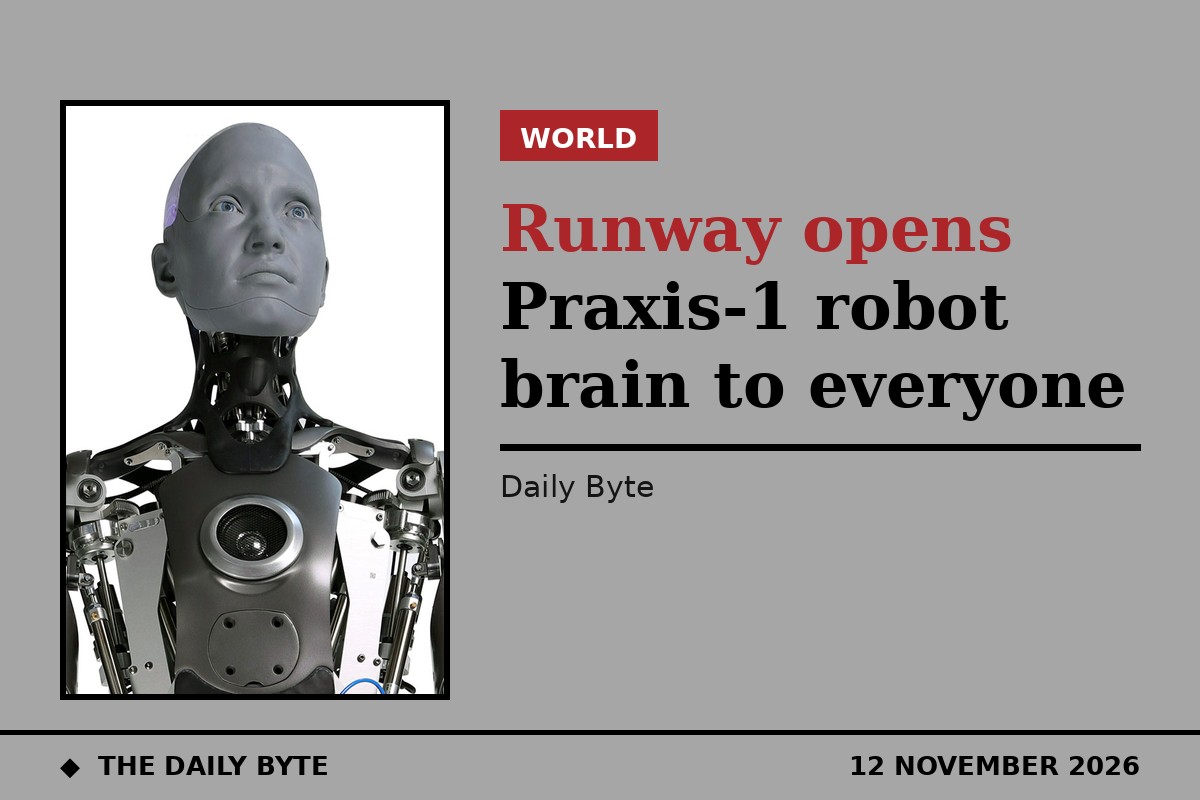
Runway has released Praxis-1, its robot control model, with open weights under the Apache 2.0 licence, allowing anyone to download it, run it on their own hardware, fine-tune it for their own robot and use it commercially. The company made the model generally available on 11 November 2026, after first introducing it in September and testing it with selected partners.
Praxis-1 is what Runway calls a world action model: a 27-billion-parameter mixture-of-experts diffusion transformer that predicts video and robot actions together. Instead of mapping a camera image directly to a motor command, the system predicts a short video clip of what should happen next and derives the robot's actions from that imagined future. Each call to the model produces 1.6 seconds of motion, 24 action rows at 15 Hz, in roughly half a second on a single H100 GPU, according to Runway's technical write-up.
What the release includes
The download is unusually complete for an open model. Three checkpoints are available: the base mid-trained model, a version fine-tuned on the DROID robot dataset, and one fine-tuned for the bimanual YAM robot. Alongside the weights come inference code and both full and LoRA fine-tuning code, on GitHub and Hugging Face with native support for the LeRobot robotics library, plus serving through vLLM-Omni and hosted inference on Runway's Reactor platform.
The full model is 54.4 GB in bfloat16 format and needs a single 80 GB GPU, while a 4-bit NVFP4 quantised version shrinks the weights to 17.5 GB. Runway says it runs out of the box across NVIDIA hardware, from H100 and B200 data-centre cards to RTX 5090 and RTX PRO 6000 workstation cards, and on the Jetson Thor computer that sits inside the robot itself.
The benchmark numbers, and their limits
Runway's headline number comes from RoboLab-120, NVIDIA's simulated benchmark of 120 tabletop manipulation tasks with 10 trials each. The DROID fine-tuned version of Praxis-1 completed 555 of 1,200 episodes, a 46.2 per cent success rate, ahead of FLUX 3 Action at 42.9 per cent. Runway says that is the best result among the listed world action models and open-source robot foundation models. Fine-tuned on Google's RT-1 robot, which it never saw in training, the model reached 80.0 per cent on SimplerEnv, against 52.4 per cent for the original RT-1 policy.
Two caveats belong next to those numbers. First, every figure so far is Runway's own, and no independent laboratory has reproduced the leaderboard result yet. Second, 46.2 per cent is a first-place finish that still means failing more than half the time, on simulated tabletop tasks rather than a factory floor. Three launch partners have already run the model on real machines: Noble Machines on a legged humanoid, Standard Bots on a six-axis industrial arm, and Ultra on a dual-arm warehouse robot.
A crowded week for robot models
Praxis-1 arrives in the middle of a crowded week for robot models. NVIDIA opened up its GR00T 2 model days earlier, and Google's Gemini Robotics 2.5 is already running on a Mercedes-Benz factory line. Runway's entry is the most permissive of the three, with full weights, fine-tuning code and a licence that allows commercial use. That openness matters because robot foundation models have so far mostly lived behind APIs or restrictive licences, limiting who can adapt them to new hardware.
Open weights do not automatically produce safe robot motion: a model that predicts plausible actions can still crush, drop or misjudge. The release gives researchers and builders the material to test, adapt and audit the model themselves, which is the point of an open release, but the responsibility for safe deployment stays with whoever puts it on a machine.
Sources: Runway and AI Frontier Post.