Russia Says Europe Has No Place at Ukraine Peace Talks
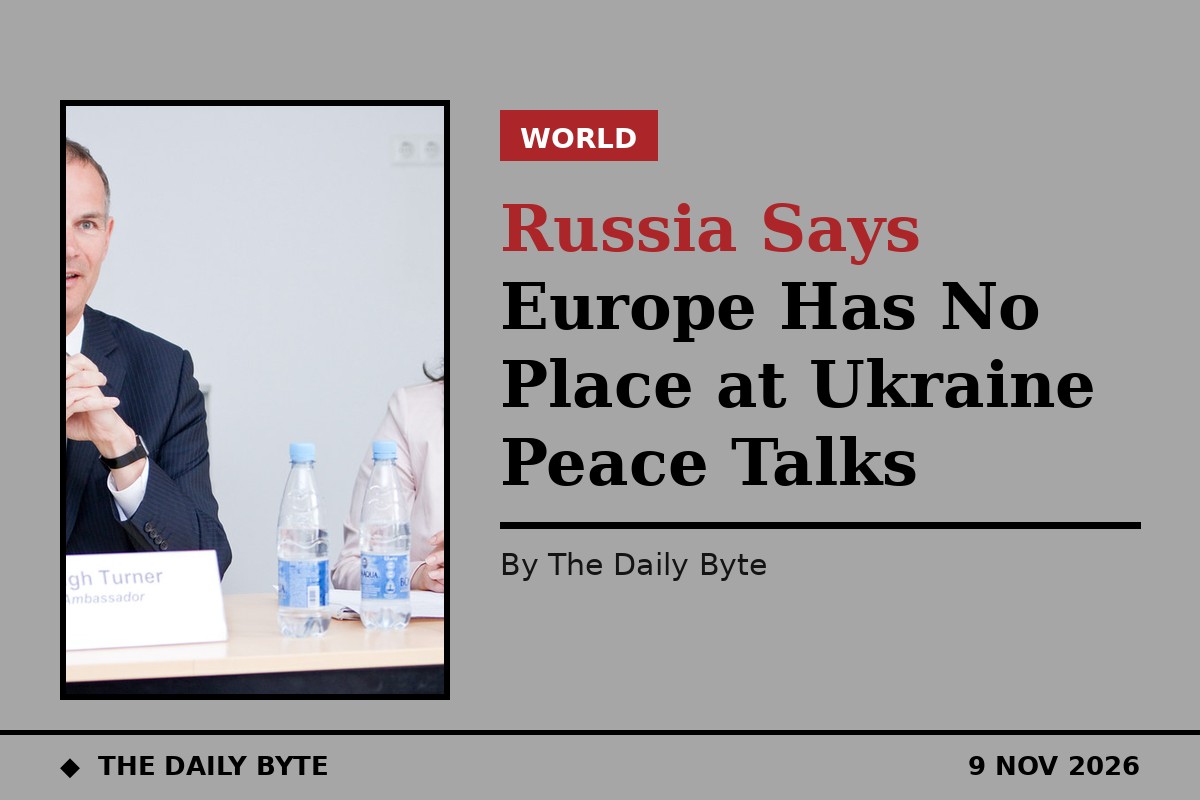
Russia has declared that European countries have no place at the negotiating table over Ukraine, days before Russian, Ukrainian and American envoys meet in Abu Dhabi for a new round of peace talks.
Foreign Ministry spokeswoman Maria Zakharova said the deployment of foreign armed contingents in Ukraine was categorically unacceptable, whether through the Coalition of the Willing or any other grouping, and warned that such forces would be treated as legitimate targets.
Her remarks, carried by the TASS news agency, were a response to the launch of Exercise Koalicja 26.2, a multinational military exercise that begins on 9 November and runs until 22 November at Nowa Dęba in south-eastern Poland.
The exercise behind the warning
About 2,800 troops from 11 countries will join roughly 2,000 Polish troops to rehearse the work of the Multinational Force Ukraine, a contingent that Britain and France want ready to deploy once the fighting ends and rebuilding begins.
Britain and France lead the force, with Poland providing the largest core contingent alongside them. Germany, Spain, Sweden, Estonia, Lithuania, the Netherlands and Belgium are also sending units, while Turkey has pledged to lead the maritime element without placing troops on the ground.
The participating governments stress that the force is not a NATO structure, would carry no peacekeeping or ceasefire-monitoring role, and could enter Ukraine only after hostilities end and only at the request of the government in Kyiv. American troops are not taking part in the exercise.
Europe shut out of Abu Dhabi
Zakharova accused London and Paris of seeking to keep a military foothold in Ukraine in order to confront Russia and inflict a defeat on it. She argued that staging the exercises on the eve of the Abu Dhabi consultations showed that European capitals had disqualified themselves from any seat at the table.
The talks, set for 10 and 11 November, were announced by American special envoy Steve Witkoff and cover security guarantees for post-war Ukraine, de-escalation and humanitarian questions. The Russian delegation will be led by presidential aide Vladimir Medinsky.
Moscow is insisting that the future of Ukraine be settled between Russia, Ukraine and the United States alone. That position sits awkwardly beside earlier remarks from the Kremlin itself: spokesman Dmitry Peskov has previously acknowledged that European representatives would eventually need to take part in discussions on security guarantees and the wider European security system.
France says Europe will be there
France has pushed back against the exclusion. French Foreign Minister Jean-Noël Barrot said on Sunday that Europeans would participate in the Abu Dhabi talks, telling RTL radio: “The Europeans will be well represented. France will be in Abu Dhabi to take part.” He did not say who would represent France.
US President Donald Trump said in an interview broadcast on Sunday that he believed the war would end soon and suggested Ukraine could emerge from a settlement with altered borders. On Thursday, he told reporters the war was close to being settled and that ending it might involve all of Europe.
US Secretary of State Marco Rubio said on Sunday that Trump was probably alluding to progress on security guarantees for Ukraine and Europe, and that advances had been made on what the post-war security architecture could look like. Trump envoy Jared Kushner said US officials held productive and substantive discussions with Ukraine, NATO and European partners in Brussels on Thursday about security guarantees and a broader European security architecture.
What happens next
The Abu Dhabi round is the first three-way meeting of Ukrainian, Russian and American negotiators since February. Whether European representatives attend in any formal capacity, and what role they play, remains unresolved, with France insisting it will be present and Russia insisting the format is trilateral only.
EU leaders are due to discuss on 13 November how the bloc should be represented at future peace talks, after Italian Prime Minister Giorgia Meloni criticised the lack of a single European approach.