Sánchez pledges pensions in constitution in Bilbao
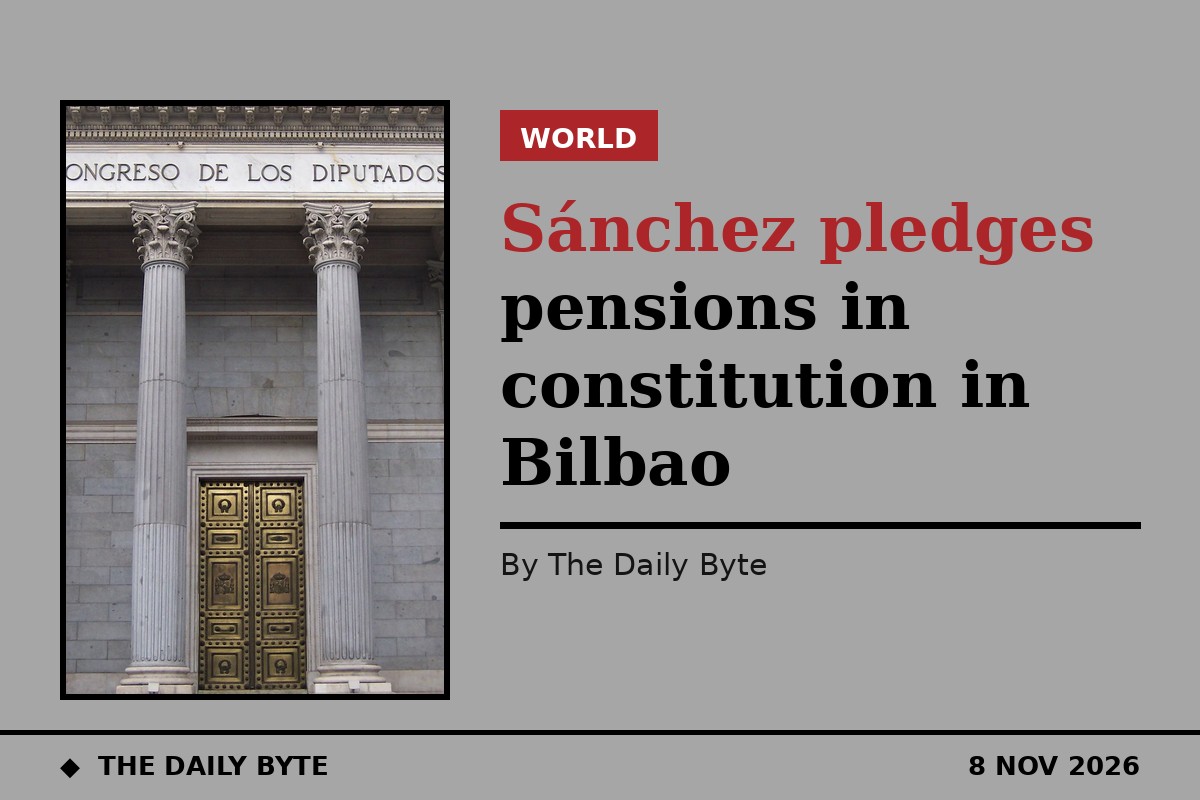
Spanish Prime Minister Pedro Sánchez resumed election campaigning on Sunday with a rally in Bilbao, where he promised to raise the minimum wage every year and to entrench the revaluation of pensions in the Constitution if his party wins the general election on 29 November.
Sánchez, the Socialist PSOE candidate for re-election, spoke at the Palacio Euskalduna in Bilbao before around 2,800 people, according to figures provided by the party. He called for people to vote “en masse” on 29 November and to back a progressive government for the next four years.
The event marked the resumption of Socialist pre-election activity after the party suspended its events following the rail accident in Urda, Toledo. Sánchez was accompanied by the general secretary of the Basque Socialists, Eneko Andueza, the Socialist spokesperson in Congress and lead candidate for Bizkaia, Patxi López, and Bilbao councillor Nora Abete.
Speaking under the slogan “The strength of the Country”, Sánchez described pensions as a solemn commitment. He said that, as long as he continues at La Moncloa, the government will increase the interprofessional minimum wage, known as the SMI, every year and will “lock in the Constitution” the updating of pensions. He also said a future Socialist government would entrench the right to abortion in the Constitution.
Sánchez presented the election as a choice between advancing social rights and going backwards. He argued that Spain had made progress on social rights while the economy grew, and said it would be possible to go “much further” in the next four years with a new progressive government, including on housing, healthcare, education and long-term care.
“I’m not asking for a simple majority; I’m asking for a broad and progressive majority in the next Parliament, to reach sooner and go further in social gains,” he told the rally, adding that the only border between progress and regression was the vote.
He warned that a government formed by the conservative PP and the far-right Vox party would mean, in his view, “reaction and cuts”. He also accused the two parties of listening only to businesspeople and of spreading claims that the public pension system is collapsing, a claim he rejected.
Sánchez directed criticism at PP leader Alberto Núñez Feijóo and Vox leader Santiago Abascal, questioning whether they would stand up to United States President Donald Trump. He said both men would accept the NATO commitment to raise defence spending to 5 per cent of gross domestic product, and argued that decisions about Spain should not be made in Washington, Tel Aviv, Buenos Aires or Moscow.
He also pointed to his government’s foreign policy positions, saying it had said no to the war in Iran, had described what is happening in Gaza as a genocide, and had refused to spend 5 per cent of the budget on defence so that it could keep paying for education. Those are the prime minister’s own characterisations of his government’s record.
Feijóo was also campaigning on Sunday, taking part in a meeting in Málaga with the president of Andalusia, Juanma Moreno. The two main blocs are contesting an election called early after Sánchez’s housing reform legislation collapsed in parliament at the start of October.
Polling published on Sunday put the PP ahead. An average of 11 polling institutes gave the PP 30.8 per cent, the PSOE 26.2 per cent and Vox 19.5 per cent. A separate IMOP poll for El Confidencial, conducted between 2 and 6 November, put the PP on 29.8 per cent and 126 seats, the PSOE on 25.9 per cent and 106 seats, and Vox on 19.9 per cent and 70 seats, with the PP and Vox together on 196 seats, above the 176 needed for an absolute majority.
For Sánchez, the Bilbao rally was therefore both a policy pitch and a mobilisation call. By choosing Bilbao, described in reports as the epicentre of pensioners’ protests, he placed pensions and the minimum wage at the centre of his campaign’s final three weeks, and asked voters to deliver the broad majority he says he needs to carry those promises through.