Satellites' Weakest Link Is on the Ground, Report Warns
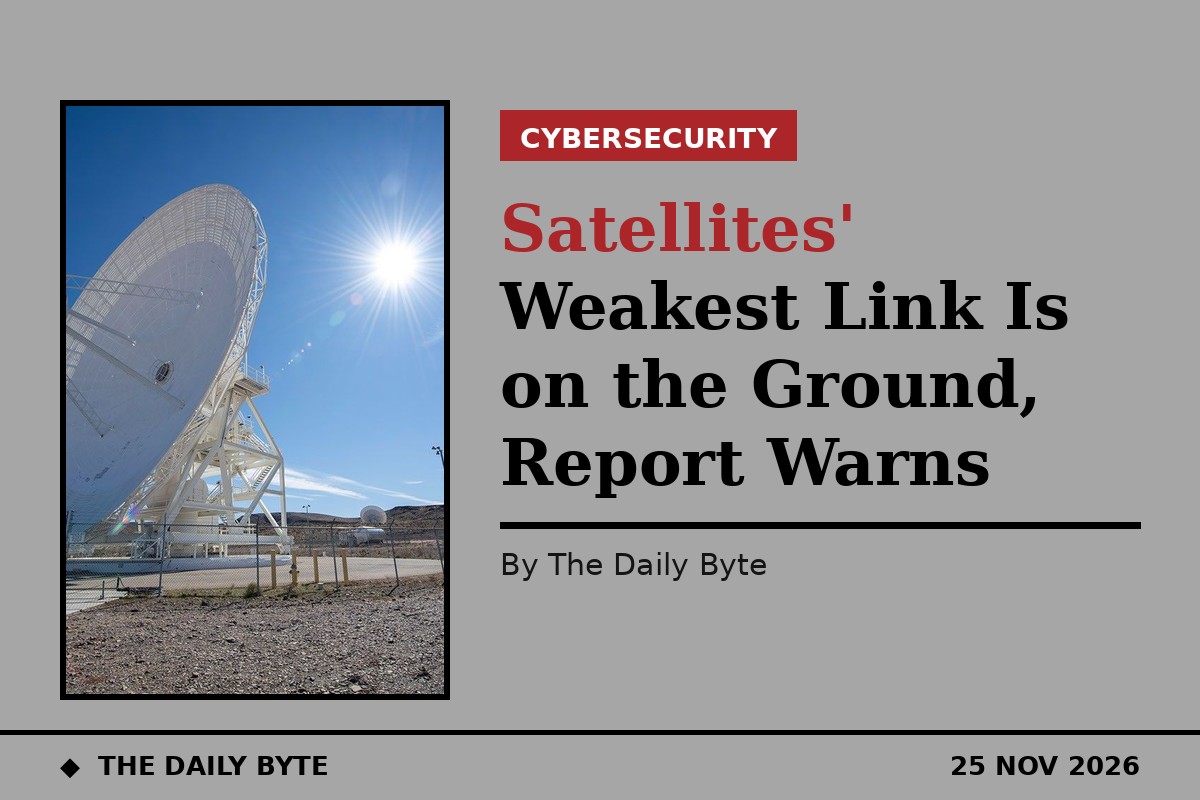
Attackers do not need to touch a satellite to knock out satellite services. The ground stations that command them, the terminals that connect to them and the vendors that supply them are the weak point, according to a new analysis by Recorded Future's Insikt Group, covered by Dark Reading on 24 November 2026.
The warning comes as the space economy grows fast. In 2025 alone, organisations and nations around the world placed 4,517 satellites in orbit, 87% of them commercially owned, contributing to a space economy reported at $686 billion. Satellite services now underpin communications, navigation, shipping and infrastructure monitoring — so the fallout from an attack that disrupts them keeps growing too.
The Viasat attack showed the pattern
The most consequential example came in February 2022, just before Russia invaded Ukraine. Russian attackers used a destructive, data-wiping malware known as AcidRain to disable tens of thousands of modems connected to Viasat's KA-SAT satellite broadband network, after first gaining access through a misconfigured VPN appliance on the ground. The disruption hit Ukrainian military communications as well as ordinary customers across Europe. In Germany, some 5,800 wind turbines lost their remote monitoring connections.
A similar pattern emerged in attacks against Iran's commercial shipping fleet in 2025, when a group calling itself Lab-Dookhtegan disabled communications aboard dozens of tankers and cargo vessels. The attackers reportedly entered through Fanava Group, an Iranian IT provider serving the fleet, gained administrator-level control of shipboard Linux systems, and used it to disable satellite communications software and the software used for tracking ship movements.
Recorded Future also pointed to an incident last August, in which an oil tanker lost communications for about 30 hours after attackers seemingly compromised the ship's onboard network. Investigators focused on the satellite terminals aboard the ship and the remote-maintenance systems connecting them to shore as possible points of entry.
Nobody touched anything in orbit
"In none of these cases did anyone touch an object in orbit. The attackers went for the vendor, the terminal, the management plane," Recorded Future said. "Every satellite has a terrestrial address: the ground stations that command it, the links that carry its telemetry, the user terminals at the edge, and the software supply chain behind it all. That is where attackers go, because that is where the doors are."
The report sits alongside research by teams at the University of California, San Diego, and the University of Maryland. Using a satellite dish costing just $800, the researchers found that roughly half of the geostationary satellites they could observe were transmitting data unencrypted. The exposed traffic included telecommunications backhaul, corporate communications and military data.
Governments are warning too
The US National Security Agency has also warned of the expanding attack surface created by the proliferation of low-Earth-orbit satellite networks. In a joint advisory with the Australian Signals Directorate and other partners, the NSA examined risks across the whole satellite communications ecosystem — satellites, ground stations, user terminals, radio links and third-party suppliers — from jamming, spoofing and interception to weaknesses in ground infrastructure and user equipment.
"The ground segment is highly exposed to cyber threats due to its extensive connectivity with terrestrial networks," the NSA and its partners warned. "Ground segments are typically the most interconnected and vulnerable points in a space system." The risks they highlighted included malware injection, social engineering, denial-of-service attacks, identity-based attacks and poor user practices.
What needs to change
The advisory recommended continuous monitoring of ground systems, stronger endpoint security and access controls, and safeguards such as frequency-hopping signals, backup communications paths and anti-jamming antennas. Recorded Future's own recommendations are to treat space infrastructure as critical national infrastructure, hold vendors to stronger security standards, and put in place basic measures such as encryption for satellite communication.
The stakes are only rising. The growing militarisation of space and the emergence of orbital AI data centres — such as the ones Google and SpaceX are exploring with Project Suncatcher and Starmind — add another layer of risk. As more of everyday life depends on services beamed down from orbit, the security of the unglamorous equipment on the ground matters as much as anything in space.
Frequently asked questions
Can hackers attack a satellite directly? In the incidents Recorded Future cites, they did not need to. Attackers reached satellite services through ground stations, misconfigured VPN appliances, IT providers and shipboard terminals — the terrestrial side of the system.
What was the Viasat AcidRain attack? A February 2022 attack in which Russian attackers used data-wiping AcidRain malware to disable tens of thousands of modems on Viasat's KA-SAT network, after entering through a misconfigured VPN appliance.
Is satellite traffic encrypted? Not always. University researchers using an $800 satellite dish found roughly half of the geostationary satellites they could observe were transmitting data unencrypted.