SBP Injects Rs13.54tr Into Banks in Liquidity Move
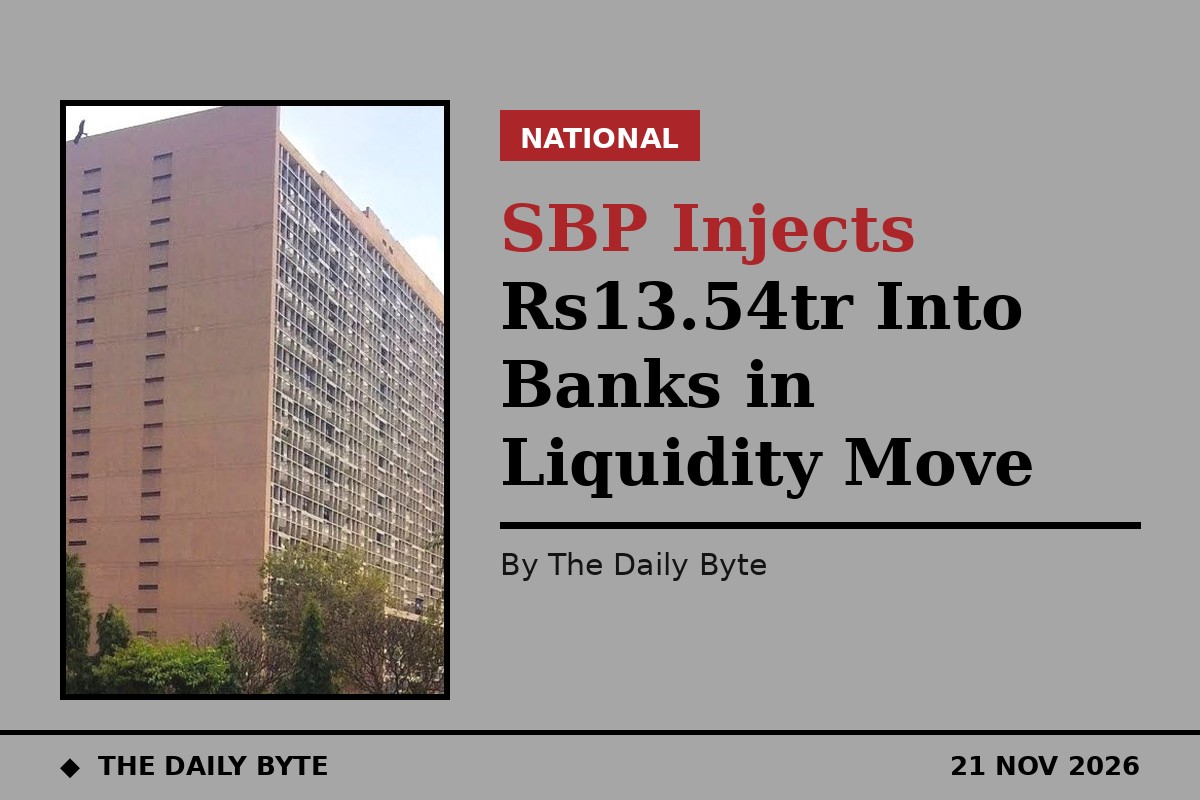
The State Bank of Pakistan injected Rs13.54 trillion into the banking system on Friday through conventional and Shariah-compliant open market operations, in one of the largest single-day liquidity operations of recent weeks.
The central bank conducted a reverse repo and Shariah-compliant Modarabah-based open market operation on 20 November, cumulatively injecting Rs13.54 trillion into the market. Of that total, Rs13.16 trillion was injected through the conventional reverse repo operation, while the remaining Rs388.1 billion came through the Modarabah-based operation.
Under the reverse repo operation, the State Bank accepted Rs756.4 billion for seven days and Rs12.4 trillion for 14 days. The accepted rate was 12.01 percent, with bids in the 14-day tenor ranging from 12.00 to 12.09 percent. The bank accepted Rs5,278.3 billion of the Rs5,711.3 billion offered at 12.01 percent on a pro-rata basis.
Under the Shariah-compliant Modarabah operation, the bank accepted Rs50 billion for seven days at 12.06 percent and Rs338.1 billion for 14 days at 12.04 percent.
What open market operations do
An open market operation is the tool the State Bank uses to inject funds into, or mop up funds from, the banking system according to its liquidity needs. In an injection, the central bank lends funds to banks and primary dealers against eligible collateral, such as Market Treasury Bills and Pakistan Investment Bonds, to address a shortage of liquidity.
The size of an injection reflects how much cash the banking system was short on the day, rather than a change in the policy stance. The policy rate stands at 12 percent, and the operation was priced just above it, with accepted rates between 12.01 and 12.06 percent across the two channels.
Banks face continuous changes in their cash positions as customers deposit and withdraw money and businesses settle payments. When funds run short, short-term borrowing costs can rise and interbank transactions can be disrupted. By supplying liquidity, the central bank aims to keep the overnight rate close to the policy rate and money market conditions orderly.
Why the scale matters
The Rs13.54 trillion injection is far larger than the roughly Rs1 trillion operation conducted a week earlier on 13 November, when the State Bank injected Rs1.02 trillion through the same two channels. The difference reflects the banking system’s funding needs on the day, which move with the calendar of government receipts and payments.
Market participants will now watch how banks use the funds and whether the injection keeps short-term rates steady in the coming days. The next operation will show whether Friday’s large shortfall was a one-day funding squeeze or the start of a tighter liquidity patch.