SBP Warns of Rs8 Billion Youth Loan Funding Gap
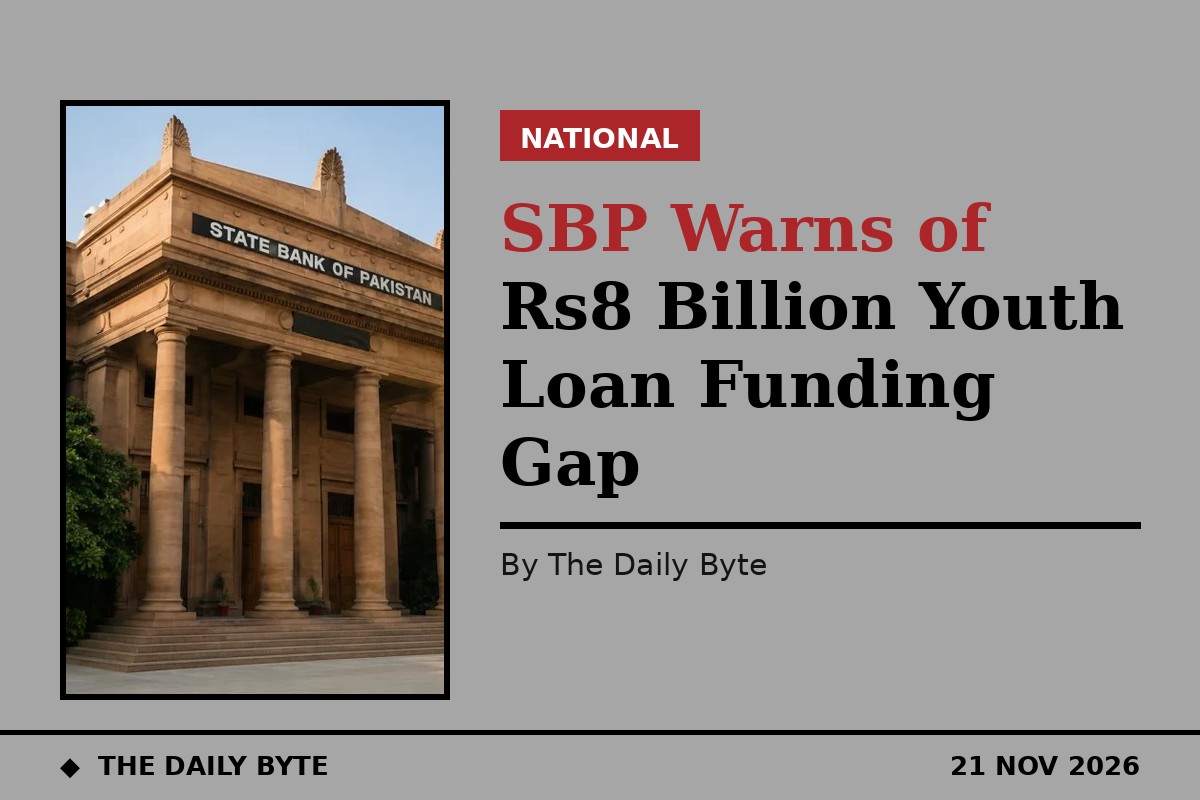
The State Bank of Pakistan has warned that the government's expanded youth loan programme may need an additional Rs8 billion in funding during fiscal year 2027, because the subsidy budget set aside for the scheme does not cover its estimated cost.
The warning, reported by ProPakistani, follows Prime Minister Shehbaz Sharif's approval of a Rs292 billion disbursement target for the Prime Minister's Youth Business and Agriculture Loan Scheme. That target exceeds the Rs288 billion distributed during the programme's first three years.
The government has also raised the maximum loan size under the scheme from Rs7.5 million to Rs25 million to accommodate larger businesses, a change that increases the subsidy the state must pay on every loan.
The subsidy maths behind the gap
According to the central bank, the subsidy requirement for the scheme is estimated at Rs38 billion, based on projected disbursements of Rs250 billion in the current fiscal year. The available budget allocation, however, stands at only Rs21 billion, leaving a substantial gap before the higher target is even counted.
The revised Rs292 billion disbursement target is expected to add roughly Rs8 billion to the subsidy requirement in FY27, putting further pressure on the scheme's financing arrangements.
The gap arises from how the scheme works. Borrowers pay a fixed, subsidised markup, while banks charge a market-linked rate. The government covers the difference, so every extra rupee lent at the top end adds to the state's subsidy bill.
New Tier 4 loans drive the expansion
The government recently added a Tier 4 category to the programme, allowing borrowers to obtain loans between Rs7.5 million and Rs25 million at a fixed interest rate of 8 percent. The category offers financing for up to eight years, including a grace period of up to one year, along with first-loss risk coverage of up to 10 percent on a portfolio basis.
Authorities plan to disburse Rs150 billion through this tier during FY27, more than half of the overall Rs292 billion target.
Alongside the expansion, the government reduced commercial banks' profit margins under the scheme by 0.6 percentage points, lowering the rate from KIBOR plus 3 percent to KIBOR plus 2.4 percent. The changes are intended to make larger loans more accessible to young entrepreneurs while keeping the cost of borrowing predictable.
What happens next
The State Bank's warning highlights the financial strain that comes with scaling up a flagship youth lending programme. The scheme is one of the government's main tools for youth employment and small-business growth, and demand for its loans has been strong since it began.
How the government addresses the subsidy shortfall in the coming budget cycle will be closely watched by banks, borrowers and policymakers alike. Options include finding additional funds, slowing disbursements, or revising the scheme's terms, but no decision has been announced.
For young applicants, the scheme itself remains open, with the higher Rs25 million ceiling and the new Tier 4 category in place. The funding question is about the cost to the exchequer, not about eligibility, and the central bank's warning is a signal to the finance ministry rather than a change to the terms on offer.