Supreme Court: Inheritance Rights Never Expire
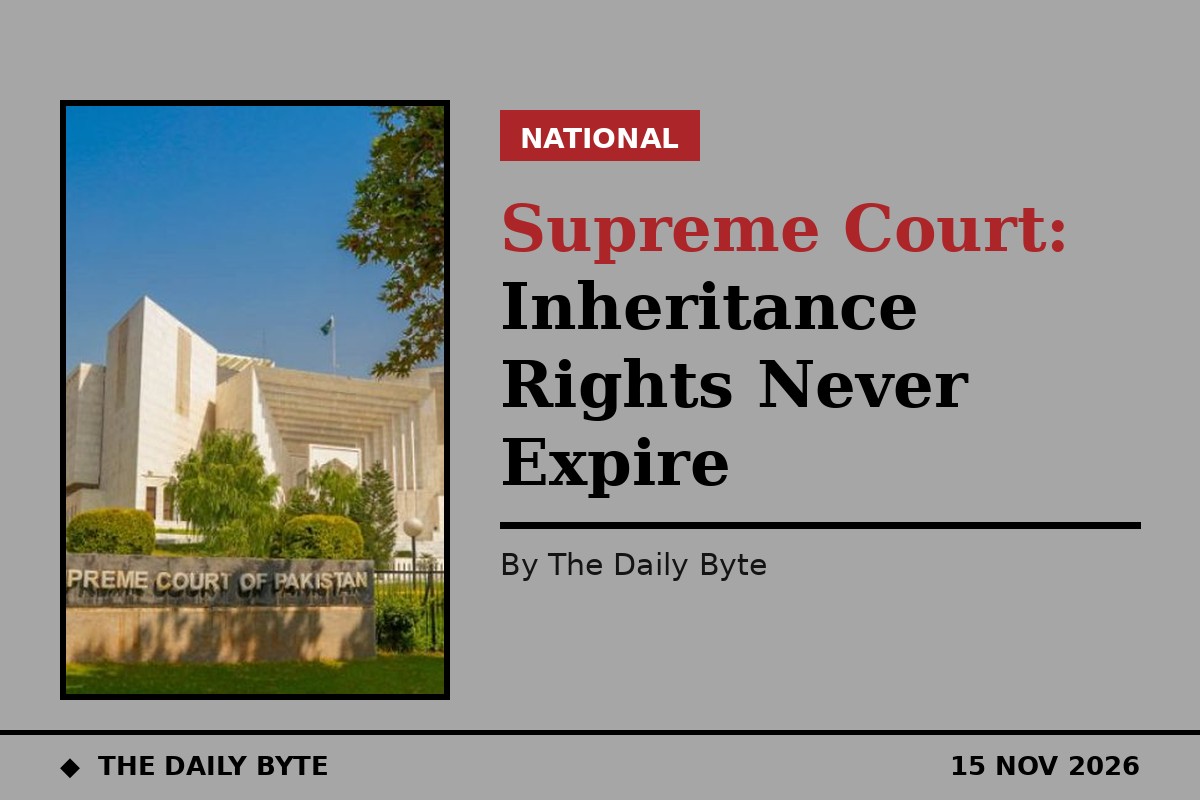
ISLAMABAD: The Supreme Court of Pakistan has ruled that an heir's right to inheritance never lapses merely because time has passed, in a landmark judgment that will reshape how property disputes are handled across the country.
A five-member larger bench headed by Justice Shahid Waheed announced the judgment on 13 November 2026. The bench also comprised Justice Naeem Akhtar Afghan, Justice Aqeel Ahmed Abbasi, Justice Shakeel Ahmed and Justice Miangul Hassan Aurangzeb. The 106-page judgment, authored by Justice Shahid Waheed, decided scores of appeals filed against a Peshawar High Court order dated 3 June 2013, led by Civil Appeal No. 909 of 2013.
Share vests at the moment of death
The court held that an inheritance share vests in the legal heir immediately upon the death of the property owner. It ruled that inheritance rights cannot be extinguished merely through silence, delay or an oral relinquishment.
The limitation period for filing an inheritance claim is six years under Article 120 of the Limitation Act, 1908, but the court settled when that clock starts: only from the date when the heir's right is clearly denied, and that denial is brought to the heir's knowledge.
“Time does not run against the heir; it runs against the heir's knowledge of a wrong,” the judgment said. “The share is nasiban mafrudan, an appointed share; the law of limitation may close the courtroom door upon a claimant who knowingly stays away, but it will never be used to lock out one who was never told the door was open.”
New safeguards for inheritance mutations
The court issued detailed directions to protect heirs, particularly women, from being quietly written out of family property. It directed that all provinces and other areas ensure no inheritance mutation is attested without a family registration record issued by the National Database and Registration Authority, or equivalent proof of all heirs; written notice to every heir shown in it, including female heirs at their own address; and a recorded statement of any heir said to have received less than his or her share.
Before attesting any gift, sale, relinquishment or settlement mutation by an heir in respect of inherited land, the revenue officer must record the heir's personal appearance and identity, and a statement that the heir was informed of the precise share. For a female heir, this must be recorded in the presence of a woman revenue officer where one is available.
Registering authorities, development authorities, cantonment boards and cooperative housing societies must not transfer property on the basis of inheritance except upon a succession certificate, letters of administration or a court decree, and must give written notice to all heirs before effecting the transfer. Settlement officers in areas under first settlement, including the merged tribal districts, must record all heirs according to Shariah and give them notice of objection proceedings.
Recommendations to Parliament
The court also commended to the legislature and the Law and Justice Commission of Pakistan that any relinquishment, settlement or takharuj of an inherited share be effected by a registered instrument executed after the heir is informed of the share, and that a specific article be added to the Limitation Act, 1908 for suits by heirs, fixing the period and its starting point by statute, together with an outer long-stop protecting a purchaser in good faith.
Trial courts, where limitation is pleaded in an inheritance suit, must frame the relevant issues, decide them on evidence and endeavour to decide such suits expeditiously, the court directed. Copies of the judgment have been sent to the secretary of the Ministry of Law and Justice, the law secretaries of all provinces, the Attorney-General for Pakistan, the advocates general of all provinces and the Islamabad Capital Territory, and the secretary of the Law and Justice Commission.
The ruling is expected to affect thousands of pending inheritance cases, many involving women and other vulnerable heirs who discover years later that their names were left out of revenue records. The News reported the judgment, and legal analysis published on 14 November confirmed the case reference and the bench's directions.