Sensex, Nifty fall as India CPI tops 6%
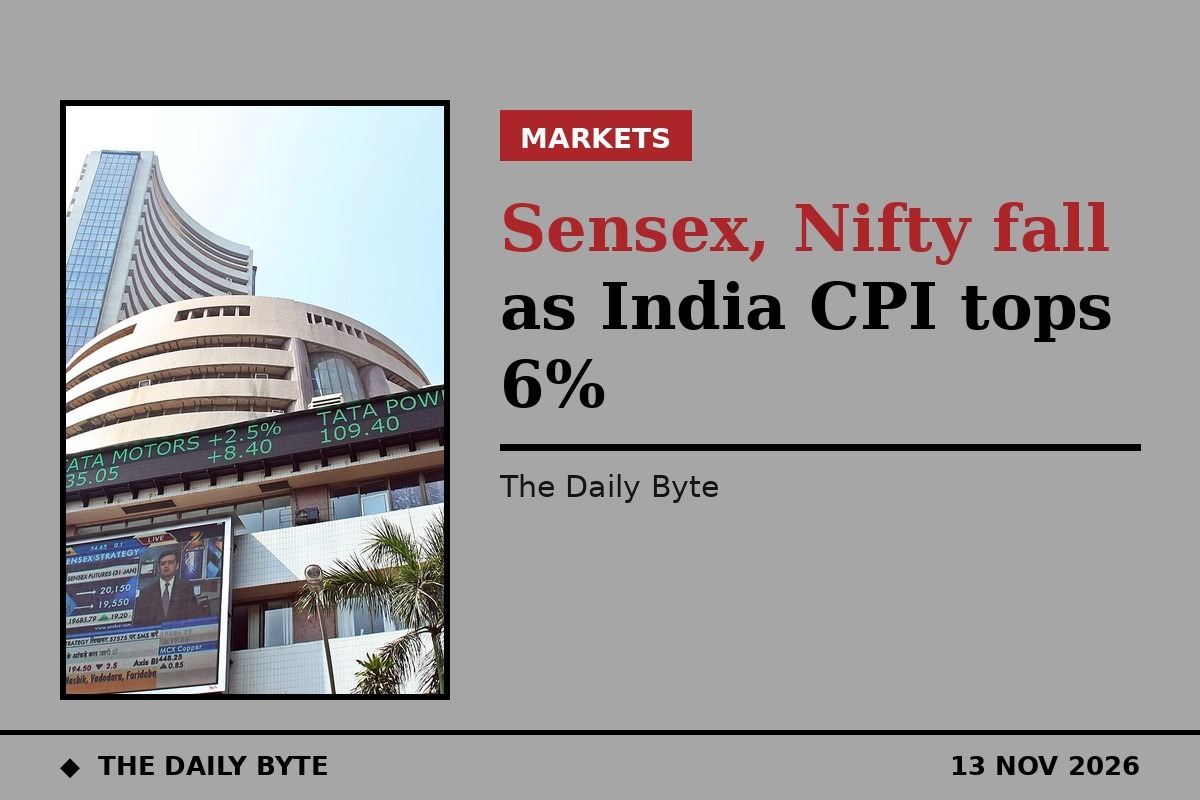
Indian shares opened lower on Friday, 13 November, as rising inflation and higher oil prices weighed on sentiment after a strong rally in November. The Sensex and the Nifty 50 both slipped in early trading, with banking and car stocks among the main drags.
The BSE Sensex opened at 81,833.78, down 77.23 points or 0.09%, while the NSE Nifty 50 opened at 25,209.85, down 89.50 points or 0.35%. Both indices fell further after the open. By late morning in Mumbai, the Sensex stood at 81,777.52, down 133.49 points, and the Nifty at 25,228.05, down 71.30 points, according to The Hindu BusinessLine's live market coverage.
The weakness followed a strong run. On Thursday, the Nifty closed at 25,299.35, up 0.18%, and the Sensex finished at 81,911.01, up 0.04%. The benchmarks have gained 1.1% so far this week, putting them on course for a third consecutive weekly rise, and the Nifty is up 9.7% so far in November, according to Geojit Investments.
Inflation breaches the RBI's 6% ceiling
The main domestic concern is inflation. India's retail inflation, measured by the consumer price index, accelerated to 6.09% in October, up from 5.54% in September, breaching the Reserve Bank of India's upper tolerance limit of 6%. It is the highest reading in two years, with food inflation at 8.94%.
The reading has raised expectations that the central bank may have to tighten monetary policy. V. K. Vijayakumar, chief investment strategist at Geojit Investments, said the Reserve Bank would have to raise rates by at least 25 basis points each in December and February, and warned that rising inflation in India and the United States pointed to a higher interest-rate environment that could prove adverse for equities.
Higher crude oil prices added to the pressure. Brent crude traded at about $95.39 a barrel on Friday morning, up from about $92 at the close of Indian trading on Thursday, as attacks on Saudi energy infrastructure and shipping disruption through the Strait of Hormuz threatened global oil flows.
Foreign buying continues despite the dip
One factor still supporting the market is foreign buying. Foreign investors made net purchases of 78.31 billion rupees, about $832.71 million, in Indian equities on Thursday, provisional data showed. That was their ninth consecutive session of net buying, and November inflows have already reached $8 billion, the highest monthly tally since December 2020.
Vijayakumar said the aggressive return of foreign investors had been the most important trigger for the swift rally, and that buying could continue, taking monthly inflows above 1 lakh crore rupees, which would be a record. He added that with buying of that scale, sellers would struggle to push the market down.
The selling on Friday was broad-based. The Nifty 100 fell 0.34%, the Nifty Midcap 100 declined 0.31% and the Nifty Smallcap 100 lost 0.17% in early trading. Among sectors, the Nifty Auto index fell 0.38%, metals lost 0.56%, private banks were down 0.41% and information technology slipped 0.25%. Mahindra & Mahindra and HDFC Bank were among the leading losers on the Sensex.
Global markets mixed
Other Asian markets were mixed on Friday. Japan's Nikkei 225 traded at 61,390, up 0.94%, Taiwan's weighted index jumped 1.80% to 43,955 and Singapore's Straits Times gained 0.29%, while Hong Kong's Hang Seng fell 0.90% to 23,792 and South Korea's Kospi was flat at 5,334.
Wall Street also ended Thursday lower, with the Dow Jones Industrial Average down 0.36%, the S&P 500 down 0.35% and the Nasdaq Composite down 0.39%. Investors are now watching the US producer price index, due later on Friday, for further clues on inflation and the Federal Reserve's next move, after hotter-than-expected US consumer prices reinforced expectations of a rate rise in December.