Shehbaz Unveils Rs400bn Tax Relief and EV Push
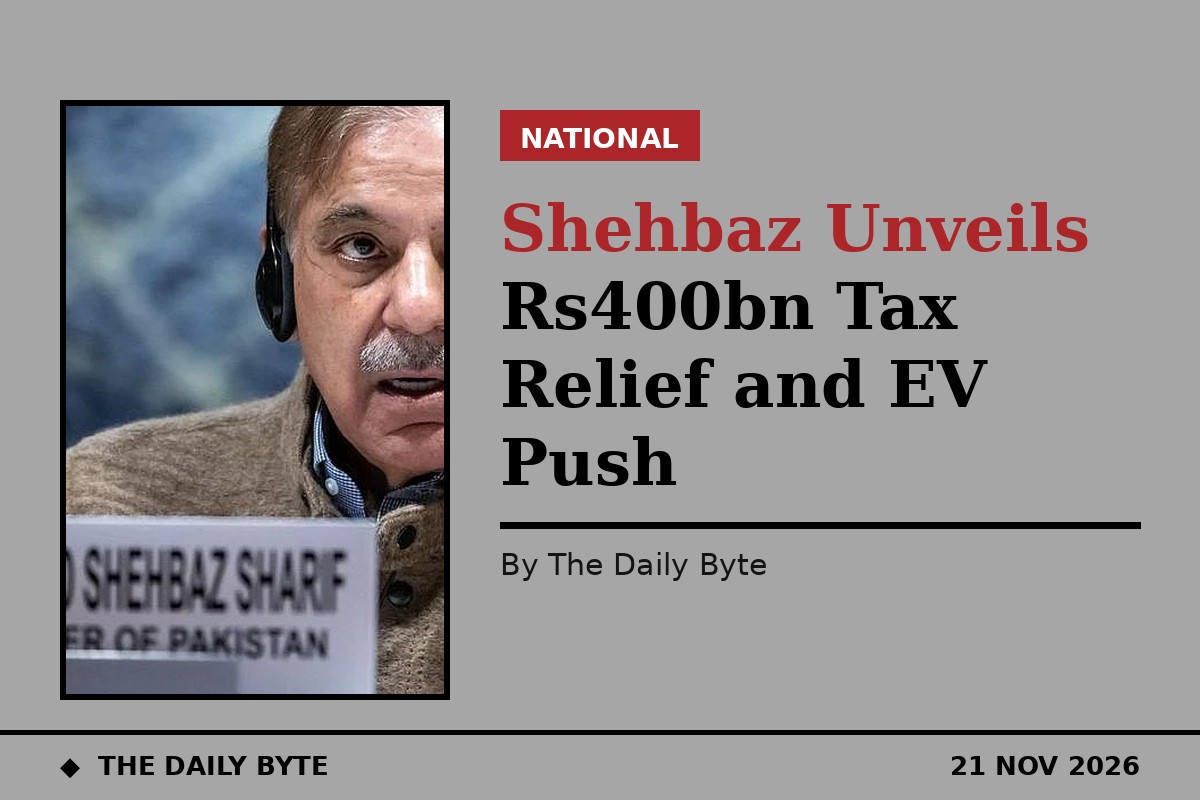
Prime Minister Shehbaz Sharif has announced Rs400 billion in tax relief and a policy push towards electric vehicles, telling American investors in Islamabad that Pakistan's economic growth must now be driven by exports. He was speaking on Thursday at a gathering of the Pakistan-American Business Council, where he set out the government's case that stability has been restored and that the next task is to turn that stability into trade and investment.
"It has to be export-led, nothing else, export-led growth," the prime minister said, adding that his government was determined to consolidate the gains of the past two and a half years and to build an investor-friendly environment. He said the government had spent four months working with the finance, industries and commerce ministries before deciding to promote electric vehicles and discourage conventional petrol and diesel cars.
What the prime minister announced
The Rs400 billion in tax relief was provided through the current budget, and the prime minister said the International Monetary Fund had agreed to allow the relief because of the government's disciplined economic management. The relief is aimed at exporters, manufacturers, the corporate sector and salaried individuals, and is intended to stimulate business activity.
Alongside the tax relief, the government has put Rs4 billion into the Export-Import Bank of Pakistan so that it can offer subsidised financing to exporters. The Export Development Fund has also been reformed, with private-sector entrepreneur Omar Saeed appointed to lead it.
On vehicles, the prime minister said the government wants to encourage electric vehicles and discourage internal combustion engine vehicles, after extensive consultation across ministries. The reason is straightforward: Pakistan imports more than 90 per cent of its energy requirements, so cutting fuel imports would save foreign exchange and reduce exposure to global oil prices. He also criticised the automobile industry, saying it had achieved only about 50 per cent localisation despite decades of protection and incentives, against a promised target of 80 per cent.
The economic picture he presented
Shehbaz Sharif told the gathering that foreign exchange reserves had reached about 27 billion dollars, including central and commercial bank holdings, compared with the position in 2023 when the country faced a serious threat of default. Inflation, which had reached about 32 per cent, has fallen to about 11.5 per cent, while the policy interest rate has been cut from about 23.5 per cent to 12 per cent.
He credited the improvement to close cooperation between the political leadership and the military, describing it as a productive partnership and sharing credit with his economic team and Chief of Army Staff Field Marshal Asim Munir. He said the partnership had helped Pakistan avoid default and navigate a difficult period that included disruption linked to the Gulf crisis, and he acknowledged the sacrifices made by the public, particularly vulnerable groups, during the adjustment.
The prime minister also pointed to governance changes, including the dissolution of the Pakistan Public Works Department and a shift from subsidised food distribution to direct digital cash transfers, with Rs27 billion disbursed through digital transactions during the current year. He said he personally reviews the implementation of key economic decisions with his team every week.
What American businesses bring
Pakistan-American Business Council president Adnan Asad told the gathering that about 80 American companies were represented, including 60 council members and 20 prospective members. Together, he said, the companies generated cumulative revenue of about Rs956 billion and invested more than Rs74 billion over the past five years.
The companies directly employ about 96,000 people and indirectly support nearly two million jobs across Pakistan, according to the council. They reinvested Rs32 billion during the past two years, recorded exports of about 123 million dollars, and contributed about Rs185 billion to the national exchequer. Their community work includes planting more than 500 million trees, supporting 12 million patients through healthcare programmes, providing food assistance to 15 million people during flood relief, and funding scholarships for about 300,000 students, with combined community spending approaching Rs3 billion.
Trade with the United States
On trade, the prime minister said Pakistan was exploring increased imports of American agricultural products, including soybeans, while seeking wider access in the United States for Pakistani surgical instruments, sports goods and other manufactured products. He assured American investors that the government would address their genuine grievances and remove bureaucratic hurdles, red tape and procedural delays that discourage investment.
He identified agriculture, livestock, information technology, artificial intelligence, minerals and industry as the major investment opportunities, and stressed vocational and technical training so that Pakistan's young population can gain marketable skills. The message to the room was that the government sees its role as facilitating business rather than running commercial activity itself, and that private enterprise should now drive growth.