Singapore Haze Cost S$2.32 Billion, Worse Than 2015 Crisis
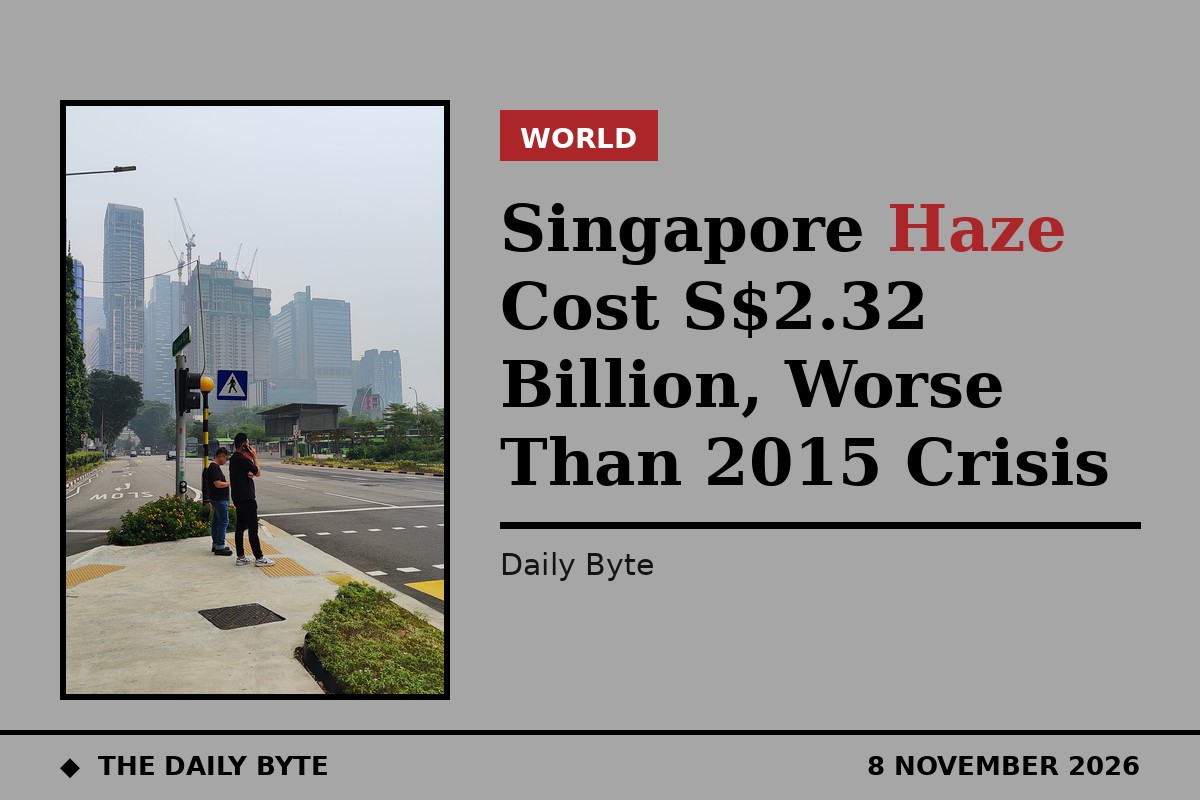
Singapore's 2026 haze episode caused an estimated S$2.32 billion in damage as at 31 October, passing the cost of the 2015 crisis once inflation is taken into account, economists at NTU and the Singapore University of Social Sciences said in a preliminary assessment.
The figure, calculated by NTU Professor Euston Quah and SUSS academic Dr Eugene Or, is about 4 per cent above the 2015 total of S$2.23 billion in September 2026 prices. The 2015 episode cost S$1.83 billion then. The increase came despite fewer hazy days and lower average pollution readings.
Health and tourism losses were higher than in 2015, while time lost to illness and spending on masks fell. The assessment covers medical treatment, health risks, lost visitor spending, time lost to illness, protective purchases and reduced public well-being.
The researchers attributed the higher bill to a larger population, higher incomes, increased visitor spending and updated health data. More people are exposed, higher earnings raise the value of lost time, and higher visitor spending raises the value at risk.
In Indonesia, where many of the fires burned, the burden was stark. Its Ministry of Health recorded 401,586 acute respiratory infection cases across seven affected provinces by 2 November, including 179,617 cases among children aged nine and younger. Haze also disrupted 2,604 domestic flights in Indonesia and 14 international services involving Singapore.
On 27 October Singapore and Indonesia agreed a joint task force to investigate companies suspected of contributing to the haze, and Singapore announced plans on 28 October to strengthen its Transboundary Haze Pollution Act. Quah and Or argue affected countries should help fund fire-free practices in Indonesia where that costs less than the damage avoided. Eco-Business reported in October that an earlier projection based on Quah's work put the full-season cost at S$3.2-3.9 billion.