Singles' Day sales rise 4.8% to 1.78 trillion yuan
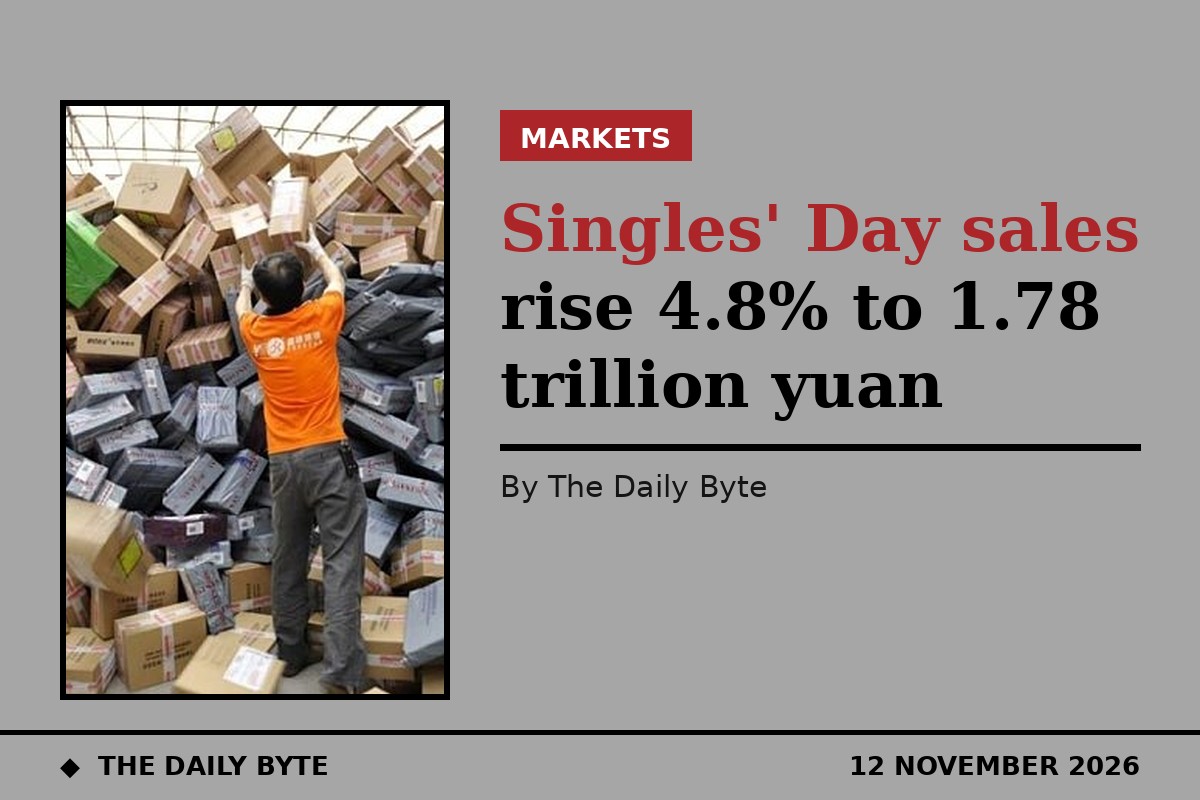
Sales during China's Singles' Day shopping festival rose 4.8% from a year earlier to 1.78 trillion yuan ($267 billion), data provider Syntun said on Thursday, as e-commerce platforms leaned on artificial intelligence chatbots to sell AI gadgets and discounted goods. The figure covers sales across the major platforms during the promotion period from 7 October to 11 November, and it is one of the few independent measures of spending during the world's largest online shopping event.
The result is a clear slowdown from last year, when the festival grew 14.2% and reached a record of almost 1.7 trillion yuan. It is also only modestly ahead of the 1.1% growth in China's overall retail sales during the first nine months of 2026, underlining how cautious Chinese consumers remain despite weeks of discounts, subsidies and livestreamed promotions.
AI shopping assistants take a larger role
Artificial intelligence was the defining theme of this year's festival. Alibaba's Taobao and Tmall platforms offered AI-driven product research, virtual clothing try-ons and tools that hunt for discounts, while JD.com said its Dongdong shopping assistant attracted almost 80 million users during the campaign. On Douyin, the short-video and social commerce platform, about 5% of purchases made in October came through chatbot links, according to data from WPIC Marketing and Technologies.
The AI push also showed up in what shoppers actually bought. JD.com said it sold more than 50 million AI-related products and generated more than 300 million service orders during the promotional period. Transaction values for AI PCs, AI workstations, AI cameras, AI glasses and AI recording devices more than doubled from a year earlier, the company said, while searches for "token" rose more than 13-fold and sales of large-language-model token packages increased more than tenfold.
Alibaba reported that sales of AI toys on its platforms passed 100 million yuan within about a year of the category being created, and that sales of AI companion robots were almost five times higher in the second half of October than in the same period last year. From 15 to 27 October, 333 brands that had been launched for no more than three years ranked first in their specialised categories, including AI companion robot maker Fuzozo and smart-sleep company Eight Sleep.
Growth slows as shoppers stay cautious
The festival unfolded against a backdrop of subdued consumer confidence, with a prolonged property downturn, weak income expectations and job insecurity weighing on household spending. Early data had pointed to a muted outcome: Syntun put sales growth at 2.4% between 7 and 31 October, and the final figure confirms that the closing days of the campaign lifted the total only modestly.
Beijing-based independent technology analyst Liu Xingliang said Singles' Day was "not as lively as it used to be", noting that promotions now run throughout the year. "When a sales event is spread over several weeks, the sense that 'I have to grab deals tonight' fades," he said.
Alibaba, which created the event in 2009, and JD.com no longer publish headline sales totals for the festival, instead highlighting performance in selected categories, brands and user numbers. That leaves Syntun's estimate as the main yardstick for the whole event, which has grown from a one-day promotion into a weeks-long season of subsidies, low prices, livestreaming and AI-enabled shopping.
What the result means for China's consumer economy
The 4.8% rise is better than the near-flat picture suggested by the early data, but it still falls well short of last year's 14.2% jump, which was flattered by a longer festival. With retail sales growing just 1.1% in the year to September, the festival's modest gain suggests that even the country's biggest shopping event is struggling to unlock spending while households remain wary.
For Alibaba, JD.com and PDD Holdings, the lesson of this year's festival may be less about the headline total than about where the growth came from. AI assistants, AI devices and AI tokens were among the fastest-growing categories, pointing to a shift in how Chinese shoppers discover and buy products, even as overall spending stays restrained. At the prevailing exchange rate of 6.6703 yuan to the dollar, the festival's 1.78 trillion yuan total is worth about $267 billion.