Rs60bn 'laundered' through solar panel imports, Senate told
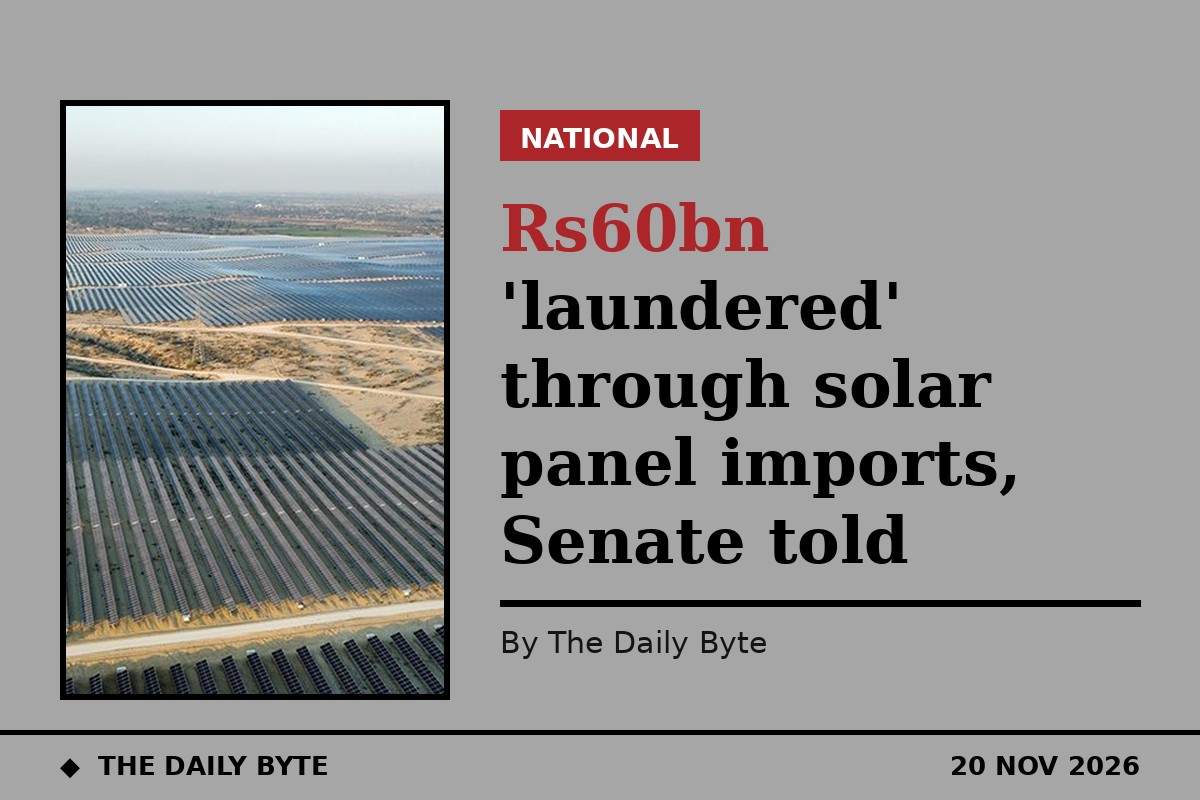
Up to Rs60 billion was allegedly laundered through solar panel imports in Pakistan, with commercial banks used to transfer the illicit funds, the chairman of the country’s anti-money laundering authority told a Senate committee.
Mushtaq Sukhera, chairman of the National Anti-Money Laundering and Counter-Terrorism Authority (NAML&CTA), briefed the Senate Standing Committee on Cabinet Secretariat at Parliament House on Wednesday. He said bank managers were involved in facilitating suspicious transactions in some cases, and described commercial banks as “conveyor belts” for money laundering.
Rs12bn in a driver’s account
Committee chairman Senator Rana Mahmoodul Hassan questioned weaknesses in banks’ Know Your Customer (KYC) procedures, asking how large amounts could be deposited without proper verification of account holders’ financial backgrounds and sources of income.
Sukhera cited a striking example in which Rs12 billion was traced to the bank account of a bulldozer driver. He recommended that banks report transactions in which a customer withdraws an account’s entire balance in a single move. The committee also noted that funds involved in the Kohistan scandal had been transferred through local banks, and that scrutiny of mobile wallet transactions had been tightened because of the misuse of SIM cards to operate bank accounts.
SBP governor summoned
The committee decided to summon the governor of the State Bank of Pakistan (SBP), Jameel Ahmad, to its next meeting to discuss the matter, and indicated that the issue could be taken up jointly with the Senate Finance Committee. It also asked NAML&CTA to present a comprehensive report on proposed anti-money laundering and fraud prevention reforms.
The panel sought detailed explanations of how banking employees who knowingly disregard KYC requirements are held accountable. The session also covered dual nationality among civil servants, provincial employment quotas and procurement for next year’s Shanghai Cooperation Organisation summit.
A familiar pattern
Solar panels have been under the lens of investigators for some years. Pakistan allows their import free of customs duty and sales tax, and the Federal Board of Revenue (FBR) has itself termed the item high-risk for trade-based money laundering because of that exemption.
The FBR started an audit of solar importers in October 2022 and detected over-invoicing of Rs69.5 billion in 6,232 goods declarations of 63 importers during 2017 to 2022. A Senate finance sub-committee was told in January 2025 that two firms, Bright Star Business Solution and Moonlight Traders, had sent Rs72.83 billion out of the country against solar imports, and tax authorities registered cases against both. The State Bank fined Askari Bank Rs40 million and Dubai Islamic Bank Rs27 million for not reporting the irregularities in time. Pakistan this year assured the International Monetary Fund of action in the case.
Wednesday’s proceedings did not clarify whether the Rs60 billion figure quoted by Sukhera includes the earlier FBR detection, and no figure for recovery was given. No court has decided on the allegation so far, and the committee’s discussions do not establish criminal wrongdoing by any specific bank or individual.