South Africa Citrus Exports Fall as Iran War Hits Trade
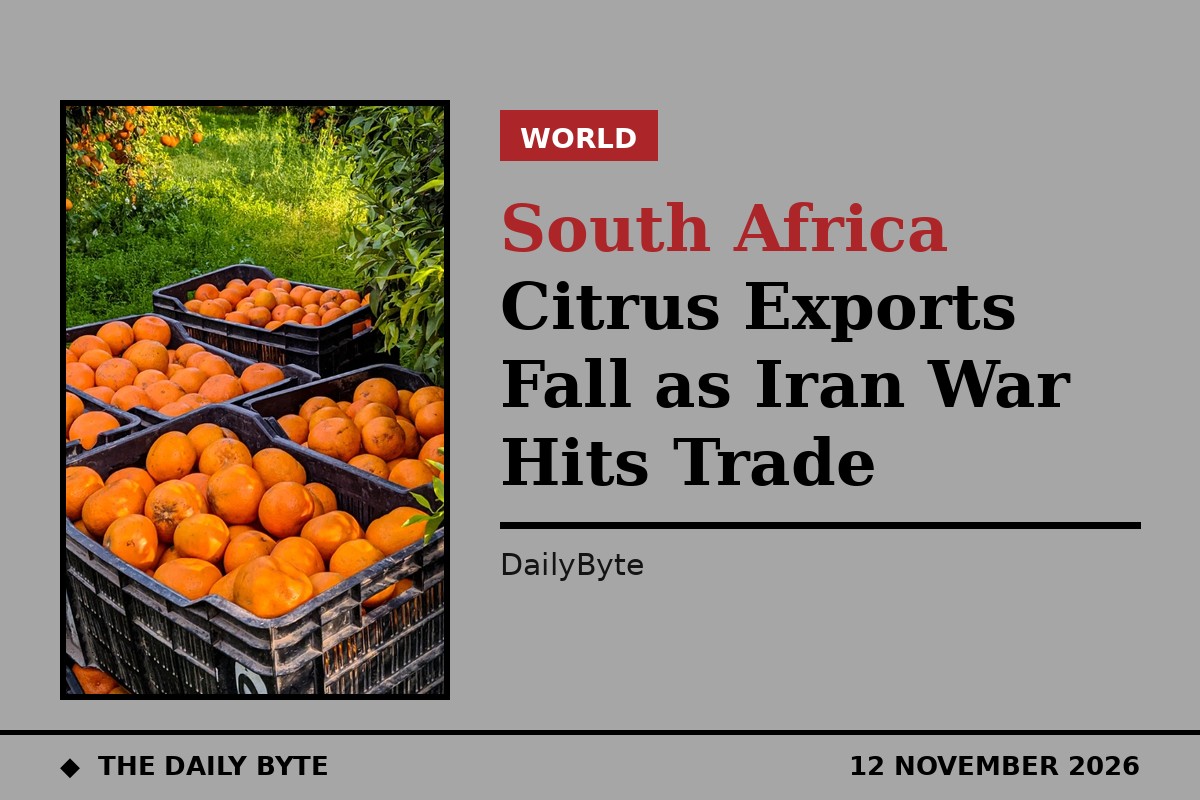
South Africa’s citrus exports fell 1.5% in 2026 as the war with Iran disrupted access to key markets and bad weather damaged production, the country’s growers’ association said on Thursday. Growers exported 201 million cartons in the 2026 season, down from 204 million cartons shipped in 2025, Reuters reported, citing the Citrus Growers’ Association of Southern Africa (CGA).
The Middle East typically takes about a fifth of South Africa’s citrus exports, and exporters struggled to reach the region amid a container shortage caused by the conflict. Flooding across the Western and Eastern Cape also destroyed some orchards in key producing regions, adding to the season’s losses.
A season of downgrades
The final figure caps a year of repeated cuts to the forecast. The CGA began the season expecting 209.4 million cartons, then revised the estimate down several times as trade routes closed and weather took its toll. By the end of week 43, packers had handled about 201 million 15kg cartons, compared with 203.5 million at the same point in 2025, according to industry figures reported by Farmers Magazine.
The pain was not spread evenly across varieties. Lemons were a bright spot, with 51 million cartons packed in 2026 against 41.4 million in 2025. But navel oranges fell to 25.2 million cartons from 31.5 million, mandarins slipped to 50.7 million from 53.5 million, and Valencia oranges dropped to 58.8 million from 61.8 million. Grapefruit volumes were broadly unchanged at 15.3 million cartons.
Why citrus matters to South Africa
South Africa is the world’s second-largest citrus exporter by value after Spain, and citrus is the country’s biggest agricultural export, earning 44.9 billion rand ($2.7 billion) in 2025. The industry supports thousands of jobs in the Western and Eastern Cape and in Limpopo, and its counter-seasonal supply — fruit shipped while northern hemisphere orchards are out of season — is a core strength.
The CGA set up a Middle East crisis committee earlier in the year to manage the disruption, and it has been pressing the government for better access to alternative markets. The association has identified the European Union, the United States, China, India and Japan among the markets where improved protocols or tariff terms could help growers sell more fruit.
What comes next
Growers will now look to the 2027 season and to the CGA Citrus Summit, scheduled for 9 to 11 March 2027, where the industry’s response to the trade disruption is expected to be high on the agenda. For this year, though, the message from the association is sober: a war thousands of kilometres away, combined with floods at home, was enough to shrink one of South Africa’s flagship export industries.