South Africa mining output falls 10.7% in September
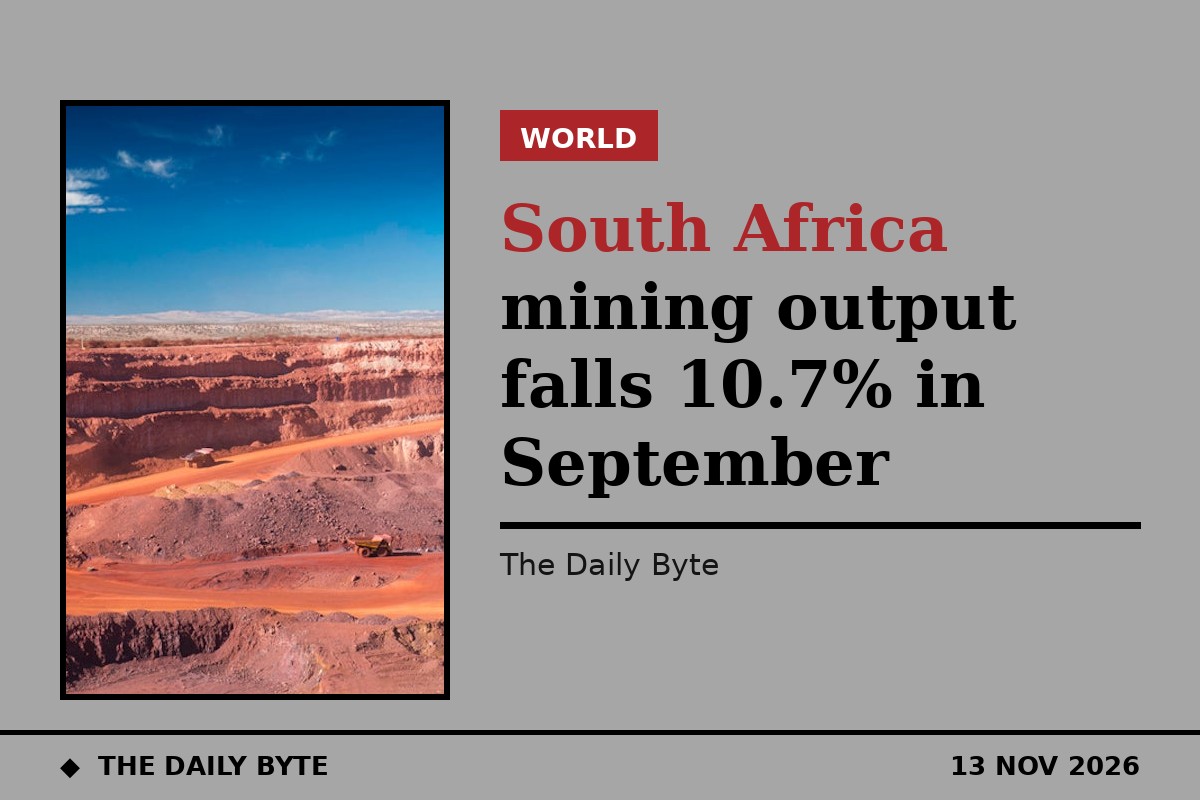
South Africa’s mining production fell by 10.7 per cent year on year in September 2026, Statistics South Africa said on Thursday 12 November, marking a fifth consecutive annual contraction and the steepest fall since October 2022. The decline followed a revised 11.7 per cent contraction in August and a 6.9 per cent fall in July, showing that the sector’s weakness deepened as the third quarter progressed.
Iron ore was the largest drag on the headline figure, with production down 23.7 per cent and subtracting 3.4 percentage points from overall output. Coal production fell 13.4 per cent, contributing a further 3.3 percentage points to the decline, while platinum group metals dropped 9.9 per cent and diamonds plunged 63.1 per cent, the sharpest fall of any commodity. Ten of the 12 mining divisions recorded lower production, pointing to broad-based weakness across the sector. The exceptions were chromium ore, up 13.1 per cent, and manganese ore, up 12.8 per cent.
Quarterly picture points to weaker GDP
On a seasonally adjusted basis, mining production rose 2.8 per cent in September compared with August, after declines of 4.8 per cent in August and 2.1 per cent in July. But the quarterly picture was far weaker: seasonally adjusted output fell 6.0 per cent in the third quarter of 2026 compared with the second quarter. Platinum group metals were the largest drag over the quarter, down 12.5 per cent, followed by iron ore, down 6.5 per cent, and coal, down 3.5 per cent. Investec economist Lara Hodes said the quarterly contraction, the measure used to calculate GDP, is expected to detract from the third quarter’s headline growth reading.
Mineral sales also weakened. Sales at current prices fell 4.1 per cent year on year in September, with iron ore sales down 23.1 per cent, platinum group metals down 7.0 per cent and gold down 4.5 per cent. Gold production itself slipped 7.5 per cent over the year, its third consecutive monthly decline.
Weakness runs through the year so far
The year-to-date figures show the downturn is not a one-month event. Mining production contracted by 2.2 per cent between January and September. Diamonds recorded the sharpest decline over that period, down 24.5 per cent, followed by copper, down 16.9 per cent, iron ore, down 9.9 per cent, and coal, down 7.7 per cent. Chromium ore and manganese ore were the bright spots, growing 16.7 per cent and 12.6 per cent respectively, while platinum group metals and gold production rose 1.6 per cent and 0.6 per cent over the nine months.
Economists warned that the pressure is unlikely to ease soon. Thanda Sithole, senior economist at FNB and WesBank, said mining output remained under significant pressure towards the end of the third quarter and that the near-term outlook remained challenging, with weak production momentum likely to persist amid infrastructure constraints, elevated operating costs and an uncertain global environment. He pointed to higher fuel prices, electricity tariffs and continuing rail and port inefficiencies, which make it harder and more expensive to move commodities to export markets.
Power supply remains a central constraint. Eskom’s average energy availability factor fell to 69.7 per cent in September, from 71.2 per cent in August, indicating weaker generation performance. According to the Minerals Council South Africa, electricity accounts for about 4.6 per cent of total mining input costs. Hodes said reliable and competitively priced electricity would remain critical to expanding production and beneficiation in the sector.
Sithole said a sustained improvement in mining activity would require more than favourable commodity prices. Addressing structural constraints in electricity supply and transport logistics, alongside improving operational efficiency and investing in mining capacity, would be critical to restoring production growth, he said. For now, the data point to a sector still shrinking, and to a drag on South Africa’s growth at a time when the economy can ill afford one.