South Korea's Lee backs hostile takeovers to lift stocks
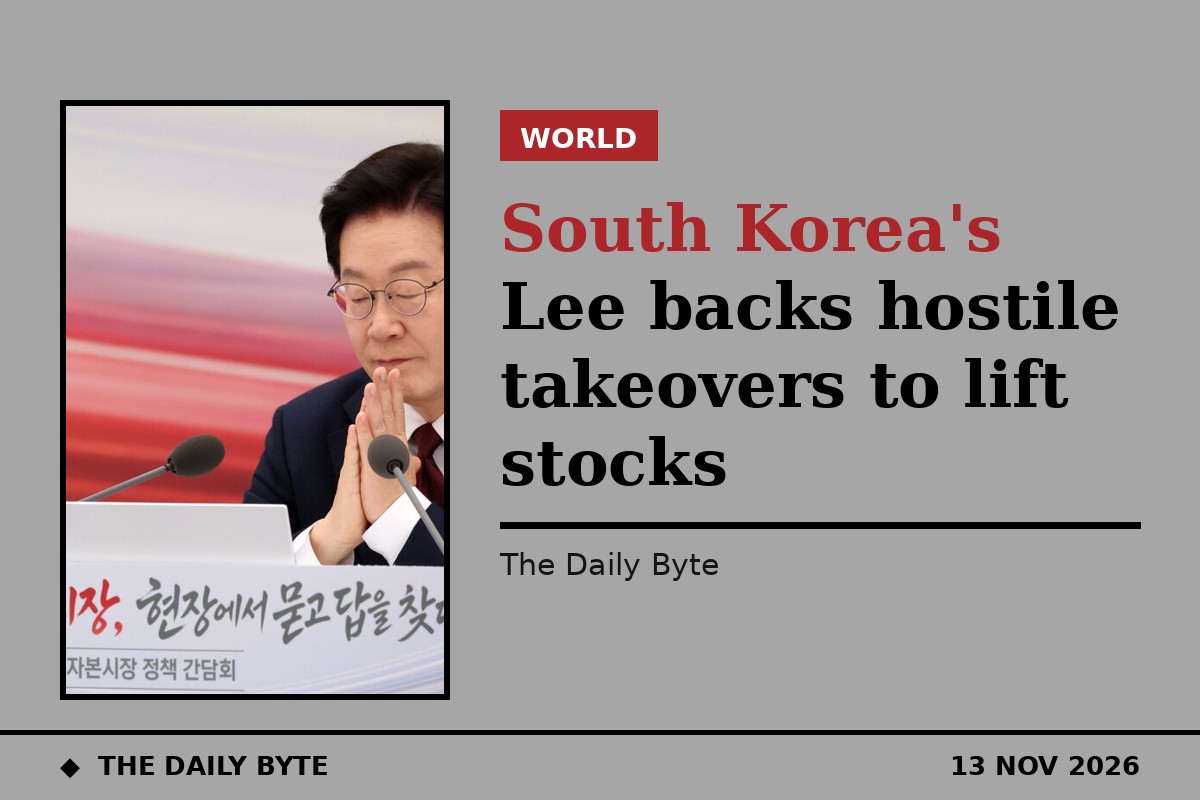
South Korean President Lee Jae Myung has ordered a full review of the rules that block hostile takeovers, arguing that encouraging contested bids is the most powerful way to close the persistent gap between the valuations of Korean companies and their foreign peers. He set out the plan at a capital market policy meeting he chaired at the Korea Exchange in Seoul on Friday 13 November 2026.
Lee told the meeting that Korean stocks trade at lower valuations than comparable companies listed elsewhere, a gap often called the Korea discount, and that restoring trust in the market was the key to correcting it. “The biggest mechanism for normalizing the market is hostile takeovers, but Korea harbors hostile feelings toward hostile takeovers, right?” he said, according to the Korea JoongAng Daily. He asked officials to survey whether any mechanisms were blocking hostile bids and to find ways to encourage them.
A hostile takeover is a bid to win control of a company against its management’s wishes, usually by buying up shares or rallying shareholders to replace the board. Lee said the government’s commitment to capital market reform had been tested again by the market’s recent sharp swings, and that restoring trust would let companies receive valuations matching their real worth.
Tender offer dispute goes to a vote
The meeting also took up the long-running debate over a mandatory tender offer rule, which would let minority shareholders share in the control premium paid in a takeover by requiring the buyer to make a public offer for at least a set portion of their shares. Korea introduced such a rule in January 1997 but scrapped it about a year later during the Asian financial crisis, and the current debate revisits the tension between giving minority investors access to takeover premiums and limiting the cost of acquiring control.
A proposal before the National Assembly would require buyers acquiring at least 25 percent of a listed company and becoming its largest shareholder to offer to raise their holdings to at least 50 percent plus one share, including shares already acquired, Aju Press reported. Critics argue that allowing buyers to purchase the controlling shareholder’s entire stake first leaves minority investors with fewer opportunities to sell at the same takeover premium, while alternatives include requiring an offer for all remaining shares or allocating purchases proportionally between controlling and minority shareholders.
Lee held an impromptu vote among participants. A proposal retaining the 50-percent-plus-one-share threshold, with proportional allocation equally to controlling and minority shareholders, drew relatively strong support, though some warned it could hinder smooth mergers and acquisitions. Lee did not announce a final decision on the purchase threshold or the allocation method, saying the ruling party would need to continue its discussions and urging that there not be too much delay.
He came down on the side of making deals easier. “Even if I take criticism for it, I lean toward growing the pie, toward the view that every shareholder benefits only when M&A is boosted and the market as a whole is normalized,” he said. “For now, it would be good to focus on breaking up the abnormal structure by encouraging hostile takeovers, rather than on building something ideal.”
Closely held firms and Kosdaq under scrutiny
Lee also turned on companies whose shares are concentrated in the hands of the largest shareholder. “Where the largest shareholder holds more than half the shares, a contest for management control is impossible, and such companies are effectively run like private companies,” he said. “Come up with and review ways to remove them from the market or to screen them out.”
He criticised many Kosdaq-listed companies for shying away from investor relations events, saying it was no different from listing, reaping the gains and then neglecting the market as no longer necessary. “I question whether [such companies] deserve to remain in the market,” he said, adding that insolvent and underperforming companies on the Kosdaq should be swiftly delisted.
Lee further ordered the creation of a high-level government body dedicated to capital market reform, with participation from both the public and private sectors, and said he would personally see to it that legislation and administrative measures were completed as quickly as possible. He said he had separately instructed the Serious Crimes Investigation Agency, which was launched on 2 October, to crack down strictly on unfair trading and stock manipulation.
Friday’s visit was Lee’s second to the Korea Exchange as president, after an on-site meeting on 11 June last year on rooting out unfair stock trading. It came after a turbulent stretch for Korean shares, with the Kospi plunging 6.02 percent on 6 November to 5,059.69 before closing at 5,342.73 on 12 November.
Sources: Aju Press and Korea JoongAng Daily.


