South Sudan massacre warnings ignored, Amnesty says
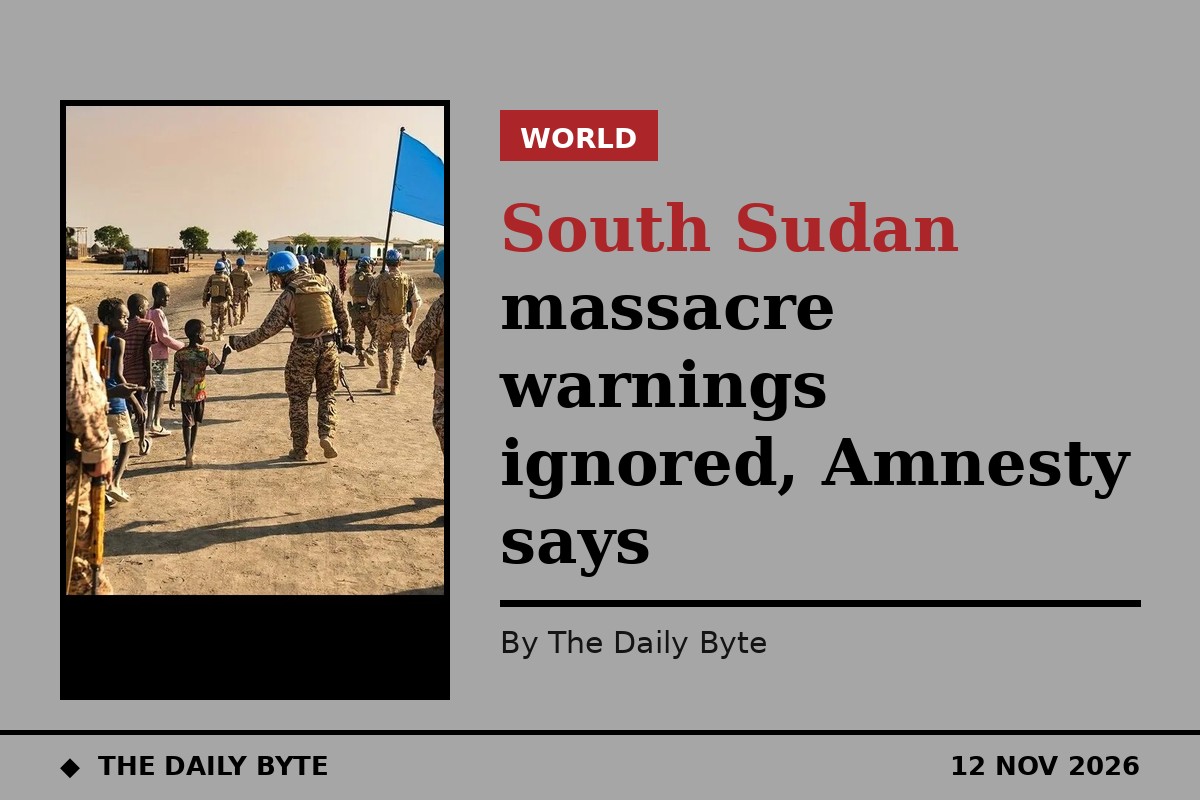
United Nations peacekeepers and South Sudanese authorities knew an attack on the town of Abiemnom was likely two weeks before it happened, yet failed to take the stronger preventive action that could have saved lives, Amnesty International said in a report published on Thursday, 12 November 2026.
The report, titled The Abiemnom Massacre: Inaction and Impunity in South Sudan, documents a four-hour assault on Abiemnom town in the early morning of 1 March 2026, in which a group of between 1,000 and 1,500 armed Nuer men from Mayom County in Unity State killed more than 200 people, including children, and injured many more. The attackers shot residents, burned homes and looted part of the hospital, according to Amnesty.
Authorities put the death toll at more than 200, including 130 town residents, 76 security personnel and seven foreign nationals. Amnesty said the attack may have been triggered by tensions over the earlier killings of several young men from Mayom County.
Warnings were received two weeks in advance
Amnesty found that both the South Sudanese authorities and the United Nations Mission in South Sudan (UNMISS) knew two weeks in advance that an attack was likely. Community members and survivors told the organisation that there had been warnings that men from Mayom County were mobilising weapons and fighters before the attack, and that a similar deadly attack had struck Abiemnom in April 2025.
UNMISS acknowledged that tensions had been high since mid-February. When violence escalated 48 hours before the attack, around 1,000 people sought protection at its Temporary Operating Base on the edge of Abiemnom town. The mission had roughly three dozen peacekeepers at the base and did not reinforce them until after the assault, when it sent an additional 40 personnel from its Formed Police Unit.
“Both the government and UNMISS had sufficient information and time to take more effective preventive action. Their failure to take stronger action cost lives,” said Tigere Chagutah, Amnesty International’s Regional Director for East and Southern Africa. “The community was left insufficiently protected despite prior intelligence that an attack was imminent.”
UN mission says it did its best with limited resources
UNMISS spokesperson Priyanka Chowdhury said the mission did its best with limited resources to protect and treat about 2,500 people sheltering at a protected area it set up in anticipation of the attack. Amnesty said the deployment of reinforcements only after the attack raised serious questions about why they were not sent before it happened.
Between March and April 2026, Amnesty interviewed 76 survivors and witnesses during visits to Abiemnom, Abyei and Juba, as well as medical personnel, community leaders and other sources. The organisation said it sent two letters to the South Sudanese authorities requesting information and responses to its preliminary findings, but had received no reply at the time of publication.
Calls for investigation and accountability
Amnesty said the authorities had not only failed to protect the residents of Abiemnom despite prior knowledge of a likely attack, but had also failed to investigate the killings, hold those responsible to account, and provide justice and redress for victims and their families. The report calls on both the South Sudanese authorities and UNMISS to investigate the failure to protect the victims of the massacre.
The findings come as South Sudan prepares for national elections scheduled for 22 December 2026, which many fear could strain a fragile peace. Amnesty’s report is a reminder that early warnings only protect people when those who receive them act on them in time.
Sources: Amnesty International and Al Jazeera, via 234Radio.