S&P 500 Stocks Move in Sync in Broadest Sell-Off of 2026
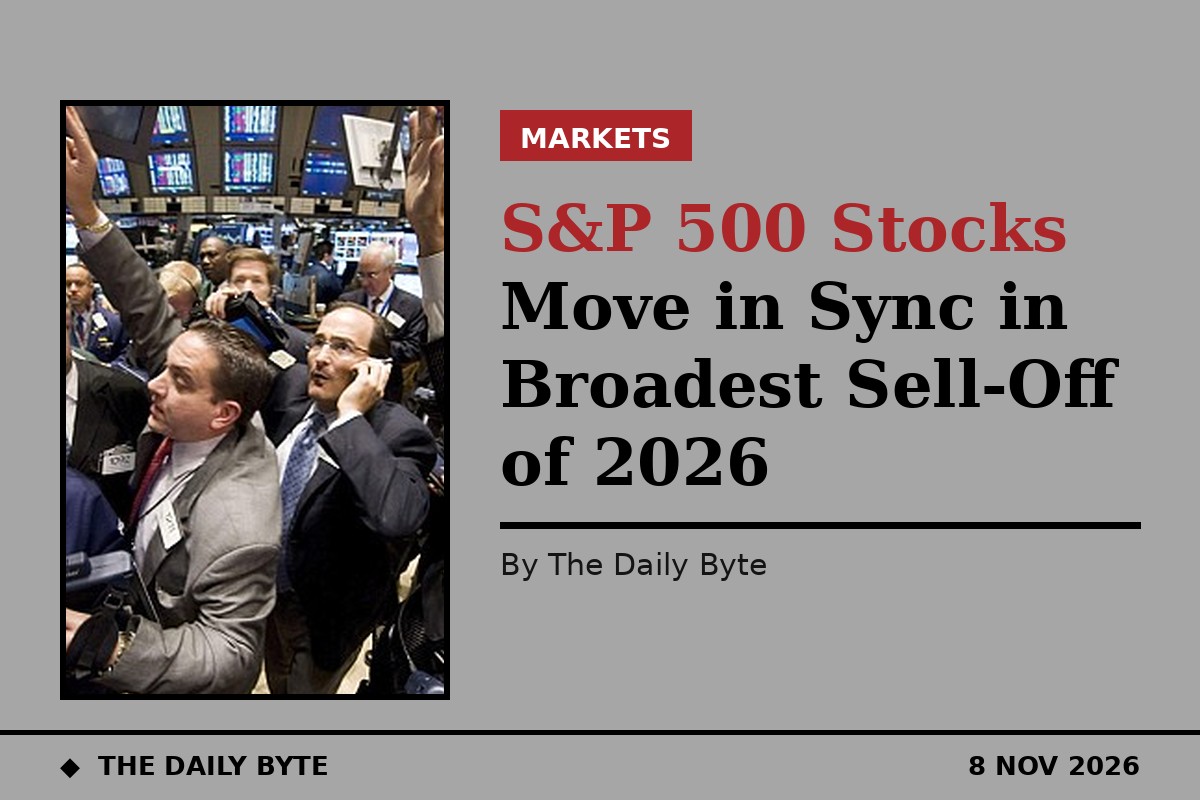
For most of 2026, the United States stock market has been a divided place. The big indexes have often risen while most of the shares inside them fell, or the other way round. On Thursday, that division vanished. Almost everything fell at once, in the most broad-based sell-off of the year, and strategists say the sudden unity is itself a warning sign.
The S&P 500 dropped 4.35% on Thursday, its worst day since the tariff turmoil of April 2025, closing at 7,353.85. The Nasdaq Composite fell 5.52% to 24,315.00, the Nasdaq 100 slid 6.36% in its worst session since 2020, and the Dow Jones Industrial Average lost 1,833 points, or 3.44%, to 51,528.16. The Russell 2000, which tracks smaller companies, fell 4.45%. A day earlier, the Dow had enjoyed its best session in more than a year and a half after the midterm elections. Thursday wiped out that entire gain, and then some.
What made the session stand out was not only the size of the falls but how many shares took part. According to Dow Jones Market Data, 430 members of the S&P 500 finished lower on Thursday, the most in a single session since 31 December. A separate tally counted decliners ahead of advancers by 411 to 75 across the index, while on the Nasdaq 2,822 stocks fell and only 463 rose. All 30 Dow components closed lower.
The selling began with chipmakers and spread through everything connected to the artificial intelligence build-out. Nvidia fell 9.26%, Advanced Micro Devices dropped about 17%, and memory makers were hit hardest of all, with Sandisk down 22.26%, Micron Technology down 17.46% and Western Digital down 17.35%. Tesla fell 10.77%. Even GE Vernova, which sells the turbines that power data centres, dropped about 7.5%.
The trigger, according to reports, was fear that the newly empowered Democrats in Congress would take steps to slow the data-centre build-out, the spending boom that has powered much of this year's market rally. But by the close, the selling had spread well beyond AI and chips. Small caps, biotech and the cheaper, domestically focused shares that had led Wednesday's post-election rally were all hit. As one market commentator put it, on Thursday there was no place to hide.
As the selling deepened, signs of genuine panic began to appear. Downside trading volume on the New York Stock Exchange, which measures the volume of trading in shares moving lower, rose above 80% on Thursday for the first time since 17 November 2025, Dow Jones Market Data showed. That ended a stretch of more than 240 trading sessions without such an elevated reading, the longest in at least 30 years, according to Jonathan Krinsky, chief market technician at BTIG.
Krinsky described the session as a major distribution day, Wall Street jargon for a sharp sell-off driven by institutional investors. He told MarketWatch he expects one more leg lower before a better base can form for a rebound, and he expects the S&P 500 to move closer to 7,000 as investors see a more widespread deterioration in individual shares. The index finished Friday just below 7,400, according to FactSet data, after a better-than-expected October jobs report helped markets recover some ground.
The synchronised fall matters because it breaks a pattern that has defined this bull market. Since the start of 2026 through late October, the S&P 500 moved in the opposite direction to most of its member stocks during roughly one-third of all trading sessions, according to Krinsky and his team. That is the most in any calendar year on record over the past few decades, and it reflects how far correlations between individual shares have fallen. Investors had begun to wonder what would happen when those relationships started to normalise. Thursday gave them an answer.
Not everyone is rushing to buy the dip. Krinsky noted that more than 25% of S&P 500 stocks were still trading in overbought territory, while 70% were trading above their 200-day moving average, which he said does not exactly scream capitulation. Craig Johnson, a technical strategist at Piper Sandler, advised that until support holds and leadership stabilises, investors should prioritise capital preservation over buying the dip.
Friday brought some relief, with markets pushing higher after the October jobs report came in stronger than expected. But the breadth of Thursday's selling has left its mark. The S&P 500's gain for 2026 narrowed from about 12.3% to 7.4% in a single session, and the Nasdaq Composite's gain fell from about 10.7% to 4.6%. All five major US indices remain positive for the year, but the week showed how quickly a market that has relied on a handful of winners can move together when the mood turns.