Spain Election Campaign Opens as Sánchez Seeks Fightback
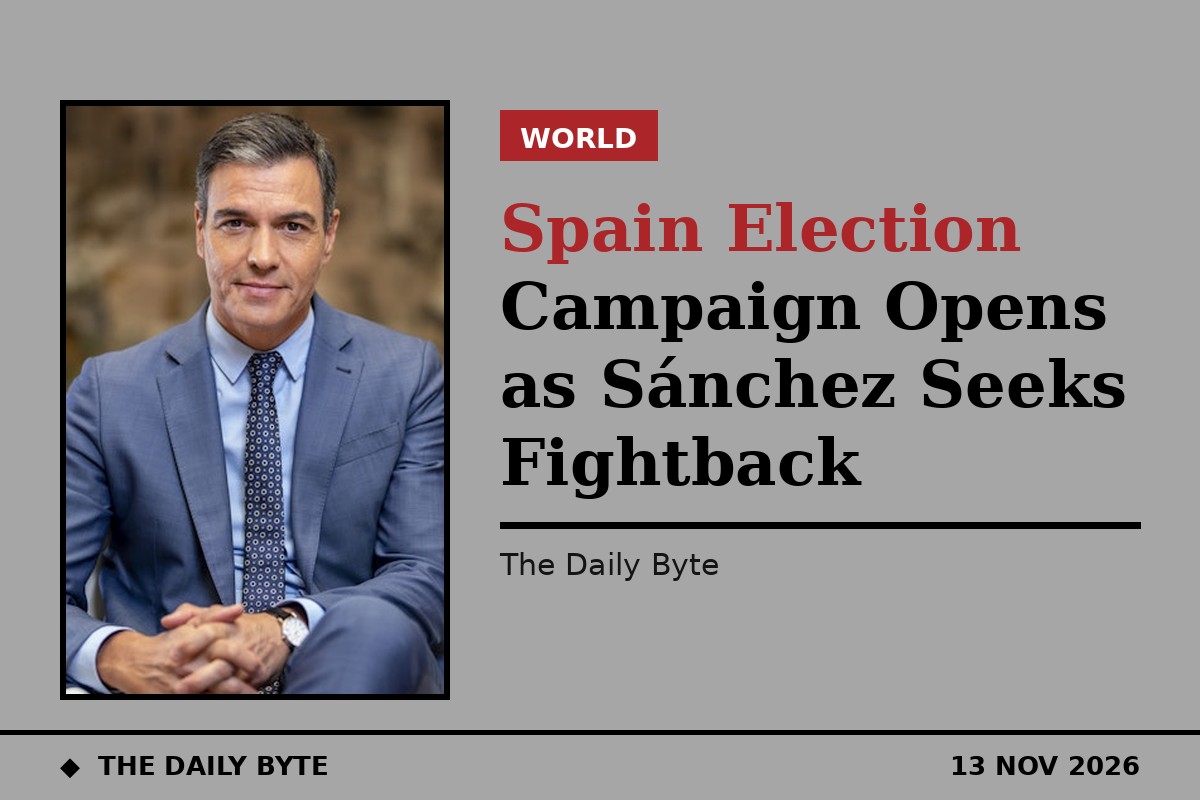
Spain's general election campaign officially opened at midnight on Friday, 13 November, with Prime Minister Pedro Sánchez launching his bid to stay in office and the conservative People's Party, the PP, leading in most private polls. Spaniards will vote on Sunday, 29 November, in a snap election called after parliament rejected the government's housing decrees.
Sánchez opened his campaign on Thursday evening at the Fibes congress centre in Seville, southern Spain, before about 4,000 supporters, according to the EFE news agency. He presented the election as a choice between his Socialist government and a coalition of the PP and the far-right Vox party, and he has called for a turnout of 75 per cent and for the 176 seats needed for an absolute majority in Congress.
The campaign runs until 27 November, with 28 November set aside as a day of reflection before polling day. Sánchez and PP leader Alberto Núñez Feijóo are due to face each other in a televised debate on Monday, 16 November.
Polls point to a right-wing majority
All 15 private polls published up to 12 November gave the PP and Vox a combined absolute majority, averaging 50.6 per cent of the vote. A Sigma Dos survey for El Mundo on 9 November put the PP on 131 seats, the PSOE on 105 and Vox on 68, giving the two right-wing parties 199 seats between them, well above the 176 needed for a majority in the 350-seat Congress.
Vox won 12.4 per cent of the vote and 33 seats at the last general election in 2023, and the party is now polling at about 19 per cent in some surveys. Feijóo has campaigned on a hardline migration message, while Sánchez has tried to make housing and the defence of public services the central issues of the campaign.
State pollster tells a different story
The state-run Centre for Sociological Research, the CIS, paints a very different picture. Its pre-election survey put the PSOE first on 33.3 per cent, ahead of the PP on 25.5 per cent, a lead of 7.8 points. The gap between the private polls and the CIS survey has left the outcome of the election uncertain, with the two sets of figures pointing to different governments.
Sánchez called the snap vote on 5 October after Congress rejected two housing decrees, cutting short a parliamentary term that began after the July 2023 election and had been due to run until 2027. He had previously said on several occasions that he intended to serve the full term.
Housing at the centre of the campaign
Housing has dominated the opening days of the campaign. After parliament rejected the decrees, the government approved new measures proposing rent caps, temporary eviction protections and restrictions on corporate purchases of residential property. Protests over the housing crisis culminated in a general strike on Wednesday, 11 November, which unions said brought more than three million people onto the streets. It was the first general strike backed by the main unions, CCOO and UGT, since 2012.
The protests were fuelled in part by the eviction of 87-year-old Maricarmen Abascal in September and her subsequent death. Sánchez has argued that anger over housing and fear of the far right will rally voters behind his Socialists, but polls so far show support for his party hovering at around 26 to 29 per cent, little changed from before he called the election.
With two weeks of campaigning to go, the left has also been reshaped since 2023, with Sumar dissolved and a new Frente Amplio coalition running in parts of the country. Sánchez is seeking tactical votes in small provinces, where Spain's electoral system disadvantages smaller parties, and has described his strategy with the roulette-table phrase "all on red". For more detail, see Brussels Signal and SRN News.