Spain general strike: millions protest housing crisis
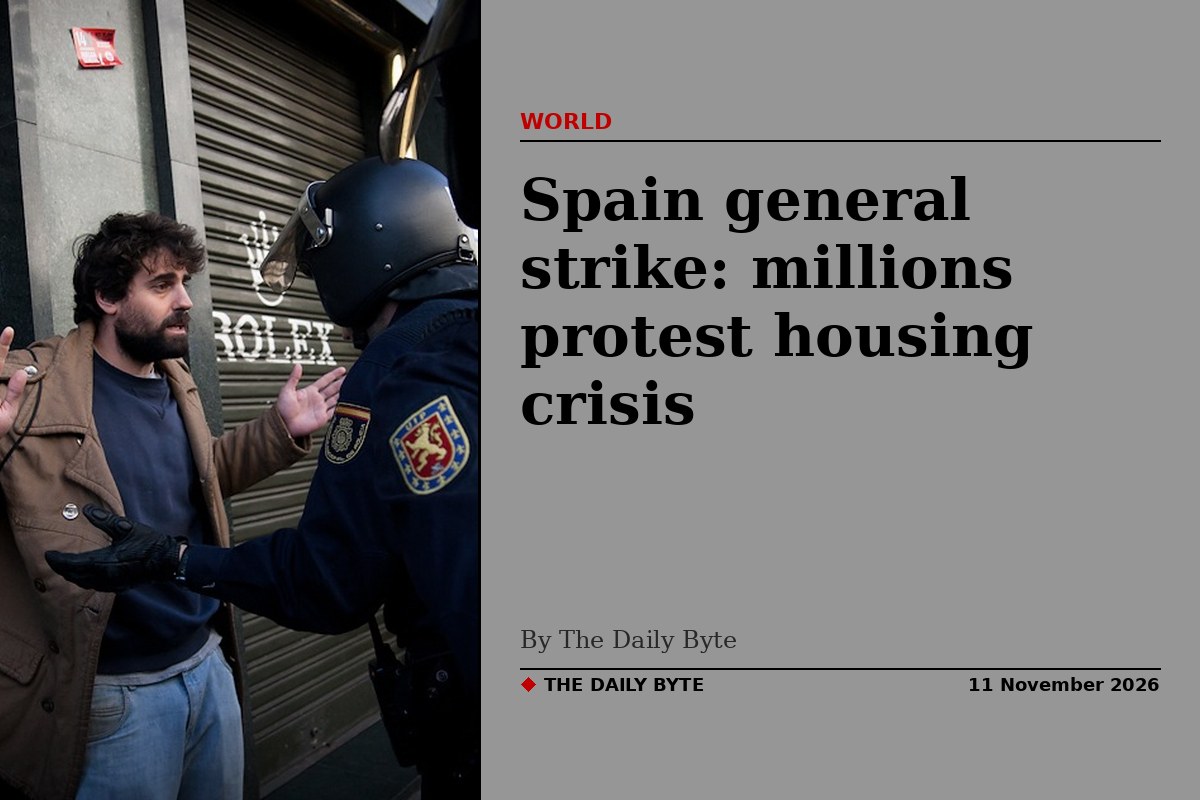
Millions of Spanish workers took part in a general strike on Wednesday, the first in 14 years, in a mass protest against the country’s housing affordability crisis less than three weeks before a snap general election. Unions said four million people joined the walkout, enduring stormy weather to set up picket lines across the country.
It is the first general strike since workers downed tools in 2012 against austerity measures during the eurozone debt crisis. The walkout was backed by Spain’s two largest unions, UGT and CCOO, which represent more than a million workers, as well as tenants’ associations angry about rising rents and evictions. The tenants’ union said it still expected participation to reach five million by the end of the day. Spain has around 23 million workers, according to the national statistics institute.
The spark for the protest was the eviction on 23 September of Maricarmen Abascal, 87, from the Madrid apartment where she had lived for 70 years. Her death two weeks later provoked a wave of outrage and protests in several cities. The Tenants’ Union then called for a general strike, a call quickly taken up by the major labour unions, as reported by Le Monde.
Spain has a deficit of about 750,000 homes, which is set to grow to more than a million by 2028, according to the central bank. With fewer people able to afford a home, renting has increased sharply. The average rental price of €1,176 is equivalent to about 98.7% of a young person’s average monthly salary in Spain, according to the Youth Council of Spain. “I’m 36 years old and I still can’t move out on my own,” Madrid resident Jesus Gonzalez, who works in a hospital IT department, told CNN. “Rents just keep going up, house prices just keep going up, and it’s simply impossible.”
Unions described the strike as a success, although participation was uneven, with the strongest support in coastal regions where housing pressures have been particularly acute. According to UGT and CCOO, participation reached 90% at ports and in the automotive sector, with “total stoppages” reported at factories including Volkswagen’s in Navarre and SEAT’s in Barcelona. Electricity demand dropped by as much as 15.5% between 10am and 11am, according to grid operator Red Electrica, while Madrid’s metro said peak-hour usage was down 42% compared with the same period last week.
On Madrid’s Gran Via, one of the capital’s main shopping streets, protesters cheered as stores including Primark, H&M and Pull & Bear drew their shutters amid a heavy riot police presence. “We’re going to close the Mango store,” the protesters chanted as they jangled sets of house keys above their heads.
Police reported 40 arrests by midday from 476 incidents linked to the general strike, including blockades of offices and industrial estates and burning of rubbish containers. Unions said they would file a criminal complaint over what they described as a “disproportionate” response during a police operation involving tear gas and batons that left 20 protesters injured.
The strike quickly took on a highly political dimension. Prime Minister Pedro Sanchez hopes to harness voter resentment over housing in the 29 November election, and his Socialist government backed the movement, with no ministers scheduling any official events on Wednesday. The right condemned the close ties between the unions and the government, with Partido Popular leader Alberto Núñez Feijóo calling the movement “an absurdity that doesn’t exist in any other European Union country”. Sanchez called the snap election after parliament rejected his decrees aimed at curbing evictions and limiting rent pressures on 2 October.
The protest revealed deep unease in a country where strong economic indicators contrast with daily struggles. The International Monetary Fund forecasts 2.5% growth for Spain in 2026, among the highest in advanced economies, and unemployment has fallen from 14.55% in 2018 to 10.18%, according to the national statistics institute. But the average annual gross salary rose only about 23% between 2018 and 2024, from about €24,000 to €29,540, less than the nearly 27% rise in prices over the same period, while rents have increased by 22.9% over the past decade. Nearly three million tenants, one in four, now spend more than 30% of their income on rent.
Plans for large protest marches in the afternoon were threatened by two heavy storms, Charles and Bruna, with unions suspending a demonstration in the southern port city of Cadiz. With more people able to work remotely and services carrying more weight in the economy, the impact of the strike is likely to be less pronounced than in previous years, according to Miguel Cardoso, chief economist at BBVA Research, who estimated it could shave 0.1% to 0.2% off Spain’s annual gross domestic product.


