Spain General Strike 11 November Over Housing and Pay
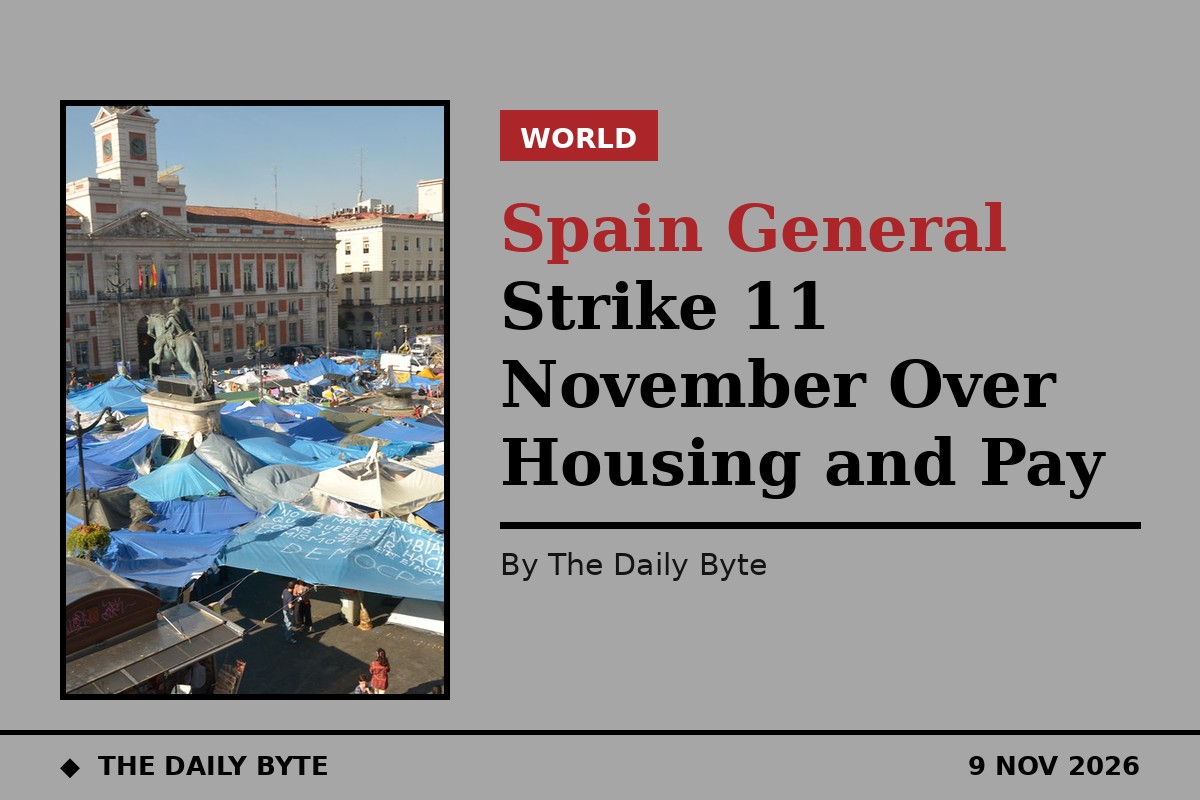
Spain is preparing for a 24-hour general strike on Wednesday, 11 November 2026, as unions demand action on housing costs, wages and public services. The stoppage was called by the Tenants' Union, the Sindicato de Inquilinas, and is backed by the country's two largest union federations, CCOO and UGT. It will be the first general strike jointly supported by the two federations in 14 years.
The strike is set to run from midnight to midnight on Wednesday. Organisers say more than 2,000 works councils across Spain have endorsed the action, and rallies are planned in towns and cities across the country, including a central demonstration in Barcelona in the late afternoon.
What the unions are demanding
Housing is at the centre of the dispute. The unions want rent containment, more public and protected housing, and stronger safeguards against eviction. They also want pay rises of between 4% and 7%, and a rise of at least 7% in the statutory minimum wage for 2027. The campaign slogan is "Salarios. Vivienda. Precio" — "Wages. Housing. Prices."
The unions argue that housing costs now take too large a share of workers' pay. Spain's National Statistics Institute recorded a 12.2% year-on-year increase in its Housing Price Index in the second quarter of 2026, while property website Idealista put average advertised rent at 15.10 euros per square metre in August, up 5.8% on a year earlier. Inflation reached 4.9% in September, according to the global public services union federation PSI.
UGT says employers have refused for more than a year to renew the national agreement that sets the terms for pay rises, leaving wage increases stalled while prices have kept climbing. Its general secretary, Pepe Alvarez, said no collective agreement can withstand the rise in the price of housing.
Why the strike was called
The call grew out of Spain's housing protests. It followed the death of Maricarmen Abascal, an 87-year-old woman from Madrid who died two weeks after being evicted from her home, a case that became a symbol of the housing campaign. The Tenants' Union, which lacks the legal capacity to call a general strike on its own, sought the formal backing of CCOO and UGT, and the two federations agreed to support a 24-hour stoppage.
The strike also covers pensions and public services. CCOO general secretary Unai Sordo has said the defence of public services is a third leg of the dispute, alongside housing and wages, and that the state must offer security and stability in areas such as health, pensions, education and care.
Disruption expected for travellers
Travellers face possible disruption to flights, trains and city transport. Catalonia's regional government has set minimum services at 25% of normal on the Barcelona metro and buses during the protected morning and evening windows, from 06:30 to 09:30 and from 16:30 to 21:00. The bus linking Barcelona with its airport is scheduled to run at 50% of normal service.
Rail disruption could extend beyond the strike day itself. Renfe train drivers are due to walk out on 10 and 12 November over railway safety following the deadly Urda rail collision on 28 October, while meat industry workers are striking from 9 to 13 November over pay and working conditions. As of 5 November, minimum services for high-speed and long-distance trains and for flights had not yet been published.
Strike falls just before snap election
The timing is highly political. The stoppage lands two days before the official campaign begins on 13 November for a snap general election on 29 November. The election was called by Socialist Prime Minister Pedro Sanchez after parliament defeated a bill intended to bolster housing affordability.
Spain's main employers' confederation, CEOE, has criticised the strike, while the unions deny that it serves any particular party. With housing now the central issue of the election campaign, the turnout on Wednesday will be read as a measure of how far the housing crisis has moved from street protest to national politics.


