Spain general strike: millions walk out over housing
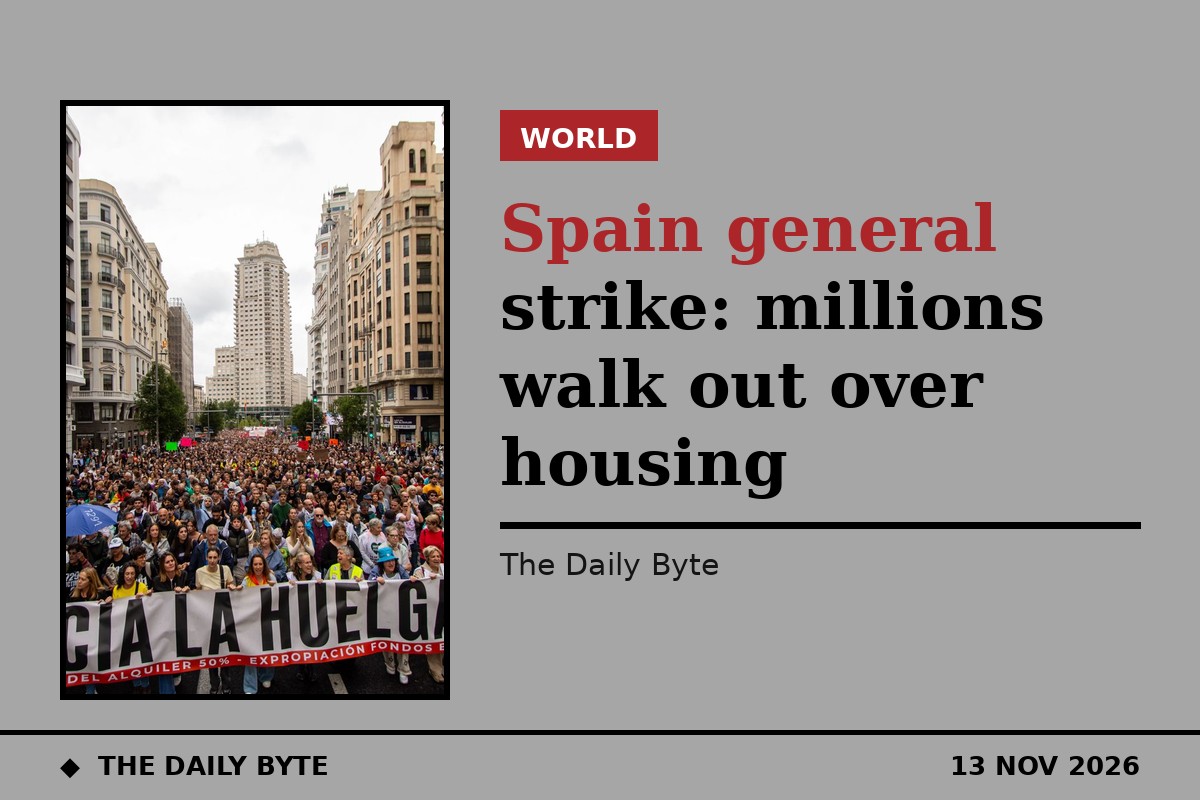
Millions of workers across Spain walked out on Wednesday 11 November 2026 in the country's first general strike in 14 years, in a protest over housing costs, rents and wages that unions said drew about four million people. The 24-hour stoppage, backed by Spain's two largest unions and tenants' associations, shut shops, slowed transport and filled city centres with marches less than three weeks before a snap general election on 29 November.
The walkout was called by the UGT and CCOO unions, which represent more than a million workers between them, together with tenants' associations that have been organising rent protests for months. CNN reported it was the first general strike since workers downed tools in 2012 against austerity measures during the eurozone debt crisis, and the first whose main push came from housing unrest rather than a labour dispute. Marchers rallied under the slogan "Salaries. Housing. Prices."
Why housing drove workers to strike
Spain has a housing deficit of about 750,000 homes, which the central bank expects to grow to more than one million by 2028, according to CNN. The average rental price of 1,176 euros a month is equivalent to about 98.7% of a young person's average monthly salary in Spain, according to the Youth Council of Spain, and rents have risen sharply while wages have failed to keep pace.
The immediate trigger was the eviction in September of Maricarmen Abascal, an 87-year-old woman who had lived in her Madrid flat for seven decades, and her subsequent death. Her case became a symbol of the housing crisis, and weeks of demonstrations followed. Parliament's rejection last month of government decrees aimed at curbing evictions and limiting rent pressures then prompted Prime Minister Pedro Sanchez to call the snap election for 29 November.
A day of shuttered shops and marches
On Madrid's Gran Via, protesters cheered as stores including Primark, H&M and Pull & Bear drew their shutters amid a heavy riot police presence, with marchers jangling sets of house keys above their heads. Many shops in Barcelona were also closed and boarded up in anticipation of unrest. Madrid authorities estimated that around 120,000 people took part in the march in the capital despite heavy rain.
Transport and industry felt the stoppage unevenly. Barcelona's metro said no trains would run outside peak commuting hours, while Madrid's metro said peak-hour usage was down 42% compared with the same period the previous week. The UGT and CCOO said participation reached 90% at ports and in the automotive sector, with total stoppages reported at factories including Volkswagen's in Navarre and SEAT's in Barcelona, and electricity demand dropped by as much as 15.5% between 10am and 11am, according to grid operator Red Electrica. Two heavy storms, Charles and Bruna, forced unions to suspend a demonstration in the southern port city of Cadiz.
Clashes and arrests
Police reported 40 arrests by midday from 476 incidents linked to the general strike, including blockades of offices and industrial estates and the burning of rubbish containers. Unions said they would file a criminal complaint over what they described as a disproportionate police response involving tear gas and batons that left 20 protesters injured.
Employers' leaders criticised the action. Angela de Miguel, vice president of Spain's main business lobby CEOE, said the strike was counterproductive and that the solution was to build more homes and lower taxes on construction and home buying. BBVA Research estimated the strike could shave 0.1% to 0.2% off Spain's annual gross domestic product.
What happens next
Sanchez hopes to harness voter anger over housing in the 29 November election, but Reuters reported that his Socialist Party is still polling at around 26% to 29%, with an alliance between the conservative People's Party and the far-right Vox seen as the most likely next government. Alicia del Rio, spokesperson for the Tenants Union which called the strike, told reporters that voting alone was not enough and that popular pressure would have to keep housing at the centre of the campaign whoever wins.