Spain General Strike: Millions Protest Housing Crisis
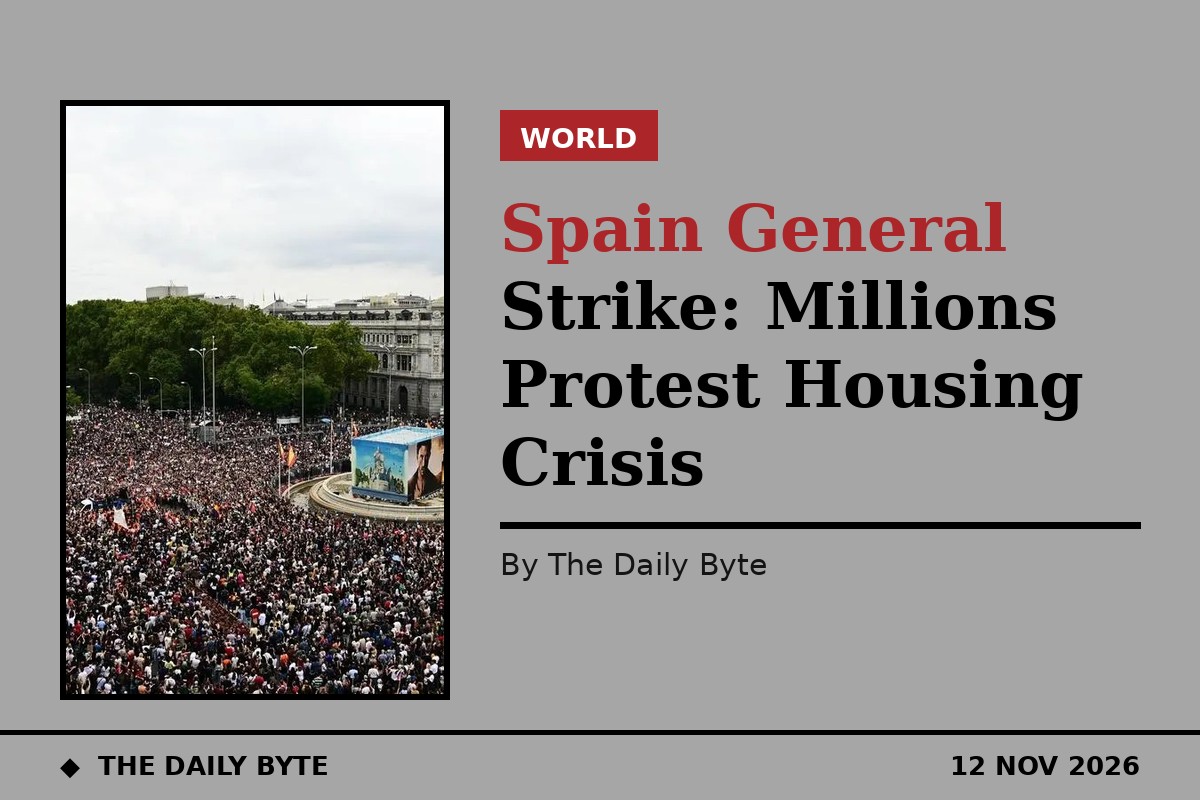
Millions of Spanish workers took part in a general strike on Wednesday 11 November 2026, the country’s first in 14 years, in protest at the housing affordability crisis less than three weeks before a snap general election. Picket lines were set up across the country despite stormy weather, in a walkout jointly backed by Spain’s two largest unions, UGT and CCOO, along with other labour organisations and tenants’ associations angry about rising rents and evictions.
Unions said four million workers took part, and the tenants’ union said it expected participation to reach five million by the end of the day. Those figures come from the organisers and have not been independently verified. Spain has around 23 million workers, according to the national statistics institute. The strike was the first general strike since workers stopped work in 2012 against austerity measures during the eurozone debt crisis, and the first in 14 years to be jointly backed by UGT and CCOO, which together represent more than a million workers.
Ports and car plants stopped, services less affected
Participation was uneven across Spain, with the strongest support in coastal regions where housing pressures have been particularly acute. According to UGT and CCOO, early participation reached 90% at ports and in the automotive sector, with total stoppages reported at factories including Volkswagen’s plant in Navarre and SEAT’s plant in Barcelona. The unions put early turnout at 85% in the meat industry, 82% in waste collection and 75% in the energy sector.
Participation was lower in healthcare and social services, at 38%, and in the postal service, at 35%. Electricity demand dropped by as much as 15.5% between 10am and 11am, according to Spain’s grid operator Red Eléctrica, a measure that points to a sharp fall in industrial and commercial activity during the morning even though many offices and services stayed open.
Tensions flared early in the day at Madrid’s Mercamadrid wholesale market, where about 1,000 protesters gathered. Police reported 40 arrests by midday from 476 incidents linked to the general strike. Transport was disrupted in several cities, although minimum service levels kept some trains and buses running.
A housing crisis at the centre of the election
The strike was called over housing, not pay. Unions and tenants’ groups say rents have risen beyond the reach of many workers, evictions continue, and too little affordable housing is being built, particularly in Madrid, Barcelona and other coastal cities where demand from tourism and short-term rentals adds to the pressure. Demonstrations over housing costs have been held in major Spanish cities through the year, and the issue has become one of the defining arguments of the election campaign.
Spain will hold a general election on 29 November, in which Prime Minister Pedro Sánchez is seeking re-election. The strike was timed to put housing at the centre of that campaign, and its organisers described it as a success despite the uneven turnout. Employers’ groups disputed the unions’ account of the scale of the stoppage, reporting conflicting figures for turnout and economic impact, in a pattern familiar from previous national strikes.
What happens next
The walkout was a 24-hour stoppage, and its political effect will be measured less in a single day’s lost output than in whether housing stays at the top of the election agenda. The unions have not announced a further general strike, and the government has not yet set out a fresh response to the housing demands raised by the organisers. What the strike did show, on the unions’ own figures and on the evidence of empty ports and car plants, is that the housing issue can still bring large numbers of workers onto picket lines in bad weather, 14 years after the last general strike.
For the millions who did not strike, the day was a reminder of how far housing costs have moved up the political agenda in Spain. For the parties contesting the 29 November election, the question now is what concrete measures on rents, evictions and housebuilding they are prepared to offer voters who took to the streets, and the picket lines, to demand them. CNN and Reuters reported the strike.