Sánchez struggles to rally Spain's left before election
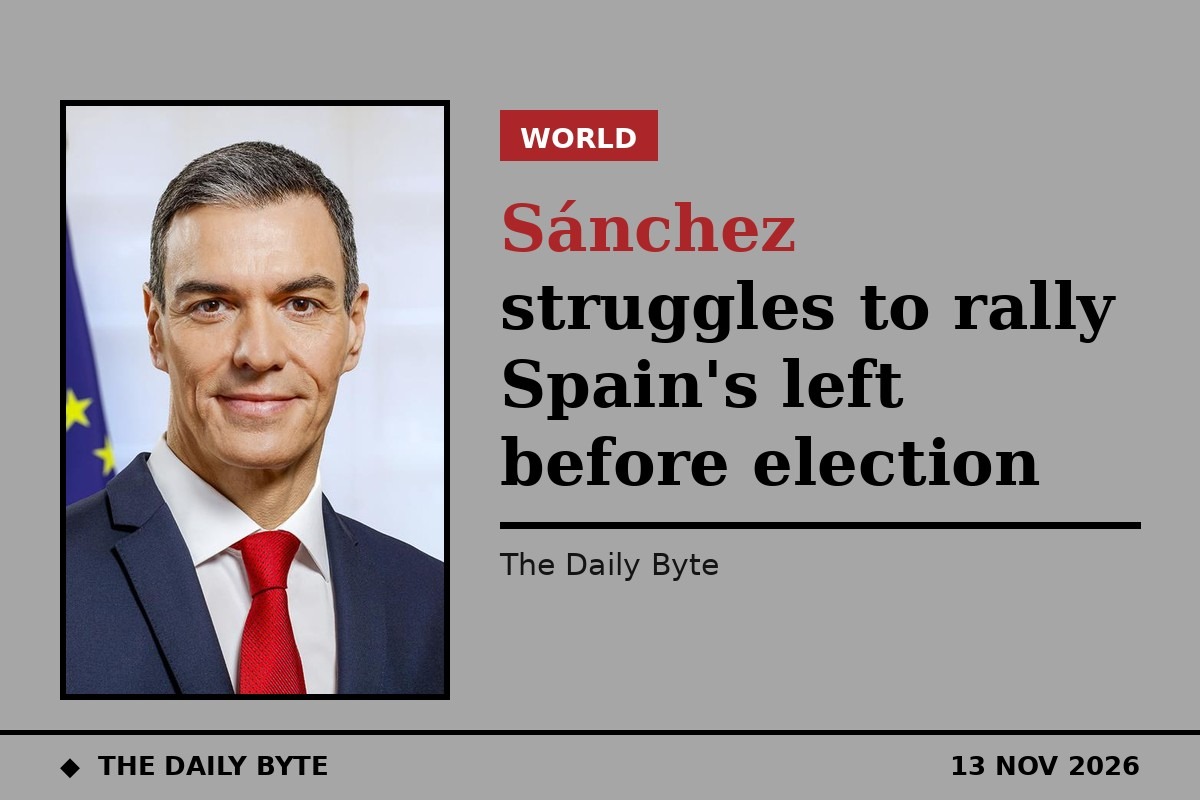
Spain's Prime Minister Pedro Sánchez is struggling to rally disillusioned voters on the left as the official campaign opens for the snap general election on 29 November.
When Mr Sánchez called the election last month, he was betting that anger over housing and fear of the far right would rally all shades of the left behind his Socialist Party. Interviews and polls reported on Friday suggest that many potential supporters are too frustrated with the record of his own government to respond in the way he had hoped.
Polls show backing for the Socialists still hovering around the 26%-29% level recorded before he called the election. Without a shift in the next two weeks, an alliance between the conservative People's Party and the far-right Vox party is seen as the most likely next government.
Housing at the centre of the campaign
Housing has become the defining issue of the election. The eviction of 87-year-old Maricarmen Abascal in September, and her subsequent death, triggered protests against a housing crisis that culminated in a general strike on Wednesday, which unions said brought more than three million people onto the streets.
"Every generation has its own struggle — for us, that struggle is housing," Mr Sánchez said at his first rally after calling the vote. But the protests have been led in large part by movements further to his left, and many of those involved say the government's own record on housing and public services is part of the problem.
"We're really tired of so many things," Maria Torrena Perez, a 40-year-old primary school teacher, said at a march in Madrid on Wednesday night. "We need decent housing. We need a quality public education system. We need a decent healthcare system. Ultimately, they're not investing in what they should be investing in."
A divided left
The challenge for Mr Sánchez is that disillusionment with the status quo appears, for many voters, to outweigh the urge to keep the far right out of government. Talks last month among left-of-centre parties to form a united platform broke down, leaving disgruntled leftist voters with a choice between sticking with the Socialists, abstaining, or voting for a smaller party.
Podemos, which at the height of its popularity in 2015 attracted more than a quarter of voters, has refused to join the new Broad Front alliance or consider an alliance with the incumbents. Its support has dropped to 1.9% in the most recent polls, according to Reuters, while its lead candidate, Irene Montero, has said the Socialists "will swallow you up if they get the chance".
Other voices on the left have been equally blunt. Mario Aguiriano, spokesperson for the Socialist Movement, described Mr Sánchez's government as "a government of slower regression", while Tesh Sidi, a lawmaker to the left of Mr Sánchez, said progressive voters would not be fooled by a party that "plays in elections and campaigns at being the Che Guevara of the left".
Polls point to a change of government
The polling picture has been broadly consistent. A SigmaDos poll published by El Mundo in early November put the Socialists at 24.6% backing, compared with about 26% a week earlier, which would give them between 97 and 103 seats in parliament in the 29 November election, down from the current 121.
The same poll put the People's Party at 31.1%, which would result in 133 to 139 seats, while Vox was on 19.3%. A majority in parliament requires 176 seats, meaning the People's Party would need support from Vox to govern.
Mr Sánchez has branded the prospect of a People's Party-Vox government a threat to social rights won in recent decades, describing the two parties in a recent campaign video as "two colours, one project of regression".
The final fortnight
The official campaign opens at midnight Madrid time on Friday, 13 November. Mr Sánchez and People's Party leader Alberto Núñez Feijóo are due to take part in a televised debate on Monday, 16 November.
On the campaign trail, Mr Sánchez has used the roulette-table phrase "all on red" to appeal for tactical votes for his party in provinces with only a handful of seats, where Spain's electoral system disadvantages smaller parties. With more than a million voters still undecided, political consultant Ivan Redondo, a former campaign strategist for Mr Sánchez, has said that just four in five left-leaning Spaniards backing the Socialists in small provinces could turn things around.
Mr Sánchez's support has also been affected by two deadly train crashes, corruption convictions in his inner circle and a rush of migrants into the Spanish enclave of Ceuta. The October train crash in Urda, which killed 69 people, prompted most parties to suspend campaigning and led to the resignation of the transport minister.
The final two weeks will show whether that changes.