States Take AI In-House: Abu Dhabi, Russia, South Korea
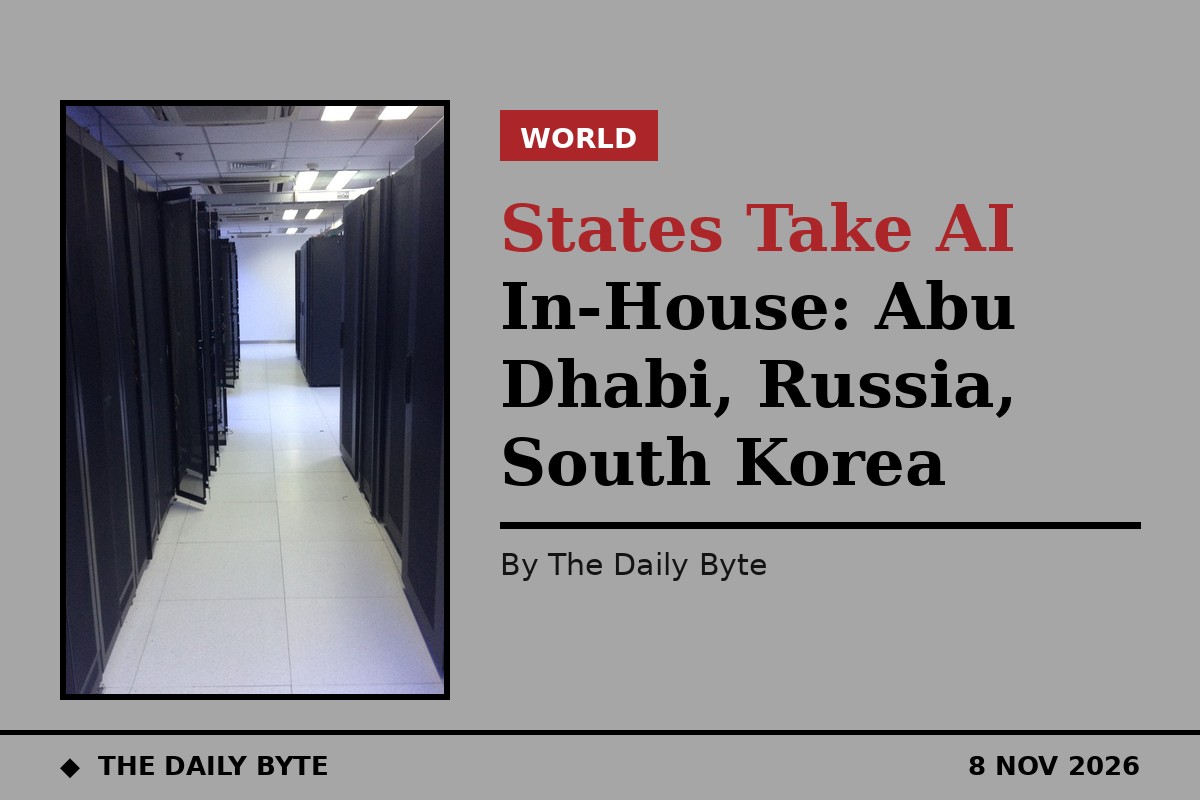
Three governments moved in the same week to bring artificial intelligence under their own control. Abu Dhabi signed a series of agreements with OpenAI, Russia ordered private data centre owners to reserve capacity for the state, and South Korea pledged to nearly double its AI spending. None of the three moves is about a new AI model. Each is about who holds the computing power and the data.
In Abu Dhabi, the national oil company ADNOC announced a multi-year partnership with OpenAI and G42 on 2 November, becoming the first energy company to deploy OpenAI's Frontier platform. The platform connects AI agents across complex business operations, and ADNOC plans to use it first for field master planning, bringing together decades of data across thousands of wells, multiple stacked reservoirs and hundreds of surface facilities. The second application will value every barrel of oil while it is still in the ground, connecting production, refining, logistics, sales and trading into a single decision-making process.
ADNOC already runs more than 200 AI applications and 70 robotics use cases, and it has rolled out ChatGPT Enterprise to more than 40,000 employees, which G42 describes as the largest enterprise deployment of ChatGPT in the Middle East and North Africa, with adoption above 97 percent. The partnership will also strengthen ADNOC's cyber defence through OpenAI's Daybreak Blue initiative, and the systems will run on G42's sovereign AI infrastructure in the UAE, with human experts keeping oversight of consequential decisions.
The government track in Abu Dhabi is wider still. The National reported four agreements after Crown Prince Sheikh Khaled bin Mohamed met OpenAI chief executive Sam Altman. They include a machine-readable government pilot already live with the food-safety authority, an investment-analysis agreement involving Mubadala and G42's Inception42, and a five-year Inception42 deal to bring OpenAI's Frontier platform to government, enterprise and education. A senior official at Abu Dhabi's Department of Government Enablement told The National that the models are used inside the country. "We are not sending out any data outside of the UAE," he said, adding that the intellectual property of what is built belongs to the department. The aim is an AI-native government by 2027 within a Dh13 billion ($3.5 billion) digital strategy, with some procedures falling from days to minutes.
Russia took a different route. President Vladimir Putin signed a decree on 2 November, Decree No. 802, obliging owners of non-state data centres to reserve 10 percent of their capacity for the state, according to Reuters. Authorities could then gain access within 24 hours of a decision, and the decree sets a 10-day deadline for the reservation. It also allows temporary use of data centres abroad, subject to approval by the FSB security service, and the Digital Development Ministry must inventory capacity and floor space at privately owned sites. No operator, such as Yandex or Sberbank, has said publicly how it will comply.
South Korea chose money over control. President Lee Jae Myung told parliament on 2 November that the country would invest 21.3 trillion won ($15.97 billion) in AI and three megaprojects covering semiconductors, physical AI and AI data centres next year, nearly twice this year's amount. The 2027 budget totals 820.9 trillion won ($615.62 billion) and still needs parliamentary approval, according to Reuters.
The three approaches differ sharply. Abu Dhabi buys a foreign vendor's models but insists on in-country processing and local ownership of what it builds. Russia takes a slice of privately owned capacity. South Korea funds the supply chain. What they share is the treatment of computing power as national infrastructure, not as a footnote. Readers should still judge each by delivery rather than announcement: the deals are signed, but there is no independent measurement of the time savings Abu Dhabi expects, and OpenAI has said Stargate UAE's first 200 megawatts were expected to go live in 2026, which has not been independently confirmed. The next tests are whether that capacity goes live by year end, how Russia enforces its decree once the deadline passes, and whether South Korea's parliament approves the budget.