Sugar mills delay crushing despite TCP sugar purchase
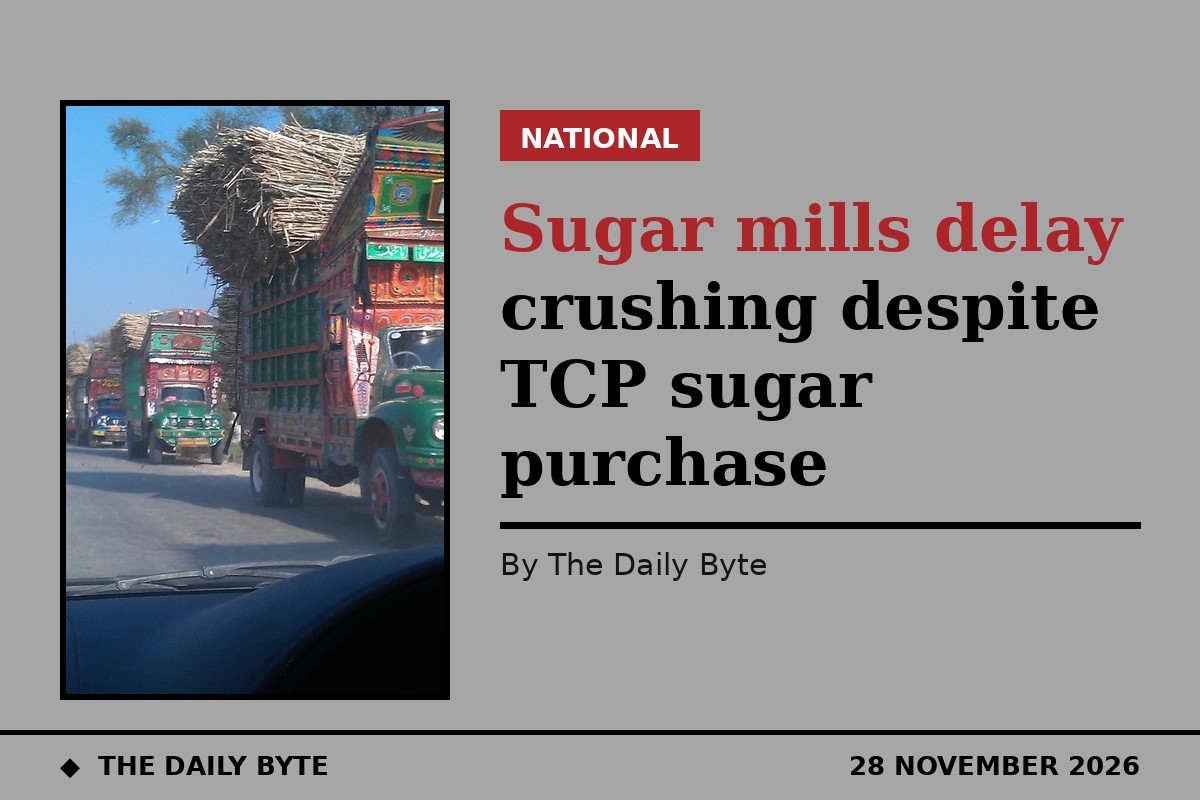
Pakistan's sugar mills are delaying the start of the 2026-27 crushing season even as the government moves to buy sugar from them, with growers and millers locked in a dispute over the price of sugarcane.
The Trading Corporation of Pakistan (TCP), a state-owned commercial organisation under the Ministry of Commerce, invited bids on Friday to buy 200,000 tonnes of white refined sugar. Under the terms, the sugar must be delivered to the TCP Pipri Godown in Karachi within 60 days and meet strict quality standards set by the Pakistan Standards and Quality Control Authority. Sealed bids must be submitted by 4 December 2026.
The purchase comes despite the fact that the crushing season has so far begun largely in name only. Farm leaders say only Madina Sugar Mills and two units of Hunza Sugar Mills are consistently processing cane. Most other mills have held only ceremonial events, creating the impression of compliance with the Punjab government's 15 November deadline for starting crushing.
Even the country's largest sugar mill group, owned by Jahangir Khan Tareen, has kept its gates closed to farmers, in contrast to previous years, when most mills began processing cane in the first half of November.
Farmers want Rs700 a maund, mills offer half that
At the heart of the standoff is price. Farmers are seeking Rs700 per maund for sugarcane this season, while mills are offering just Rs350 to Rs375, well below last year's average. For the third year in a row, the government has opted not to announce cane prices, leaving them entirely to mill owners.
In Sindh, JK Sugar Mills has warned growers not to harvest without a permit, saying farmers will bear the losses if they cut cane without authorisation.
The mills say they are holding back because of more than one million tonnes of unsold stocks from the previous season. Earlier this month, the Pakistan Sugar Mills Association (PSMA) refused to start crushing before December, citing those stocks. Yet the government has already moved to ease the mills' position: the TCP tender, together with the government's recent approval to export more than 600,000 tonnes of sugar, effectively creates favourable conditions for millers, although the measures are being described as belated.
Deregulation lands in the middle of the dispute
The dispute is playing out against the biggest reform of the sector in decades. On 24 November, the federal cabinet approved the National Policy for Deregulation of the Sugar Sector, ending government-fixed sugarcane pricing, lifting restrictions on setting up or expanding mills, ending export subsidies and removing curbs on moving sugar between provinces. The decision, taken through circulation, also satisfies a long-delayed structural benchmark under Pakistan's International Monetary Fund programme, which had been due by 30 June 2026. The IMF's executive board meeting is now expected on 11 December.
The policy includes safeguards for growers, such as third-party validation of weighing scales, a sucrose testing framework and interest payments by mills on delayed sugarcane payments. The government will retain authority to maintain buffer stocks and monitor data on sugarcane production, sugar output and market availability, with transitional arrangements in place for the current crushing season.
The mills have welcomed the reform. PSMA chairman Asim Ghani Usman said the decision to deregulate the sugar sector was a very positive move that would yield beneficial results, most notably for farmers, who would receive better returns for their crops. The association has also asked the government to restore sugar export land routes.
Farmers remain unconvinced. Pakistan Kissan Ittehad president Khalid Mahmood Khokhar put the fair minimum price for cane at Rs700 a maund and warned on 11 November that farmers would burn their crops without a policy and crushing schedule. On 24 November the Lahore High Court allowed an early hearing of a year-old petition by Sardar Zafar Hussain, president of Kissan Board Pakistan, asking the Punjab government to fix the price at Rs700 a maund and to order mills to clear last season's dues.
The stakes are high. Punjab has 2.45 million acres under sugarcane this year, 16 per cent more than last year, according to Profit by Pakistan Today, and the cane competes with wheat for the same land and the same growers' cash.
Provincial law requires mills to begin crushing by 30 November at the latest, a deadline the mills' association has said it cannot meet. With the TCP tender closing on 4 December and the IMF board meeting due a week later, the next fortnight will test whether deregulation can get the mills running and the cane bought at a price farmers will accept.