Sunak Urges New National Service for UK Resilience
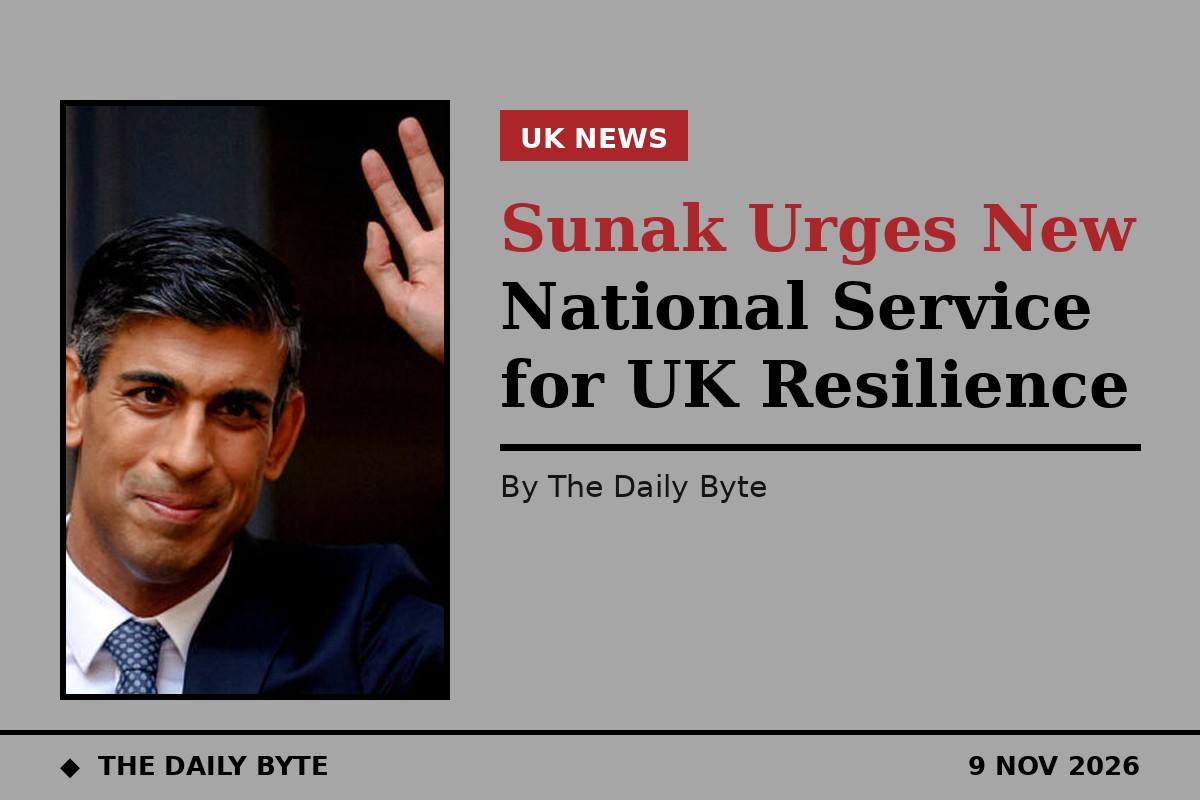
Former prime minister Rishi Sunak has renewed his call for a modern form of national service, arguing that Britain needs a universal “resilience corps” to prepare the country for cyberattacks and other threats.
Writing in The Times, Sunak said the stockpiling advice issued by the government would not be enough on its own to keep the country running if a serious attack struck. He argued that the country’s culture needed to change so that people were better prepared for the challenges ahead.
What Sunak is proposing
Sunak said it would be impractical to bring back national service in its original form, in which young men spent 18 months in the armed forces. Instead, he proposed an updated version that would give young people a choice of roles.
Under his plan, a small number of people could apply for a selective military cadre, while others could serve with search and rescue teams, St John Ambulance or Meals on Wheels, or train in areas such as cybersecurity. He said the scheme should be universal, offering training, experience and values to everyone who takes part.
Sunak first proposed a new model of national service during the 2024 general election campaign, when the idea quickly became the subject of jokes. He wrote that the threats he had seen as prime minister — constant probing by hostile states that did not distinguish between civilian and military targets — had convinced him that some kind of resilience corps would soon be needed.
Cyberattacks behind the renewed call
The former prime minister pointed to a recent series of cyberattacks across the country, including attacks on supermarkets in Europe in which fridges were remotely set to 50C so that food would spoil. He said defence spending alone would not stop that kind of attack, and that responsibility for security could not simply be left to the military.
He also noted that the government now feels obliged to tell households to stockpile tinned goods, and said it would take more than well-stocked cupboards to meet the moment. His argument is that resilience has to be built into society, not just into government plans.
Why the armed forces could not take everyone
Sunak acknowledged one of the main objections to his original proposal. When he raised national service as prime minister, the armed forces stressed that they did not have the capacity to take on and train more than 800,000 18-year-olds. His revised model is designed around that constraint, with only a small military element and most participants in civilian roles.
He pointed to other European countries moving in a similar direction. France and Germany are both taking steps towards new forms of national service, and Sunak said he had recently returned from Sweden, where places on both the military and civilian schemes are highly prized by teenagers and employers alike.
Jobs and social cohesion
Sunak also linked the proposal to the large number of young people not in education, employment or training, saying national service could give almost one million young people a sense of purpose. He argued it would make the country more cohesive as well as more resilient, bringing together young people from very different backgrounds and reminding them that citizenship brings responsibilities as well as rights.
The original national service was introduced in the United Kingdom in 1949 and required able-bodied men aged 17 to 21 to serve in the armed forces for 18 months. It was abolished in 1960. Sunak’s proposal is not a return to that system, but a new scheme built around civilian service and resilience training.
Whether the idea gains political traction remains to be seen. Sunak is no longer prime minister, and the current government, led by Andy Burnham, has so far focused on household stockpiling guidance rather than a service scheme. But with cyberattacks on civilian infrastructure now a regular feature of the news, the debate over how Britain prepares for them is unlikely to go away.