Suparco Warns Punjab Smog to Worsen as 690 Fires Burn
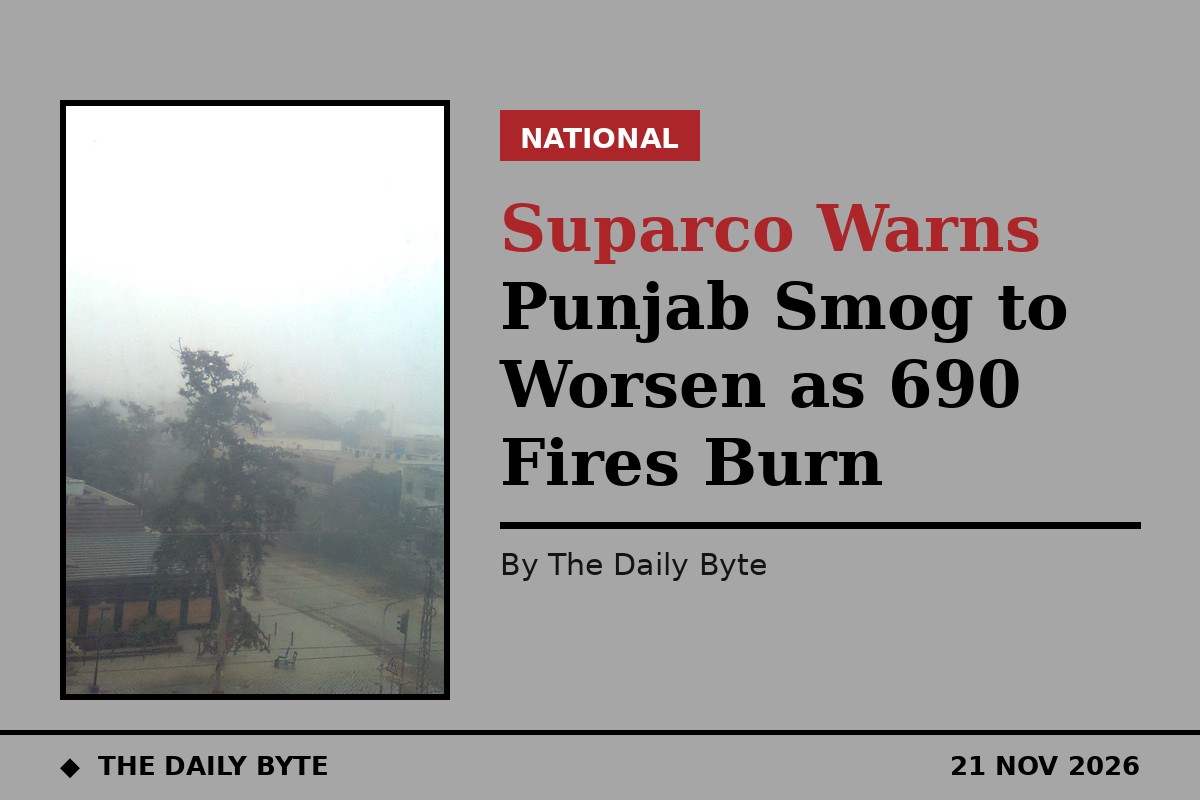
Pakistan’s space agency has warned that smog across Punjab is likely to worsen over the next three days, after its satellites detected 690 active fire incidents in the province and adjoining areas.
In its 17 November smog assessment, the Pakistan Space and Upper Atmosphere Research Commission (Suparco) said satellites recorded 386 fires in Punjab and 304 in adjoining regions during the preceding 24 hours. The review used VIIRS and MODIS satellite data and covered 36 districts across the province.
Seven districts were identified as facing high or severe smog conditions: Jhang, Narowal, Sheikhupura, Sialkot, Hafizabad, Gujranwala and Dera Ghazi Khan.
The mean aerosol optical depth, a measure of atmospheric aerosol concentration, was recorded at 0.25, with the highest readings in Chiniot, Jhang and Faisalabad. Suparco said nitrogen dioxide levels were 21 per cent below the 2019–2025 average for this time of year, but warned that atmospheric conditions could still deteriorate in the coming days.
Pollution trapped close to the ground
Atmospheric dispersion was rated very poor, meaning pollutants are likely to remain trapped close to the ground instead of dispersing. The Copernicus Atmosphere Monitoring Service projected PM2.5 concentrations of between 51 and 71 micrograms per cubic metre, although Suparco noted that such model estimates are generally lower than ground-based readings during winter.
Ground readings underlined the scale of the problem. Lahore topped the IQAir live ranking of the world’s most polluted major cities on Wednesday morning, when its air quality index reached 339 between 10am and 11am. Faisalabad recorded 686, followed by Gujranwala at 550 and Kahna Nau at 516. Multan recorded 437 and Kasur 371.
The Pakistan Meteorological Department has forecast fog and smog during morning and night hours over the next 48 hours in Lahore, Sialkot, Narowal, Sheikhupura, Okara, Kasur, Faisalabad, Jhang, Khanewal, Multan and nearby areas.
Authorities step up stubble-burning checks
The Punjab Environment Protection Agency has deployed five senior directors to different divisions to supervise anti-stubble-burning operations and coordinate with agriculture departments and district administrations.
Most of the fires detected by the satellites are believed to be crop residue burning, the seasonal practice of clearing fields by setting fire to leftover stalks after harvest. It sends large volumes of smoke into the air at exactly the time of year when cold, still weather traps pollution close to the ground.
Suparco’s satellite monitoring is used to track the spread of smog, identify fire hotspots and assess atmospheric conditions across Punjab. With the three-day outlook pointing the wrong way, residents in the affected districts face reduced visibility and elevated pollution levels in the days ahead, and health experts generally advise limiting outdoor activity when air quality declines sharply.