Supreme Court frees brothers after 20 years on death row
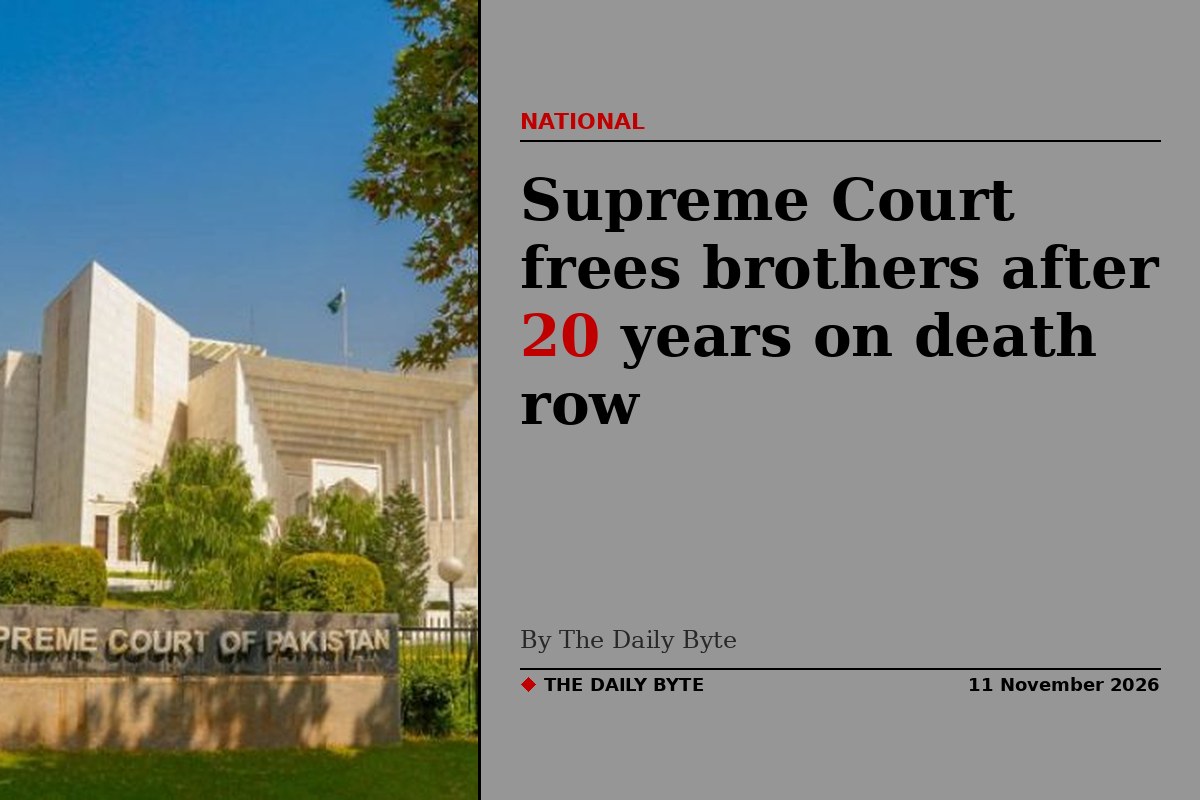
Pakistan's Supreme Court has acquitted two brothers who spent close to 20 years in prison, much of it under sentence of death, after ruling that psychiatric evidence raised real doubt about whether they were of sound mind when the alleged offence took place.
Umar Draz and Liaqat Ali were sentenced to death in 2006 under Section 295-C of the Pakistan Penal Code. A three-judge bench led by Chief Justice of Pakistan Yahya Afridi set aside their convictions and ordered their release, unless they are required in another case.
Justice Ishtiaq Ibrahim wrote the main judgment. Justice Shakeel Ahmad agreed with the acquittal while adding a separate note of his own, stressing that a psychiatric diagnosis on its own does not automatically establish that a person lacked legal capacity at the time of an offence.
Two decades behind bars
The case began in March 2006, when a sessions judge in Jhang convicted both men on 27 March that year, sentenced them to death and fined each of them Rs500,000. They have been in prison ever since.
The Lahore High Court upheld the death sentences on 17 September 2015. The brothers' appeals then reached the Supreme Court as Criminal Appeal No. 96 of 2020.
The case arose from a marital dispute between Umar Draz and his wife, who accused him of making blasphemous statements before their divorce. His brother was drawn into the case after a document said to contain blasphemous statements was found among belongings returned after the divorce.
The medical evidence
The men's lawyer did not argue the facts of the complaint before the Supreme Court. He argued a single point: that the two men were mentally unsound at the time and so lacked the guilty mind the law requires for a conviction.
The medical record pointed in different directions at different times. A three-member board at DHQ Hospital in Faisalabad found both men mentally sound in 2007. But an eight-member Board of Certification diagnosed them in 2023 with bipolar affective disorder with psychotic symptoms, and a nine-member board in September 2025 found both brothers were suffering from bipolar disorder in a current manic episode.
The court said the unanimous view of the specialist boards, made up of senior professors of psychiatry, carried more weight than the early assessment by a board with only one psychiatrist on it. It treated the fact that both brothers, examined separately, received the same diagnosis as compelling scientific corroboration that their illness was inherited and pre-existing.
Examining the evidence under Section 84 of the Pakistan Penal Code, which deals with criminal responsibility where unsoundness of mind prevents a person from understanding the nature of an act or that it is wrong, the court concluded that reasonable doubt existed about the brothers' culpability. "The appellants have spent around 20 years behind bars. In the light of the opinion of medical board which raises doubts regarding the culpability of the appellants, the benefit of doubt cannot be withheld from the appellants," the judgment said.
Release and treatment
The court directed that the men be released if they are not required in any other case, and asked the Punjab Institute of Mental Health to make sure their medical treatment continues.
The judgment does not change the law. But it shows the court weighing medical evidence on its own terms before allowing a death sentence to stand, and it underlines how long death-row appeals can take in Pakistan.
According to Pakistan's National Commission for Human Rights, 767 people were imprisoned on blasphemy charges in July 2024. The Human Rights Commission of Pakistan reported 729 prisoners in Punjab province alone in June 2025. Pakistan has not carried out a judicial execution for blasphemy.
For the two brothers, the ruling ends a case that has lasted most of their adult lives. What it cannot give back is the 20 years they spent in prison.