Supreme Court grants bail to four accused in Islamabad placenta case
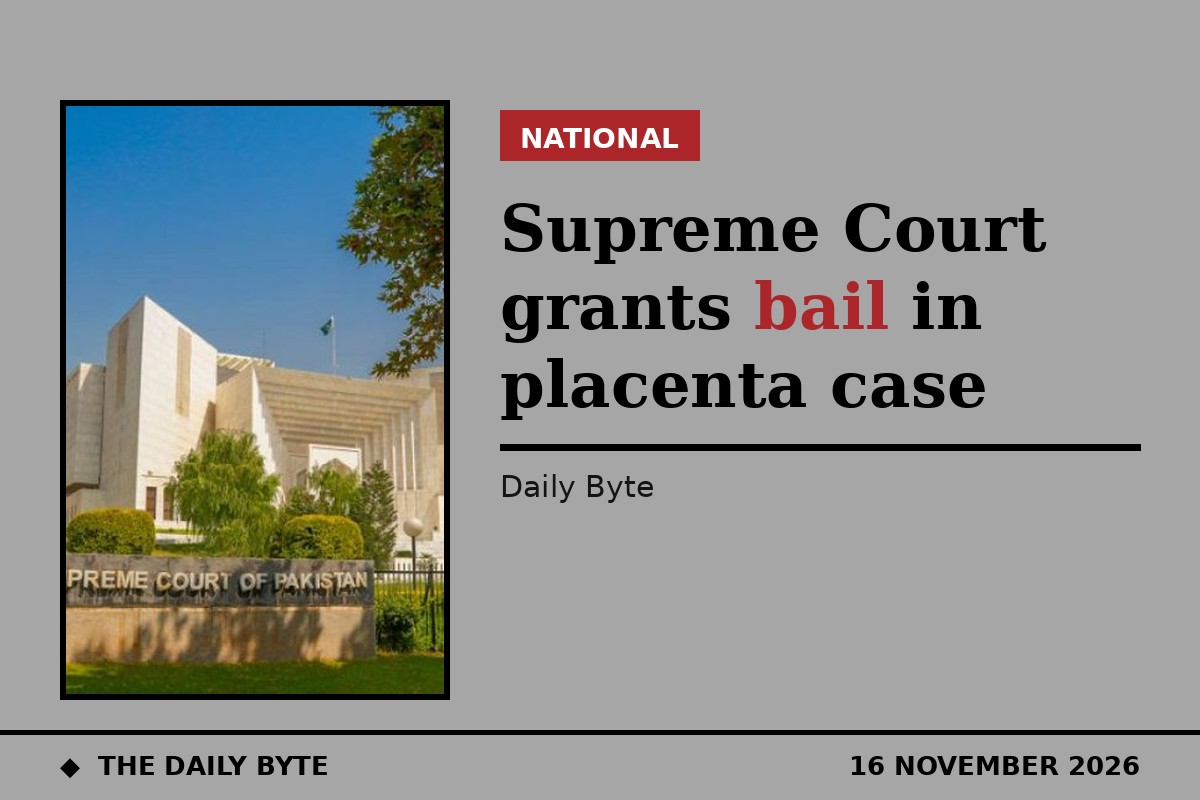
The Supreme Court has granted post-arrest bail to four accused, including three foreign nationals, in a case involving the alleged commercial collection and export of human placentas in Islamabad.
A two-member bench comprising Justice Shahzad Ahmad Khan and Justice Aqeel Ahmed Abbasi approved the bail applications against surety bonds of Rs1 million and two local guarantors for each accused.
The question of whether the recovered material attracted the offences invoked by investigators formed part of the further-inquiry issue before the court. The grant of bail does not dispose of the prosecution, and it does not amount to a final ruling permitting the commercial trade in placental material.
The raids and the alleged export operation
The investigation centres on operations carried out by the Federal Investigation Agency (FIA) and the Human Organs Transplant Authority at premises in Islamabad's F-7/1 and E-11 sectors.
According to the FIA, investigators recovered fresh and dried human placental material from the premises and uncovered an alleged arrangement for its collection, processing, preservation and shipment abroad.
A separate consignment weighing 580 kilograms was intercepted at Islamabad airport. The agency alleged that the material was being declared as sheep placenta for export to Vietnam. The prosecution has put the overall recovery in the case at 1,241 kilograms.
Investigators also alleged that placentas were being collected from hospitals and clinics in Islamabad, Punjab and Khyber Pakhtunkhwa before being brought into the supply chain.
The case was registered under Sections 9 and 11 of the Transplantation of Human Organs and Tissues Act, 2010, along with Sections 420, 109 and 34 of the Pakistan Penal Code. Earlier court reporting named the accused as Muhammad Waqas, Li Gangkai, Wang Bao and Peng Fei Guo, and recorded that a lower court had refused them post-arrest bail before the matter reached the Supreme Court.
The dispute over the law
A central question is whether collecting and commercially dealing in placentas after childbirth constitutes an offence under legislation regulating human organs and tissues.
Deputy Attorney General Raja Shafqat Abbasi argued that human placenta falls within the definition covered by the transplantation law. Advocate Mian Dawood, commenting on the case, questioned the basis on which the FIA had invoked the legislation. He argued that material discarded after childbirth should not automatically be treated in the same manner as organs removed for transplantation.
The statutory wording is broader than a list of named organs. Section 2(e) defines a human organ as "any part of a human body, organ or tissue". The absence of a specific reference to placenta therefore does not, on its own, settle whether it is covered.
Section 9 concerns authorisation for removal for purposes other than therapeutic use. Section 11 addresses specified commercial dealings and provides for imprisonment of up to ten years and a fine of up to Rs1 million. These are maximum penalties, rather than an automatic sentence in every case.
Why the case raises wider questions
Medically, the placenta is a temporary organ that develops during pregnancy. It supplies oxygen and nutrients to the developing fetus, helps remove waste and performs functions essential to pregnancy. The US National Institutes of Health expressly describes it as an organ.
Its delivery after childbirth and subsequent disposal do not change that biological description. At the same time, a medical definition alone cannot establish that a particular accused has committed an offence.
The debate also concerns the rights of women whose placentas may enter a collection system after delivery. Former Islamabad Healthcare Regulatory Authority chief executive Dr Quaid Saeed, in a published commentary on the controversy, highlighted questions about ownership, informed consent and the conditions under which placental material could be collected for research or commercial purposes. He called for clearer safeguards addressing those issues.
For Islamabad's healthcare authorities, the wider issue is how biological material moves from hospitals and clinics into outside hands, and whether institutions maintain records capable of tracing that movement.
The Supreme Court's bail decision leaves the substantive allegations to be examined through the judicial process. The prosecution must establish both the conduct attributed to the accused and its connection to the offences invoked.