Supreme Court, HEC Sign MoU for Merit-Based Recruitment
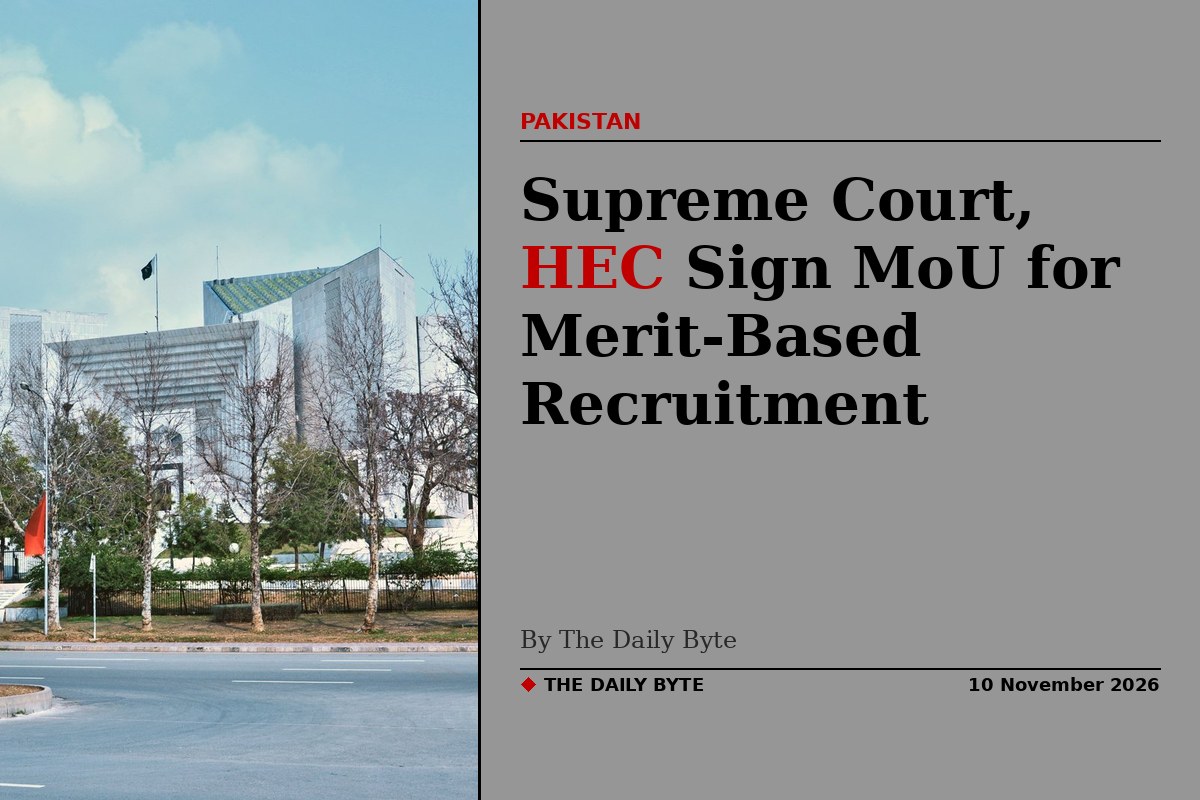
The Supreme Court of Pakistan and the Higher Education Commission's Education Testing Council (HEC-ETC) have signed a Memorandum of Understanding (MoU) to establish a framework for institutional collaboration on transparent, merit-based recruitment.
The agreement was signed in Islamabad on Tuesday, 10 November, by the Supreme Court's Additional Registrar, Suhail Muhammad Laghari, and the Chief Executive Officer of HEC-ETC, Dr Muhammad Imtiaz Haider, according to the Associated Press of Pakistan.
The signing ceremony was attended by the Registrar and other senior officers of the Supreme Court, along with HEC-ETC officers.
What the agreement covers
Under the agreement, HEC-ETC will provide professional testing, examination management and assessment services to facilitate the recruitment process of the Supreme Court.
The collaboration aims to promote a systematic, efficient and transparent recruitment process through standardised testing and assessment mechanisms, ensuring that appointments are made purely on merit.
Officials said the agreement would help build public trust in recruitment and set a model for other national institutions to adopt fair and standardised testing systems.
One-year agreement
The MoU is effective from 10 November 2026 and will remain valid for one year, subject to mutually agreed terms and conditions.
The partnership reflects the commitment of both institutions to strengthening professional cooperation, upholding merit and transparency, and enhancing the effectiveness of recruitment and assessment processes at the national level.
The testing council's role
The Education Testing Council was set up by the Higher Education Commission in January 2017 and revamped in 2018, after the Supreme Court directed the HEC to run assessment tests for admission to law degree programmes. It now provides standardised testing for admissions, scholarships and public-sector recruitment, with the stated aim of a merit-based induction system.
The model has already been used elsewhere in government. In December 2022, the Government of Gilgit-Baltistan signed an agreement with the Education Testing Council under which the council conducts screening tests for recruitment in the departments of the Gilgit-Baltistan government, a step officials said at the time would bring standardised testing to public-sector recruitment and enforce merit across the board.
The Supreme Court agreement follows the same pattern, bringing the court's own hiring under an independent testing framework rather than leaving assessment to the institution itself.
The council's best-known test is the Law Admission Test for entry to five-year LLB programmes, run on a quarterly cycle. The next sitting is scheduled for Sunday, 15 November 2026, with roll number slips issued on 6 November and results due on 24 December, according to the council's published calendar.