Supreme Court: Inheritance Rights Do Not Expire
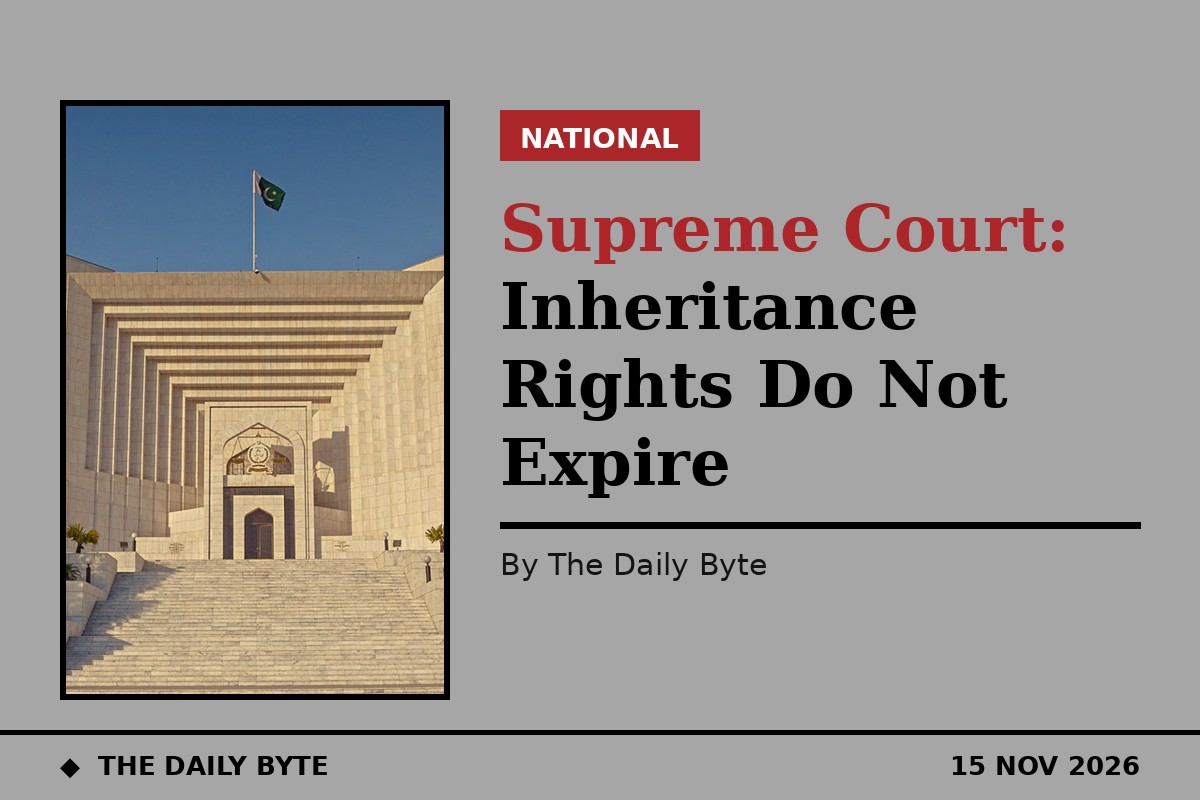
The Supreme Court of Pakistan has ruled that an heir's right to inheritance does not lapse merely because time has passed, in a landmark judgment that could reshape thousands of property disputes across the country.
A five-member larger bench headed by Justice Shahid Waheed announced the unanimous 106-page judgment on 13 November 2026, in Civil Appeal No. 909 of 2013, Mst. Meraj Bibi and another v. Mst. Zar Gula (deceased) through legal representatives and others, along with 17 connected matters. The bench also comprised Justice Naeem Akhtar Afghan, Justice Aqeel Ahmed Abbasi, Justice Shakeel Ahmad and Justice Miangul Hassan Aurangzeb.
The court was asked to resolve conflicting decisions by lower courts on when the limitation period for inheritance claims begins. Its answer was decisive: an inheritance share vests in the legal heir immediately upon the death of the property owner, under Islamic law, and requires no acceptance or consent from other heirs.
When the six-year clock starts
Under Article 120 of the Limitation Act 1908, a suit for a declaration of an inherited ownership share between co-heirs must be filed within six years. The court held that the clock begins to run only when two conditions are both satisfied: there must be a clear, effective denial of the heir's right, and that denial must be brought to the heir's knowledge.
Until that moment, the clock has not started, and no court may pretend that it has. The share is an appointed share, the judgment said; the law of limitation may close the courtroom door upon a claimant who knowingly stays away, but it will never be used to lock out one who was never told the door was open.
The court ruled that inheritance rights cannot be extinguished merely through silence, delay, or an oral relinquishment. The right is heritable by the claimant's own heirs, and the remedy to enforce it remains subject to the Limitation Act, even though the underlying right itself never lapses with time.
Protections for women and vulnerable heirs
The judgment also addressed fraud in inheritance cases. The court identified practices including fake thumbprints, verbal gifts, and omitting women's names from inheritance records, and directed revenue and registration authorities to verify all heirs before processing inheritance transfers.
Provincial revenue authorities were directed to issue written notices to all heirs and to verify the identity of female heirs in inheritance matters. Registration authorities were told not to transfer property without a succession certificate or equivalent documents, such as the National Database and Registration Authority's family registration certificate.
The court recommended that Parliament enact binding laws to force timely estate division and to criminalise fraudulent practices in inheritance matters, a change aimed at reducing fraud, safeguarding women and other vulnerable heirs, and easing provincial court backlogs.
The ruling binds every civil court in the country and applies to suits already pending before them. The court directed its office to place the connected cases before the appropriate benches, according to the roster, for decision on their merits.
For families locked in inheritance disputes that have dragged on for years, or even generations, the judgment offers a clear principle: time alone cannot erase an heir's share. What matters is whether the heir was ever clearly told that their right had been denied.