Supreme Court Backlog Falls 47% as Cases Drop to 31,927
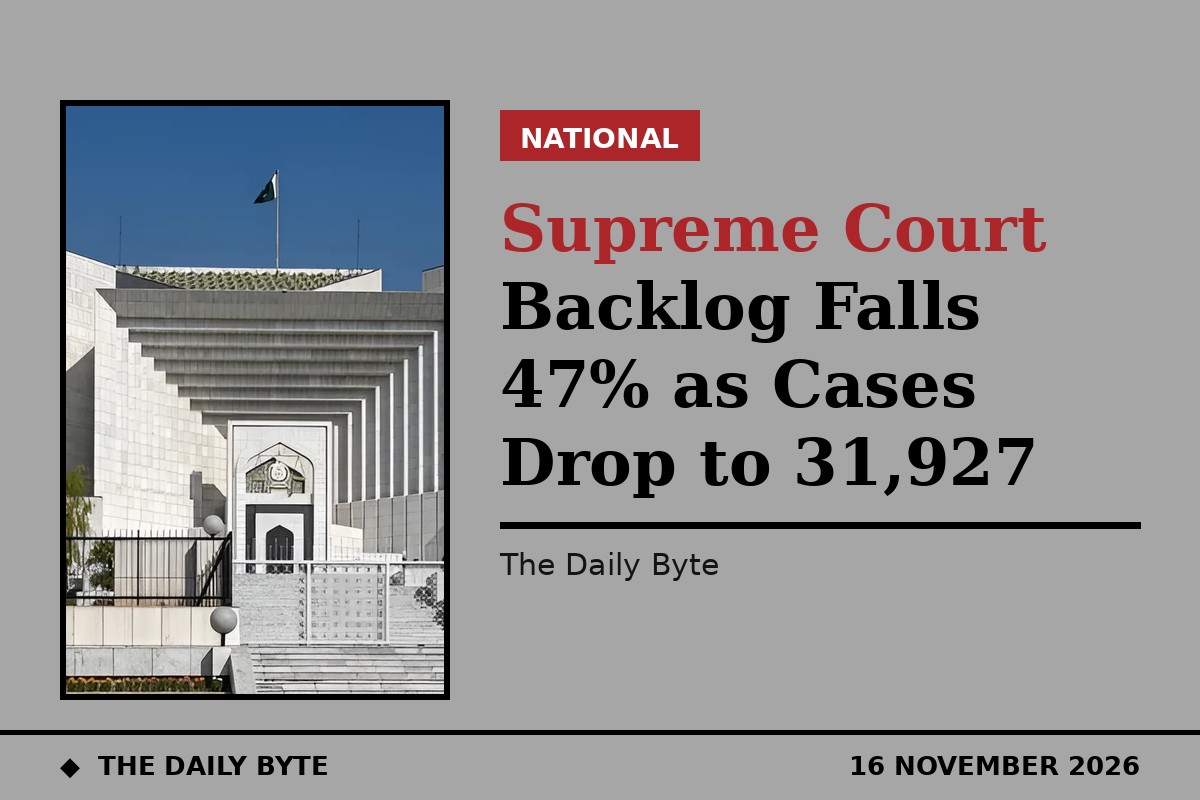
Pakistan’s Supreme Court has reported a sharp fall in its pending caseload, with cases down from 60,304 in November 2024 to 31,927 in September 2026 — a decline of about 47 per cent.
The figures come from the court’s reform progress report, reported on 14 November, which tracks an 86-point reform action plan aimed at making the justice system more accessible, efficient and transparent. According to the report, 64 of the 86 actions have been completed, 11 are on track and 11 require further attention.
Most of the fall is a transfer, not disposals alone
The headline figure needs to be read with care. During the reporting period, 22,213 cases were transferred to the Federal Constitutional Court following the constitutional amendment that created it. That transfer accounts for most of the drop from 60,304 to 31,927.
Separately, the Supreme Court disposed of 6,998 more cases than were instituted between November 2024 and September 2026. Annual disposals also rose, from 16,620 in 2023-24 to 25,989 in 2024-25, an improvement of about 56 per cent.
The reform programme has prioritised long-pending cases involving personal liberty, family rights, taxation and service disputes, according to the report.
Digital filing and case tracking
The Supreme Court Rules 2025 introduced an updated framework for electronic filing, digital records and virtual hearings, while digital case tracking and judicial analytics are being strengthened.
The proposed National Unified E-Filing and Electronic Judicial Record System has received approval in principle, and the National Judicial (Policy Making) Committee is extending reforms across the judicial system.
The district judiciary disposed of 1,467,675 time-bound cases between September 2025 and July 2026, the report said.
What the numbers do not yet show
A smaller caseload at the Supreme Court does not by itself mean faster justice for every litigant. Cases moved to the Federal Constitutional Court still have to be heard there, and the report’s own tally shows 11 of its 86 reform actions still need attention, with a further 11 on track rather than complete.
The electronic filing and virtual hearing framework is also a work in progress. The Supreme Court Rules 2025 set out the new system, but the proposed National Unified E-Filing and Electronic Judicial Record System has so far only received approval in principle, so its effect on day-to-day litigation is still to be seen.
For people waiting on a case, the figures that matter most are the ones the report points to next: how quickly the remaining backlog moves, and whether the promised electronic filing and tracking systems reach the courts where most Pakistanis actually litigate.
Sources: Daily Balochistan Times; Daily Mail Pakistan, via TDM News.