Supreme Court: Time Cannot Erase Inheritance Rights
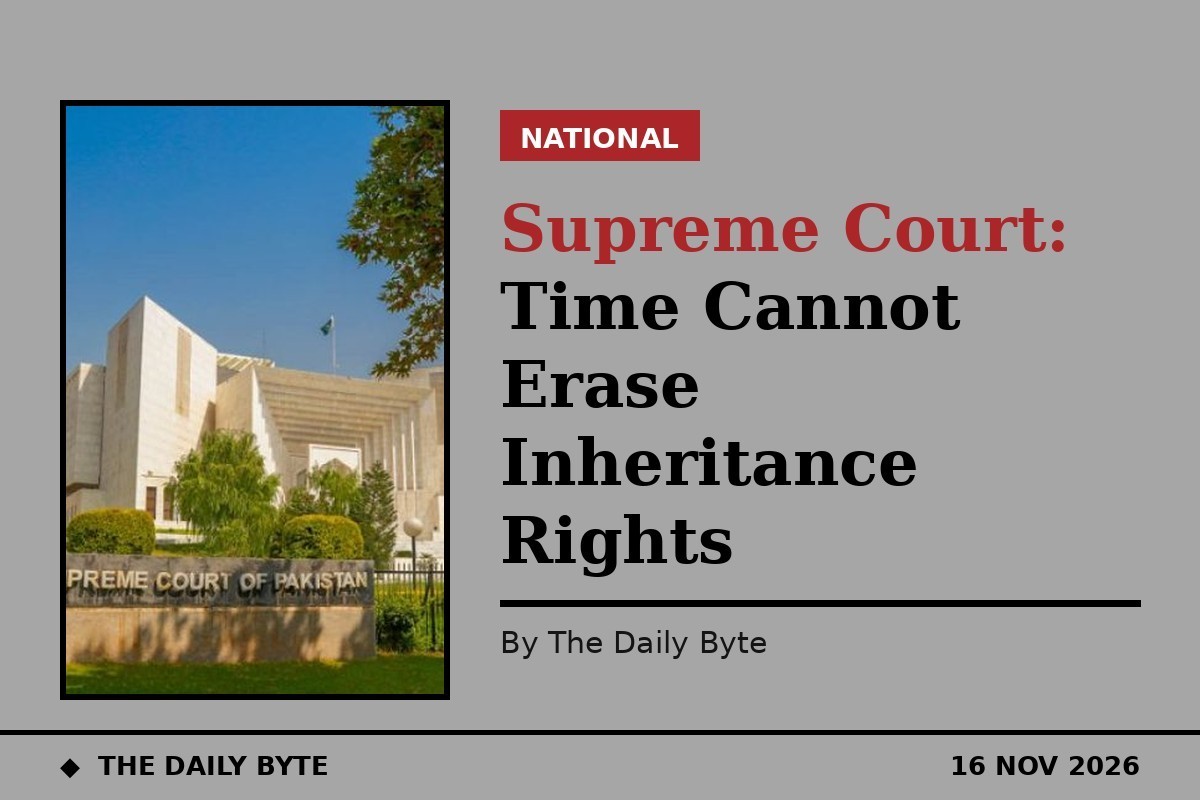
The Supreme Court of Pakistan has ruled that an heir's right to inheritance never lapses merely because time has passed. In a unanimous judgment announced on 13 November 2026, a five-member bench held that ownership of a deceased person's property vests in the legal heirs immediately at the moment of death, and that the six-year limit for bringing a claim runs only from the point when an heir is clearly told that their right has been denied.
The judgment, authored by Justice Shahid Waheed, runs to 106 pages and was delivered in Civil Appeal No. 909 of 2013, Mst. Meraj Bibi and another v. Mst. Zar Gula (deceased) through legal representatives and others, together with 17 connected matters. The bench also comprised Justice Naeem Akhtar Afghan, Justice Aqeel Ahmed Abbasi, Justice Shakeel Ahmad and Justice Miangul Hassan Aurangzeb. The appeals were taken up to settle conflicting decisions by lower courts on how limitation applies to inheritance claims.
When the six-year clock starts
The central question before the court was limitation. Under Article 120 of the Limitation Act, 1908, a suit for a declaration of an inherited ownership share between co-heirs must be filed within six years. The court held that the clock does not start with the death of the owner, with the passage of years, or with an omission from a revenue record. It starts only when two conditions are both met: there is a clear denial of the heir's right, and that denial is brought to the heir's knowledge.
Drawing on all four Sunni schools of jurisprudence, the court held that an estate passes automatically to the legal heirs at the moment of death under Islamic law. The right requires no acceptance, no consent and no acknowledgement from the other heirs, and it is itself heritable by the claimant's own heirs. Silence, the court held, is not denial, and a claim cannot quietly expire against an heir who was never told there was anything to contest.
The ruling matters most in the everyday pattern of inheritance disputes in Pakistan, where exclusion is often undocumented. A sister is told the matter was settled long ago, or a widow is given a monthly allowance in place of a share of the land, and by the time a claim is finally brought the other side pleads limitation. The judgment closes that route off.
Who the ruling protects
The court identified widows, daughters, minors and orphans as the heirs most often deprived of their shares, and deprived for the longest. Those are also the heirs least placed to know that a denial has occurred, which is why the notice requirement does real work for them. The judgment also sets out safeguards to prevent the exclusion of legal heirs, directing revenue and registration authorities to verify all heirs before processing inheritance transfers.
The court further noted the economic cost of undivided estates: land locked in a disputed succession for decades cannot be sold, mortgaged or developed, and cannot be used as collateral or improved. Settling who owns what, and doing so promptly, is therefore not only a matter of family justice but of making land usable.
Reforms the court suggested
The bench recommended that the legislature and the Law and Justice Commission of Pakistan consider four legal reforms. They include making a registered written document mandatory for relinquishment, known as takharuj, of an inheritance share; adding a specific provision for inheritance claims to the Limitation Act, 1908; prescribing a definitive long-stop period to protect a bona fide purchaser who took possession in good faith; and amending Section 498A of the Pakistan Penal Code, or adding a new section, so that male heirs such as brothers or orphan nephews who are deprived of inheritance through fraud or illegal means receive criminal protection alongside the existing protection for women.
What the ruling does not do
The judgment applies to cases, appeals and review petitions pending on the date of the judgment or filed afterwards, and it binds every civil court in the country. But it does not reopen matters that have already attained finality: judicial decrees and completed cases decided before the judgment stand. Individual appeals and petitions affected by the ruling have been directed to be fixed before the relevant benches for decision on their merits.
For families with an inheritance dispute already in the courts, the practical effect is immediate. For those whose claims were thought to have expired with time, the ruling offers a new basis to argue that the clock never properly started, provided no clear denial was ever brought to their knowledge.
Sources: The Pakistan Daily, reporting the Express Tribune account of the ruling; Voicepk reported the bench, the judgment and the proposed reforms; Adalat Online reported the case reference and the safeguards for heirs.