Supreme Court upholds Qaiser Ayub death sentence
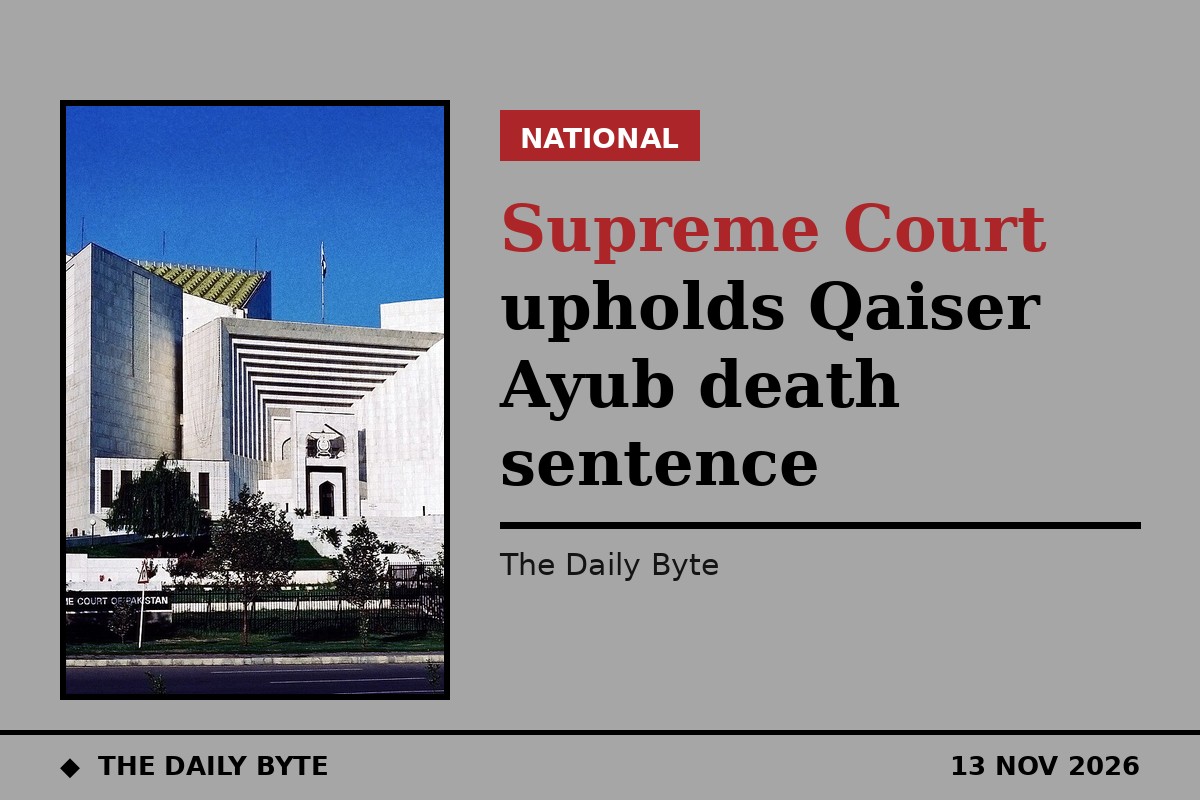
Pakistan's Supreme Court has upheld the death sentence of Qaiser Ayub, a Christian man convicted of blasphemy, in a decision made on 7 October 2026 and only recently published, according to reports published on Friday, 13 November. His younger brother, Amoon Ayub, was acquitted by the same bench, which found the evidence against him insufficient, and freed after almost twelve years in prison.
The ruling is a significant legal moment. The European Centre for Law and Justice (ECLJ), whose lawyers represent Qaiser Ayub, said it was the first time Pakistan's Supreme Court had upheld a death sentence for blasphemy, having previously overturned such sentences, including those of Asia Bibi in 2018, Wajih ul Hassan in 2019 and Anwar Kenneth in 2025.
A case that began in 2010
The case began in August 2010 in Punjab, when a resident complained after finding material described as blasphemous on a WordPress blog. The formal report was not drawn up until June 2011. Qaiser Ayub, a computer science graduate, and his brother Amoon, a music teacher, were associated with a charity, UCOPAK, and were arrested in November 2014 and April 2015 respectively.
Qaiser's defence has been that he shut the website down in 2009 and that someone else later reactivated it, leaving his name in the copyright notice. A trial court sentenced both brothers to death in December 2018, and the Lahore High Court confirmed the convictions in June 2022.
The prosecution's case rested largely on electronic evidence. The ECLJ said the link between the charity's official website and the blog that hosted the material was questionable, and that investigators had not verified the servers or the email address used to create the blog. It also said digital records showed logins, file changes and the connection of an external USB drive on Qaiser's computer after it was seized by the authorities in November 2014, raising questions about the chain of custody of the evidence.
What happens next
Very few legal options remain for Qaiser Ayub, a husband and father of three. Pakistani law allows a review petition before the Supreme Court itself, and the Constitution gives the President the power to grant clemency. The ECLJ said a review petition had been filed under Article 188 of the Constitution and called on the President to grant a pardon under Article 45 without delay. The Centre for Legal Aid, Assistance and Settlement (CLAAS), which has supported the brothers throughout the proceedings, expressed concern about the decision and called for every remaining legal avenue to be pursued.
The case had already drawn international attention before the ruling. In September 2025, six United Nations special procedures mandate holders sent a joint communication to the Pakistani authorities raising concerns about the lack of evidence and about the use of the death penalty for blasphemy-related offences.
Qaiser Ayub was convicted under Section 295-C of the Pakistan Penal Code, under which death has been the only penalty allowed since a 1990 Federal Shariat Court ruling. Pakistani courts have pronounced many death sentences under the provision, but the state has never actually executed anyone for blasphemy, according to Human Rights Without Frontiers. The ECLJ noted that the last execution in Pakistan took place in December 2019 and that more than 3,300 people were on death row as of July 2025.
The dangers around blasphemy accusations were underlined again two days after the Supreme Court decision. On 9 October, police in Narang Mandi, in Sheikhupura district, registered a case against a Christian man, Kamran Gill Masih, over a video said to be offensive, and a crowd set fire to the clinic where he practised traditional medicine. Christian families in the area left their homes. Naveed Walter of Human Rights Focus Pakistan, which sent a fact-finding team to the area, said: "No allegation can justify mob violence, arson, intimidation, or collective punishment."
Qaiser Ayub now waits for the outcome of the review petition and any decision on clemency. His brother Amoon, acquitted after almost twelve years behind bars, is free.