Sweden Brings Back Border Checks Over Russian Hybrid Threat
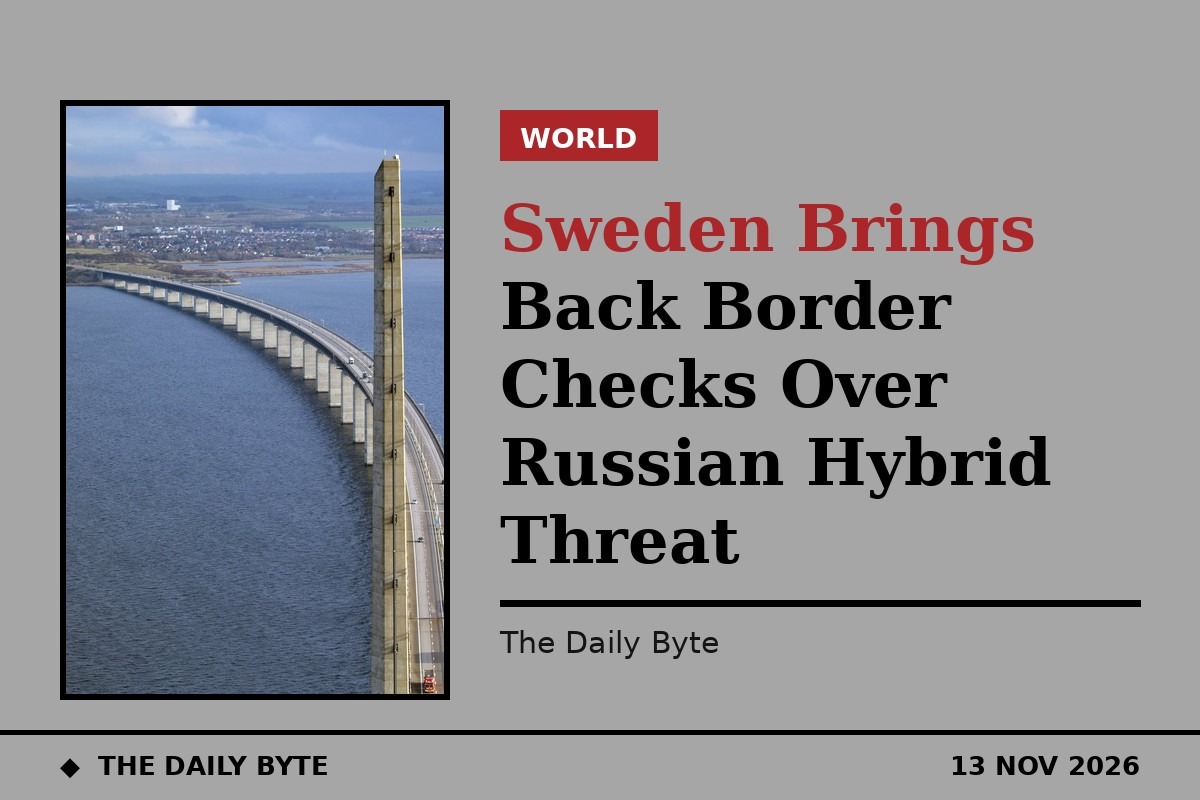
Sweden has brought back checks at its internal borders, with the government pointing directly at Russia as the reason for the move. The renewed controls took effect on 12 November and will run for six months, until 11 May 2027.
The decision, announced by the Swedish government on 5 November, is based on an assessment that there is a serious threat to public order and internal security. It marks a change in tone from previous extensions of the controls, which were justified mainly on the grounds of organised crime and terrorism.
This time, Stockholm has named Russia outright. The government said the assessment was based primarily on the serious security situation resulting from Russia's full-scale invasion of Ukraine, which it said had led to hybrid threats and hostile actors moving and operating within the Schengen area.
Why Sweden is pointing to Russia now
Justice Minister Gunnar Strömmer has linked the decision to a warning from Sweden's Security Service, Säpo, that the risk of Russian sabotage in Sweden has increased. The service warned that hostile actors could target Sweden and other European Union member states.
Sweden has in fact had internal border controls in place since 2015, usually renewed for six months at a time. What is new is the justification. After two years, the government must provide a fresh reason for continuing the controls, and on this occasion it has chosen to frame the threat in terms of Russian hybrid activity rather than crime.
The shift reflects a broader change in thinking across northern Europe. The Baltic states and Poland have long argued that the threat does not stop at the European Union's external border, but travels within the Schengen area itself. Sweden is now adopting that logic.
What travellers will notice
The controls do not close the border, and they do not amount to a return to passport checks for everyone crossing into Sweden. The government has left it to the Swedish Police Authority to decide where and how the checks are carried out, and they can take place at land borders and in traffic arriving at airports and ports from within the Schengen area.
Travellers crossing from Denmark over the Öresund Bridge, or arriving by ferry and air from other Schengen countries, may therefore be stopped and asked to show identification. The previous authorisation for the controls ran through 11 November, so the new decision continues an existing regime rather than creating one from scratch.
A wider European pattern
Sweden is not acting alone. France, Germany, Norway and Denmark have also introduced temporary border controls inside Schengen in recent years, each citing security concerns. The European Union's passport-free zone allows member states to restore checks temporarily when public order or internal security is at stake, but the measures are meant to be limited in time and scope.
For Sweden, the six-month period will test whether the new, explicitly Russia-focused justification holds up politically and legally. The government will need to show that the threat remains serious when the controls come up for renewal next spring.
Until then, the message from Stockholm is clear: the war in Ukraine, and the hybrid tactics that accompany it, are now treated as a domestic security issue inside Sweden's own borders, not only as a distant conflict.


