Syria Condemns Houthi Attacks on Riyadh
Syria has condemned Houthi missile attacks on the Saudi capital, Riyadh, and pledged its full support for Saudi Arabia, in the first test of a defence pact the two countries signed only four days earlier.
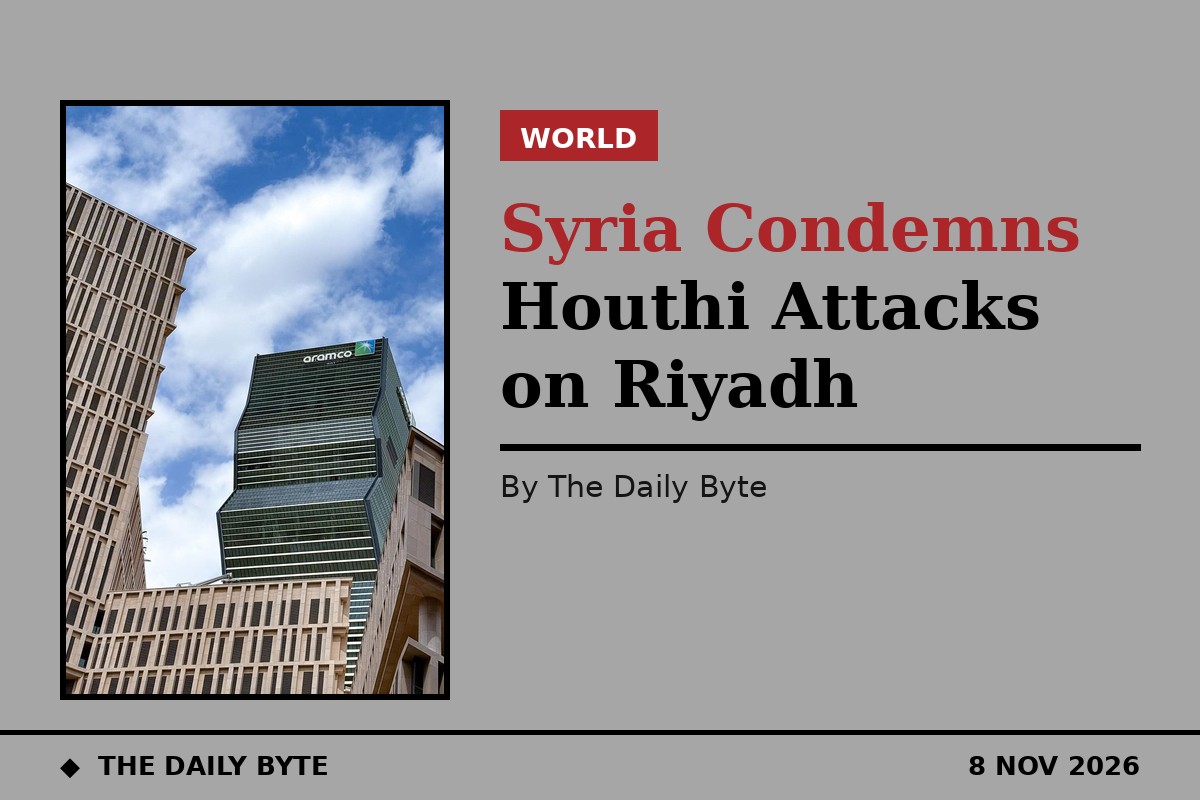
Syria's Ministry of Foreign Affairs and Expatriates issued the condemnation on Sunday, 8 November, through the state-run Syrian Arab News Agency. It condemned attacks on a building in Riyadh's King Abdullah Financial District and on a facility belonging to the state oil company Aramco, and pledged "full support for Saudi Arabia in confronting threats to its security, territorial integrity and infrastructure".
Damascus also called on the international community to "help prevent further attacks" and stressed the importance of halting such attacks to strengthen security and stability across the region.
The statement followed a morning in which the Saudi-led coalition said its air defences had intercepted two ballistic missiles and two cruise missiles aimed at Riyadh and other parts of the kingdom. Falling debris from an interception damaged an administrative building belonging to Aramco in the King Abdullah Financial District, Saudi Arabia's energy ministry said. No injuries or deaths were reported.
The Houthis, the Iran-aligned group that controls Yemen's capital, Sanaa, claimed responsibility for the attacks, saying they had carried out four operations using ballistic and cruise missiles and drones, with targets including the financial district, Riyadh airport, Aramco oil storage tanks and the eastern city of Abqaiq.
Syria was not alone in condemning the strikes. Qatar, Bahrain, Kuwait and Egypt issued parallel statements on the same day. Bahrain's foreign ministry called the attacks violations of the kingdom's sovereignty and international law and called for United Nations action. Egypt described the ballistic missile fire as a "flagrant violation of international law" and "a direct danger to civilians".
The coordinated response followed a similar round three days earlier, when Jordan, Qatar, Kuwait and Bahrain condemned a Houthi missile attempt on Madinah. The Arab Parliament went further on 6 November, calling Houthi attacks on Madinah and the drone targeting of Makkah a grave transgression against Islamic holy sites.
Syria's statement carried added weight because of the agreement signed in Riyadh on 4 November. During President Ahmad al-Sharaa's visit to the Saudi capital, the two countries' defence ministries signed a cooperation agreement that Syria's foreign ministry called the "most notable" of six agreements reached during the trip. The Saudi Fund for Development also committed 403 million dollars in concessional loans, including 100 million for healthcare, 105 million for civil defence, 90 million for the Aleppo thermal power plant, 60 million for housing and 30 million for drinking water infrastructure in Damascus and Idlib.
The visit was al-Sharaa's second to Riyadh in under a month, and it formalised a security relationship that has grown since Saudi Arabia emerged as Syria's main external backer after the fall of the Assad government in December 2024. Riyadh was al-Sharaa's first foreign destination as president.
Syria is also weighing membership of the wider Makkah joint defence treaty, which currently binds Saudi Arabia, Turkey and Pakistan. Foreign Minister Asaad al-Shaibani said on 31 October that discussions were under way to evaluate Syria's entry. Turkey's parliament ratified the pact on 5 November, and Pakistan approved it on 23 October.
Reports of Syrian military involvement in the Saudi war effort remain disputed. Reuters reported on 6 November that Syrian military personnel had travelled to Saudi Arabia to provide advice and training, while other reports put the number of deployed troops far higher. Damascus has denied active military deployments, saying its policy is focused on stability rather than opening new fronts.
The fighting between Saudi Arabia and the Houthis resumed in July, shattering a 2022 United Nations-brokered truce that had largely halted attacks between the two sides. The United Nations says more than 1,600 people have been killed and over 300,000 displaced since the fighting resumed. Houthi officials said Saudi-led strikes on a village near Sanaa on Saturday killed 33 people, a toll that could not be independently verified.
Notably, none of the five Arab states that condemned the 8 November attacks named Iran as a backer of the Houthis. Each directed its statement at the "Houthi militia" alone, a framing that contrasted with Western governments, which routinely describe the group as Iranian-backed. Iran has denied having military experts or advisers in Yemen.